Showing posts with label Climate. Show all posts

Sunday, October 21, 2012

From Gladioli to Gobo: Flowers, Food & Friendship

1st Blooms of a hardy gladiolus - a gift from a friend
When we first moved to Alberta from sunny, frost-free Brisbane, the Home Bug Gardeners hadn't much of a clue as to what we could or should grow, just a vague idea about making our yard a nice place for bugs, birds, and people. We extirpated lawns and planted the major trees and shrubs under the guidance of our friend Adrian, but the rest was up to us. We wandered the local greenhouses with starry eyes, quickly disposed of our disposable dollars, and carted home many beautiful plants in ugly black plastic pots. We still have the pots stacked high in the garage, but hardly one of those early perennial purchases survives. As to produce, we got little: mostly woody celeriac, zucchini covered with downy mildew, and green tomatoes.
Leafy bounty at the Snagwood garden
Fortunately, we soon made friend with others of like mind and far more Zone 3 experience. The Currah's garden, Snagwood, is far outside the Urban Heat Island benefits of the city, but each year they raise a stunning bounty. Even better, they meld two horticultural traditions with an interest in experimentation and are happy to share it, even with strange bug people.
Red-leghorn & Snagwood's summer flowers
The first benefit to the HBG was Gladiolus imbricatus, the flower at the top of the post. The most recent, gobo (Arctium lappa), a crunchy and yummy root crop. In between, we've been treated to innumerable tasty treats, from ginger cookies to roasted rooster, and many lively discussions. We haven't been able to return much in kind, but we would like to devote a special issue of the Home Bug Garden to Satomi: some virtual vegetables, flowers, and chickens to wish you a happy birthday!
Salt, rice, saki from Satomi to Gopher Hill


Thursday, December 24, 2009

Curb Appeal, Co-existence & The Wildlife Garden


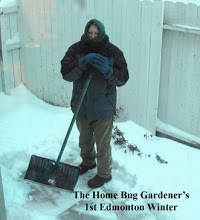
When the Home Bug Garden first started, I was worried that the neighbours might think I was an eccentric bugger with an eyesore frontage. As grass disappeared and the uniform mulch gave way to increasingly irregular eruptions of ‘wildflowers’, unmanaged horticultural variants of former wildflowers, grow-where-they-wish shrubs, and fallen autumn leaves, any claim to conformity with community norms was quickly lost. Nonconformity is rarely valued in our culture and under the relentless barrage of a monolithic media we are increasingly given one view of what is true, what we should think, and what we should not. Nonconformity, even in science, is denigrated and demonized. Living in Alberta, of course, I do have 6-7 months of a kind of conformity every year – the blanketing snow.


In Queensland, not smiling and saying hello to someone on a neighbourhood street would be unusual. Perhaps it is the constant sunshine, but an easy if superficial friendliness is the norm. Canadians seem far less welcoming to strangers on the street. I think the weather here encourages one to mind their own business and get where they are going before they freeze or are hailed upon. Most of those hurrying past the Home Bug Garden don’t stop to smile and pass the day. Those that do, however, have been uniformly pleasant and positive about my ‘woodland’. Even a door-knocking politician claimed to ‘like what you’ve done with your yard’. Well, maybe this office-seeker was just relieved there wasn’t a slavering dog or an old car up on cinderblocks. Still, none of these passersby had to say anything at all about the yard, let alone say something nice about something that is far from finished.

Of course, when neighbours ask, I am careful to describe my gardening as ‘wildlife friendly’, not as ‘bug friendly’: birds, bees, and butterflies come readily to my lips, wasps, spiders, and maggots almost never. I know then that I am on safe ground, because Wikipedia has pages for ‘Wildlife Garden’ and ‘Butterfly Gardening’. Never a reliable source of facts, Wikipedia, in its own 1984-ish kind of way, is a good guide to what are acceptable dogmas, politically correct attitudes, and proper forms of self expression. And according to Wikipedia (this morning anyway): “When one wildlife gardens, one acts always in accordance with the idea of keeping plants that are native to the area preeminent in the garden.” Sounds like a reasonable formula, I mean ‘native plants = native insects = native birds etc.’, right?


So how does one tell that a plant is ‘native to the area’? Unfortunately, ‘native’ isn’t a scientific term, but a collection of cultural concepts. As an adjective, it comes to us from Old French via the Latin ‘nativus’ for ‘produced by birth, innate, natural’. Appropriate to the season, ‘native’ has the same root as ‘nativity’, but also less savory derivatives such as ‘nativism’ and when used as a noun in Latin referred to a ‘natural slave’ – one born into bondage. As well as a plant bound to an area by birth, a ‘native plant’ is often taken to mean one that lived in an area ‘before people’ or, in a racist way common among some ideologies in North America, ‘before white people’.

The part of Edmonton that I live in was developed after World War II from a mixture of farmland and wetland. The wetland probably existed before European colonization, so its plants would count as ‘native’ by one usage. A pond is a great addition to any wildlife garden, but who wants to live in a slough?


Possibly there was some aspen forest earlier. That would be better, but if I converted my yard into an aspen forest there’d be little sun, lots of mosquitoes, clogged water and sewage pipes (aspen is bad), no veggies, and not many flowers. I suppose the largest plant in my garden is a ‘native’ spruce, so perhaps I could argue that I meet the ‘preeminent’ criterion, but a spruce forest would be a dark and oppressive place to live. If we try to expand our concept of ‘native’ and treat all peoples as equal, then the Clovis culture (~11,500-13,000 years ago) left the earliest human artifacts anywhere near here. But back then glacial ice covered all and algae was the only likely ‘native plants’. No thank you, I don’t think that kind of garden would be at all good for wildlife.

Should wildlife gardening be fun or a chore? Does ‘native’ have to imply a slavish devotion to what once grew in an area? Surprisingly, Wikipedia has a page called ‘Native Plant’ and (at least this morning) starts out with a not unreasonable definition: “A Native plant is one that develops, occurs naturally, or has existed for many years in an area.” Since I usually cannot afford the most recent horticultural fads and have no interest in putting in plants that are not going to develop, I think that a functional Home Bug Garden can be built around this concept of ‘native’. Moreover, such a garden could become a refuge of diversity in the increasingly developed and depauperate blotch of an ever-expanding Edmonton. Could be fun too.


Even for someone who has no interest in insect conservation, gardening does not have to be incompatible with bugs. Perhaps the biggest barrier is in the vegetable garden, because it is unfortunately true that there are a lot of insects that are far more efficient at harvesting our crops than we are. Tomatoes, potatoes, beets, spinach, radishes, arugula, lettuce, carrots, cabbage, and the like host far too many pests and many are of little use to foraging bees and butterflies. If you let your mustards (arugula, radish, and others in one of those plant families with two-names: Brassicaceae or Cruciferae) bolt they provide bees with some solace. Solanaceae (tomato, potato, pepper, ground cherry, eggplant) are better. But beans and peas (Fabaceae-Leguminosae) are probably the best veggies for bees. The more acceptable insects and the not too entomophobic gardener, however, can share the wealth of culinary herbs without any worries. That will be the topic of the next post.


Sunday, December 13, 2009

Winter Interest: Bye-bye Zone 3b?


The Home Bug Garden broke a record this morning: -40 C (aka -40 F) from at least 6:30 am until after 9 am. The previous record low, a smeary -39 C on our red alcohol thermometer, is burned into my memory, but alas, not recorded in my notes. My Garden Journal started on Canada Day (1 July) 2004, just in time for the 2 July flood. But regular recording of daily high and low winter temperatures didn’t start until 2006 – obsession with the weather takes a while to develop in a transplanted Queenslander used to constant warm, sunny days. So, this morning was the coldest in the HBG, but that’s a long shot from Edmonton’s coldest on record: -48.3 on 28 December 1938 (when Edmonton was a much smaller city) and matched at the International Airport on 26 January 1972 (just a few years after the airport opened).


When I checked the Environment Canada Weatheroffice website this morning, my clean, sharp -40 was perfectly bracketed by the -35 C at the City Centre Airport and the -45 C at the International Airport. Ten degrees Celsius seems like a startling difference for two airports so close together. The City Centre is a bit further north (53 34.2 vs 53 19.2 N), but ~50 m lower in elevation (671 vs 723 m). All else being equal, a site 50 m lower would be expected to average about 0.34 degrees warmer. The annual mean daily temperature of the City Centre (3.9 +/- 1.1), however, averages a full degree and a half Celsius higher than the International Airport (2.4 +/- 1.2).


This does seem strange for two weather stations only 30 km apart, and given the recent Climategate leak, perhaps a little paranoia is in order. The City Centre has been consistently claiming higher highs and higher lows than I can find on my thermometer (at almost the same elevation, 669 m, and only 15 km south). Could they be fudging the data to make things look warmer? I doubt it – as far as I can make out from the CRUtape Letters, all the value adding to the temperature data happens later, once the ‘scientists’ discover that the data does not agree with their models, and therefore, must be wrong.


Moreover, a simpler and well supported alternative answer is available – the Urban Heat Island Effect (UHI) - all the buildings and tarmac that absorb heat during the day and radiate it out at night and all the energy burned to keep the city going add up to a warmer local climate. So while the City Centre is usually warmer at night than my backyard, the backyard is often warmer than the International Airport. For morning lows, I’m often halfway in between – not surprising since the HBG is situated halfway in between the two airports and is in an area that is maybe half as urbanized as the City Centre. Daytime highs are more variable, but are more like the Airport than like downtown. UHI seems like a good explanation for these differences – and I would imagine that the International Airport is warmer than the rural areas around it.

My friend at Gardening Zone 3b near the City Centre seems to have an unfair share of UHI, but he displays the results beautifully on his blog, so I forgive him his 2-3 week advantage in spring bloom time and his later killing frosts (I’m a noble guy). I certainly don’t want my neighbourhood to get more urbanized, so I guess the HBG will just have to make do with the little UHI it has. The last couple of years, however, seem to be getting colder. That is a worry, as is the apparent correlation between sunspot activity and warmth (the Sun appears to be in a deep funk). If, as it seems, global warming was at best a delusion, then Zone 3 gardeners are going to miss it more than most people, except for Phil Jones and his mates, of course.

Sunday, June 21, 2009

Goodbye to old favourites, native and alien: Winter Kill 2008-9


Rain, glorious rain! Last night, unexpectedly, we got 11.28 mm (yes we have a digital rain gauge, so take the last digit on faith). That’s not even half an inch, but brings our HBG total to 26 mm (just over an inch) since Mayday. Looks like more is on the way too, so although that means our planned Sunday Moose Pasture hiking/canoeing is cancelled, I can plant out the last of the seedlings and catch up on blogging.

Last Fall was very dry, the Winter harsh, and the Spring non-existent. Although the snow cover this Spring was good, it came on late (no snow cover until mid- December) and from 13 December through 9 January every night-time temperature was between -10 and -35 C. The rest of the Winter and Spring experienced repeated bouts of extreme cold with -30 as late as 10 March, the last killing frost (-4) on 22 May (three weeks after the usual last frost date), and the last light frost on 9 June.

The harsh weather is no doubt responsible for the devastation of last Fall’s bulb blow-out (~380 new bulbs went in). Although the established and new crocus, squills, chionodoxa, muscari, and species tulips did well, and quite a few of the new hybrid tulips and daffodils survived and put on quite a display, many were frost blasted and there’s been no sign of others. No sign either of the new Snowdrops (Galanthus nivalis), Checkered Fritillary (Fritillaria meleagris), spendy Lilac Wonder Dog’s Tooth Violet (Erythronium denscanis 'Lilac Wonder') , Spanish Bluebells (Hyacinthoides hispanica), or Grecian Windflowers (Anemone blanda). Not much surprise with the last two – Zone 4-5 plants that have failed before - but the others were all Zone 3, well mulched, watered in, and should have survived (well, maybe not the Lilac Wonder – a bit floppy when they arrived and that is not a good sign with lily bulbs).

The few Alberta native bulbs that I have (Western Wood Lily Lilium philadelphicum, Nodding Onion Allium cernuum) don’t show themselves until late spring. They are just now in bud. None of the bulbous MIAs are ‘native’, so perhaps they just aren’t well adapted to this life. But the established ‘alien’ bulbs seemed to come through pretty well and without them, the HBG would have been pretty bleak this April and May.

The perennials were pretty badly winter whacked too, with 18 no-shows and 3 more that put up a leaf or two, but are on their last roots. Below I’ve divided them into North American Native or ‘Alien’ listed them with the year they went in and their putative USDA Zone rating. There is no obvious pattern by origin: mortality is about equally divided between exotic and North American natives, including 3 plants native to Alberta (a wild bergamot and two sunflowers).

R.I.P. North American Natives Winter 2008-9:
Doppleganger Coneflower, Echinacea purpurea ‘Doppleganger’ 2005 Zone 3
Purple Joe-Pye Weed, Eupatorium purpureum 2008 Zone 3
Wild Bergamot Monarda fistulosa 2003 Zone 3 (AB native)
Garden View Scarlet Bergamot, Monarda didyma ‘Garden View Scarlet’ 2005 Zone 3
Maxmillian Sunflower Helianthus maxmillianii x 2 2004 Zone 3 (AB native)
Sunset Strain' Bitteroot, Lewisia cotyledon 'Sunset Strain' 2008 Zone 4
Purple Leaf Coral Bell, Heuchera americana 'Purple Palace Select' 2005 Zone 4

On the ropes (a couple of leaves left):
Chocolate Mint Foamflower, Tiarella 'Mint Chocolate' 2006 Zone 3
Iron Butterfly Foamflower, Tiarella 'Iron Butterfly' 2007 Zone 3
Ruby Spice Summersweet, Clethra alnifolia 'Ruby Spice' 2007 Zone 4


‘Aliens’ lost this winter:
Fernleaf Yarrow, Achillea filipendulina ‘Cloth of Gold’ 2005 Zone 2
Giant Yarrow, Achillea grandiflora (or maybe Tanacetum macrophyllum) 2005 Zone ?
Monkshood, Aconitum napellus clump 2004 Zone 2
Yellow Loosestrife, Lysimachia punctata ‘Alexander’ x 2 2004 Zone 2
Bronze Garden Mum, Chrysanthemum x morifolium 'Morden Delight' x 2 2006 Zone 3
Siberian Bugloss 'Jack Frost', Brunnera macrophylla 'Jack Frost' 2008 Zone 3
Siberian Bugloss 'Spring Yellow', Brunnera macrophylla 'Spring Yellow' 2008 Zone 3
Chinese Lanterns, Physalis alkekengi franchetii 2008 Zone 2b

Wednesday, May 20, 2009

Internivial blooms with two Two-spotted morphs


Edmonton’s frigid Spring reappeared for the Long May Weekend, the traditional planting out time here, but the week before had a few bright spots in between the cold and snowy end pieces. Two ‘native’ wildflowers were among the highlights, Coltsfoot (Petasites palmatus) and Marsh Marigold (Caltha palustris), although both were a week or two later than ‘normal’. Coltsfoot produces thick spikes of white flowers in April (well, May now) before the leaves appear and seems to be especially relished by pollinators. Marsh Marigold is just the opposite – leaves pop out of the ground as soon as the snow melts, but flowers hold off until May (or mid-May this year) – but are equally attractive to pollinators.


Lots of other flowers from the tiny Bugleweed to the more impressive Pasqueflower have made an appearance, so here is celebration of colour and form to chase the cold clouds away. A few insects also made an appearance, including two of the several colour morphs of the 2-spotted ladybug Adelia bipunctata. When the sun shines, more and more pollinators are showing up, including the inevitable queen yellowjackets and bald-faced hornets - signs of summer barbie confrontations to come. Lots of sawflies too - quite the diversity of Tenthridinidae in Edmonton - and all looking for a garden plant to lay their eggs on. Poor columbine, willow, saskatoon, creeping jenny, and currants, but lots of happy grubs to come.

Monday, April 13, 2009

The '200 year flood and hail storms' July 2004


On Canada Day in 2004 we had a garden party to celebrate our newly mulched and planted Home Bug Garden. The next day, a massive thunderstorm dumped as much as 60 mm of rain in a few hours . Our rain gauge kept overflowing, so I'm not sure what the Bug Garden got, but much of the mulch floated down the street and the basement flooded. Nine days later (11 July 2004) a second thunderstorm dropped up to 150 mm (~ 6") of rain and hail, flooded the front street to about 1 metre, covered the ground in more than a decimetre (4") of hail, shredded most of the leaves in the garden, and again flooded the basement. Pictured above left is the front street and above right a low spot in the Whitemud freeway.

The Coming-Out of the Home Bug Gardener

This is the inaugural posting for the Home Bug Gardener. The theme of this blog will be how a small plot of urban land can be changed from a sterile and mindless conformity to an oasis of biological diversity. Well, perhaps not everyone’s cup of biological diversity, but the essence of biodiversity: lots of species living together.


This project started about 6 years ago in Edmonton, Alberta, Canada. Edmonton is an urban island of relative warmth (Zone 3b in a good winter – i.e. rarely going below -40C/F) in what used to be Zone 3a Aspen Parkland, a transition zone between the prairie and the boreal forest. The area in which we live used to be a slough (i.e. a wetland, not quite a lake and not quite a marsh), but it was filled in after World War II and covered with black clay and small houses for returning soldiers (our house was built in 1951). Eventually, the streets were planted with boulevard trees, primarily green ash and American elm. Weeping birch and other drought-intolerant Betula were soon adopted as specimen trees. Apple-crabs, crabapples, and a variety of mountain ash (rowan) also made their appearance. In the early 1960’s, the Girl Scouts arrived with a variety of conifers (white spruce, Colorado blue spruce, and a few black spruce) to celebrate Arbor Day. As a result, even with a southern exposure, sunlight can be limited.

That is the background. Time, energy, and enthusiasm permitting, the story will follow.


Suggested Reading:

Owen, Jennifer. 1991/2005. The Ecology of a Garden: The First Fifteen Years
Cambridge University Press
ISBN-10: 0521018412
ISBN-13: 978-0521018418

Tallamy, Douglas W. 2008/2009. Bringing Nature Home: How You Can Sustain Wildlife with Native Plants, Updated and Expanded
Timber Press
ISBN-10: 0881929921
ISBN-13: 978-0881929928

Relevant web visits:

Biodiversity in Urban Gardens in Sheffield
http://www.bugs.group.shef.ac.uk/BUGS1/bugs1-index.html