Showing posts with label winter. Show all posts

Saturday, November 17, 2012

Bludging with Beetles: The skin-eaters (Dermestidae)

Not a white box: Skin-eater larva trapped in the bathtub
The Home Bug Gardener has been a busy boy and not all of his time has been spent shovelling snow. Last week the Joint Annual Meeting of the Entomological Societies of Canada and Alberta graced Edmonton with its presence. For five days (and for many months beforehand) it was bugs, bugs, bugs. Also known as the Local Organizing Committee, the local entomologists get to host the rest of the nation, and that means all work and no play. By the time it was over, I looked up to see nothing but deep drifts of accumulated snow and work to dig through. There must be something better to do.
Mystery dermestid beetle
In just a few short weeks it will be time to celebrate those hardy (or pesky) bugs that snuggle-up with us for the winter (synanthropes) or love the cold (cryophiles): John Acorn's Second Annual Winter Bug Challenge. The challenge is to the birders who will be beginning their Winter Bird Counts next month. John's hope is that we can find at least as many species of arthropods actively enjoying the Alberta winter as the birders can find birds. The hairy larva at the top is one such almost record from last winter. Although we know the family, adults are needed for species identification. Possibly, this is a larva of the Larder Beetle, the only dermestid adult we have on our in-home list. But out-of-doors during the warmer months roam other more or less mysterious dermestids. Literally 'Skin + eating' (derm + este), dermestids like their skin dead and dry. Any proteinaceous scurf will do, including dead insects, dried meats, and meat byproducts like cat food. Since I accidentally kick one of the cat bowls at least once a week, I'm sure we have bits of dry cat food crumbling in corners and toasting in floor vents. In any case, a Larder Beetle or two is not an uncommon find (although we have yet to get a good picture of one).
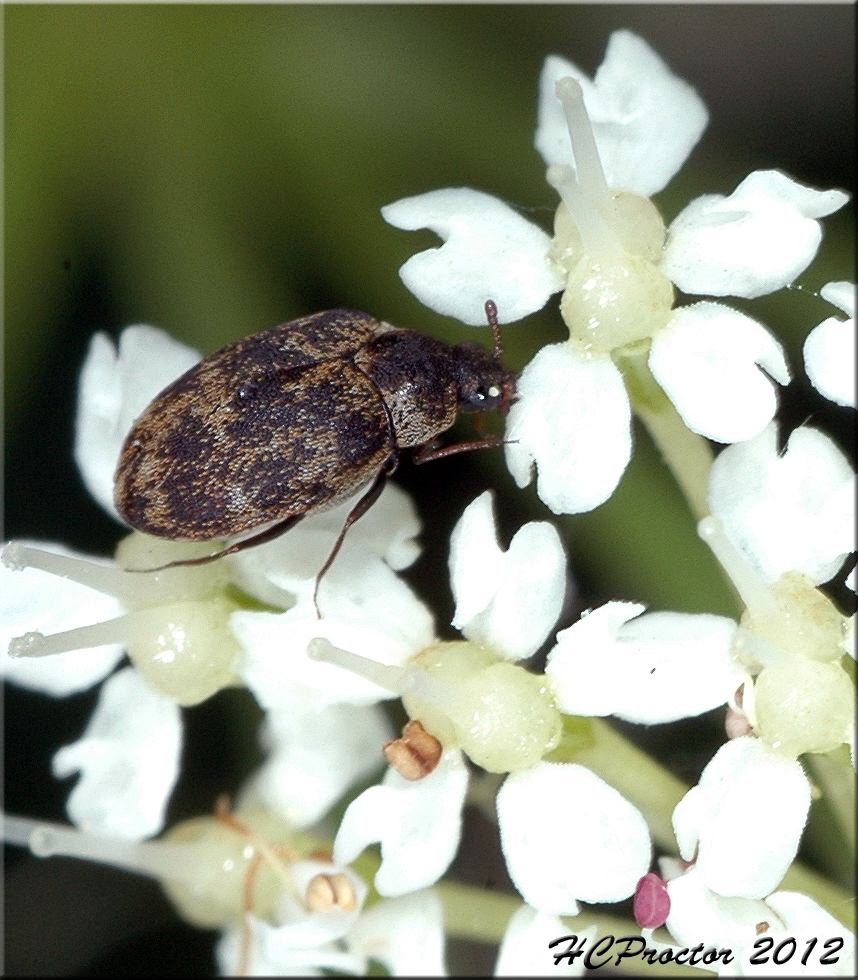
Carpet Beetle (Anthrenus sp.) enjoying a carpet of Goutweed flowers
But looking through BugGuide, I rather doubt our bathtub-bound hairball is Dermestes lardarius. Looks more like the larva of a Carpet Beetle in the genus Anthrenus, perhaps like the one above enjoying a goutweed flower (the generic name comes from the Greek for flower). Wool is another one of those animal products that dermestids will eat and several are known as 'carpet beetles' from their predilection for woollen carpets. Alas, we have no woollen carpets, but languorous patches of cat fur sprout spontaneously in front of our heat vents. I suppose there are worse ways to while away the winter days than watching a carpet beetle larva transforming cat fur into a scaly beetle.  A jar, some cat hair, and a beetle larva is all it would take. Perhaps not as much fun as watching a caterpillar transforming milkweed into a Monarch butterfly, but this is Edmonton in the winter.

Tuesday, February 28, 2012

Winter Interest in the Home Bug Garden

Cattails and rushes adding interest to a winter landscape
As the Home Bug Garden has become re-enwhitened over the last few weeks, and the illusion of a short, mild winter went the way of other illusions, the 'winter interest' in the Garden has again come to be appreciated. In general, it can be difficult to distinguish between winter interest and lazy gardening, but in a naturalistic garden one does want to look, well, natural.
'Winter interest' is also known as dead plants
Snow is a very good insulator (think igloo). If a thick enough layer of insulating snow (10-20 cm) develops then, no matter what the temperature of the air, the temperature under the snow stabilizes near freezing - warm enough for the decomposers in the soil to continue to work all winter. The vegetation under the snow becomes the food of the subniveal (under-snow) fungi, bacteria, arthropods, and worms. Although we don't see it, a significant portion of the carbon budget in boreal systems is processed under the snow during what looks like a period of dormancy.
Winter interest on its way to decomposition
But what sticks out above the snow gives some structure to the garden and some interest to all those who live above the layer of snow (I suppose that would be the 'supraniveal' fauna). This afternoon I noticed some of our winter interest falling, stalk by stalk. A White-tailed Jackrabbit was working through the remains of last year's Rough Oxeye (Heliopsis helianthoides). Well, better that than the cherries (unfortunately hares love cherry twigs). When the snow melts, all the little rabbit pellets that were once 'winter interest' will join the decomposer system too. I suppose that is better than a spring clean-up and lugging to the compost bin.
Large wings and small feet meet in the snow

Thursday, December 22, 2011

What's afoot in the Winter in the Home Bug Garden?

Young Basement Spider Tegenaria domestica
I've always found the first official day of winter somewhat strange, coming as it does, months after winter actually starts. I guess there must be some rhyme or reason to picking the solstice as the beginning of winter instead of say, Winter Hump Day. In much of the world today would be well on the way to Spring. Not in Edmonton, though, we've still a long way to go if previous years are any indication.
A typical March in the Home Bug Garden
So what is the arthropod addict to do with so many more months of winter in the way? Well, our friend John Acorn has come up with the Arthropod Winter Challenge! How many living arthropods can we find in Alberta in the winter? John thinks we can find more arthropod than bird species. Well, inside our house that certainly is true - first look around found three species of arthropods including the half grown Funnel-web Spider (Agelenidae) at the top. That is not quite fair to the birds - we have none to compete - but outside? Yes, there is a cornucopia of arthropods outside that brave the winter weather - but you need to look very closely for them and for many you need to put your nose to the ground.
Microarthropods from a few handfuls of spruce litter under the deep snows of last winter
All gardeners know that a good blanket of snow protects their plants from winter extremes, but even in very cold climates a good snow cover can also capture enough warmth for the tiny animals (microarthropods, nematodes, tardigrades, etc.) and microbes that live in the soil to go about their business. A few degrees above freezing is all they need; but so far, snow has been relatively scarce in Edmonton this winter and so no layer of relative warmth has been trapped. And, while I've enjoyed the less than usual shovelling, it has put a bit of a damper on my response to John's challenge.
A Fairy Wasp (Mymaridae, Polynema sp.) from under last winter's snow
Well, we Edmontonians know that good weather rarely lasts long and I expect that in the New Year I'll have a chance to see quite a bit more snow. I'll take comfort in knowing that under that snow my plants will be safer and there will be tiny arthropods having a good time, like the Fairy Wasp above. This tiny wasp - 0.6 mm long from head to tip of its ovipositor -  is a parasite of the eggs of leafhoppers. Bad news for baby bugs, but good news for the garden.