Friday, May 10, 2013

The Bugs are Back

Banasa dimidiata (Say, 1823) reflecting on spring in Edmonton
I'm not sure what Carl Stål was thinking of when he coined the stink bug genus Banasa in 1860. In those days, scientific names often had a classical inference and there once was a classical Banasa. The Roman Emperor Augustus founded a colony in northern Africa for veterans of the Battle of Actium called Colonia Iulia Valentia Banasa ( 'The Colony Julia Valentia of Banasa'). Although long a ruin, Banasa is fairly well known for its relics, and perhaps its bugs. The word also occurs in a Rajasthani folk Song (Raste - Raste Chalti Banasa) that adorns YouTube with brightly dressed songsters. Alas, Google Translator seems ignorant of Rajasthani, so the meaning of that banasa also remains a colourful mystery.
Banasa dimidiata looking very ruddy on a cold spring morning, and not much like its emended name
Perhaps Professor Stål was not as dour as his official portrait appears and had a fondness for colourful folk songs from warmer parts of the world. On the other hand, Anasa Amyot & Serville, 1843, perhaps best known for the Squash Bug Anasa tristis (De Geer 1773), seems to have been coined in a similar vein . Perhaps the good professor was being economical in an alphabetical way, but Google could find no 'Canasa' or 'Danasa' to support that hypothesis.
A more typical colour morph of Banasa dimidiata
Thomas Say's choice of a species name for our bug is also a bit mysterious. The spelling, as printed, was 'dimiata', a word with no obvious meaning. In general, the original spelling published is the name you are stuck with, but some people like to correct what they see as the mistakes of others. The great American coleopterist John Lawrence LeConte made such an emendation in 1859 when he published the complete writings of Thomas Say. Presumably LeConte thought Say meant 'dimidiatus', a word meaning 'halved', as many forms of this stink bug are half one colour and half another, especially on the pronotum. Well, perhaps, but I think I will go with 'prevailing use' as opposed to original spelling in this case as Richard Hoffman (2005) suggests. This multi-coloured bug is confusing enough without quibbling about its name.

References


Richard L. Hoffman. 2005. The Virginia Species of Banasa, Three Decades Later (Heteroptera: Pentatomidae). Banisteria 25: 41-44.

Katherine Kamminga, D. Ames Herbert, Jr., Sean Malone, Thomas P. Kuhar (all Virginia Tech) & Jeremy Greene (Clemson University). Field Guide to Stink Bugs of Agricultural Importance in the Upper Southern Region and Mid-Atlantic States. http://pubs.ext.vt.edu/444/444-356/444-356_pdf.pdf


LeConte, J. L. 1859. The Complete Writings of Thomas Say on the Entomology of North America. Two volumes Bailliere Brothers, New York 412 and 814 pp. 

D. B. Thomas & T. R. Yonke. 1981. A Review of the Nearctic Species of the Genus Banasa Stål (Hemiptera: Pentatomidae). Journal of the Kansas Entomological Society 54: 233-248.


This spring's first tulip


Wednesday, April 24, 2013

April is the cruelest month

Ruby Giant - not suppressed by the absence of spring
I think TS Eliot would have felt his Wasteland vindicated in an Edmonton spring. Some years the end of April has been a colourful time in the Home Bug Garden and one filled with the promise of blossoms and bees to come. Or at least that's how my mixed memories and desires would have it. Not this year, though, nor most of the last few. The coltsfoot and marsh marigolds are still under the ice. The tulips and squill barely protrude from the still frozen ground, even in the sunniest beds. No dull roots are stirring that I can see.
Hens-and-chicks - one of the few evergreenly optimistic signs
Winter has hung on stubbornly the last few years, as if the climate is getting colder instead of warmer. Yet, Mourning Cloaks and Milbert's Tortoiseshell butterflies have been on wing in the River Valley and the ice and snow is gradually receding to the shaded sides of hills and houses. Surely soon spring will come.
Pussy-toes - more or less evergreen and entirely native

Sunday, March 24, 2013

Home Bug Garden: Austral Version

Toothed White Banded Moth

There is a land far, far away, where the summers are as long as an Alberta winter and the winters as mild as an Alberta summer. Once, long ago, I inhabited such a dreamland. I was content with the land, if not the job, but the Home Bug Gardener's other half was content with neither and longed for the cold, dark whiteness of the North. White is a funny shade: it reflects all light and so seems to dominate the mind. For example, the large Toothed White Banded Moth Donuca orbigera (Guenée, 1852) above is more brown than white, but is not known as the 'brown-banded white moth'. It is related to the Alberta Underwing Moths (Noctuidae: Catocalinae) and the Fruit-piercing Moths that are such pests here. Larval hosts for the caterpillars of this moth are apparently unknown, but may possibly be trees in the genus Acacia.
Glasswing or Little Greasy Butterfly
Sometimes white can fade away to nothing but a smear (or a mess, as in the Alberta thaw) as with the Glasswing or Little Greasy Acraea andromacha (Fabricius, 1775). For some reason, the scales are shed from the front wings of this Nymphalidae butterfly (related to the Monarch, Painted Ladies, Satyrs - but in a different subfamily - Acraeinae). Caterpillars feed on the leaves of Passionfruit vines (Passiflora) and Spade Flower (Hybanthus spp.). Believe it or not, Spade Flowers were once put in the genus Viola and are still retained in the Violet family.
A Spade Flower, possibly Hybanthus enneaspermus 
Not all Queensland butterflies are white or greasy (although some Papilionidae also have transparent front wings). Most are quite spectacular, for example the Common Eggfly  Hypolimnas bolina (Linnaeus, 1758).
Male Eggfly showing eggs in wings
This is another Nymphalidae and in the nominate subfamily. It is a large butterfly and the males patrol territories about 30m long on gravel roads and trails in the hereabouts (near Miva, Queensland). The upper surfaces are brilliantly iridescent purple in the sun.
A female Eggfly, Sunshine Coast Hinterlands version
In contrast, the female is spectacular too, but looks nothing like the male. Here in the Sunshine Coast Hinterlands, she may be trying to look like a cross between a Lesser Wanderer and an Orchard Swallowtail. I don't know, but the female morph varies geographically and tends to look like distasteful crows (Euploea - another genus of Nymphalidae).
Love Flower  Pseuderanthemum variabile
In Queensland, the Eggflies use a plant with a vaguely violet-like flower as their primary host - the Love Flower Pseuderanthemum variabile. Although these plants look a bit like violets and grow on the forest floor, they actually belong to the family Acanthaceae. You can watch the females seemingly ovipositing in the ground near the plants. Or, perhaps, they are just practicing. In Australia, one must always test one's assumptions.
A Dainty, Dingy or Small Citrus Swallowtail
For example, consider the butterfly family Papilionidae, better known as Swallowtails. Above is a female of Papilio anactus Macleay, 1826. This butterfly goes by a number of nome de plumes, but I prefer 'Dainty'. But 'swallowtail' wherefore art thou? Clearly this 'swallowtail' is laying eggs on the orange tree out back, but swallowtail seems to be stretching a point. In Australia, it is always a good idea to leave your preconceptions behind, if visiting from a more northern locale.


Monday, March 18, 2013

Adventures in spider misidentification: Common Lynx

Lynx Spider perched on a rose leaf
I think this is a Common Lynx Spider (Oxypodes quadrifasciatus), but I'm pretty sure it is a lynx spider of some sort (family Oxypodidae). She's a bit more brightly red than the pictures on the Brisbane Insects & Spiders page, but such variation is to be expected. Of course, I've been known to be wrong about spiders before, but if so this time I have lots of company on the WWW since there are more than one such red lynxes with the same name appended.

The lynx spider was sitting on top of her egg mass on the underside of a leaflet of an old sprawling rose here in the Hinterlands of the Sunshine Coast until I started chasing her with my point-and-shoot. Lynx spiders are hunters and don't build webs for capturing their prey, but like to pounce like a wild cat. They tend to be fairly attractive as spiders go and are fun to watch.

Brown Huntsman in colour and maybe in genus
Australian Huntsman (Sparrasidae) are also hunting spiders and 'very interesting' to watch. When a spider with the leg-span of a large human hand is walking across your window in the middle of the night, the feeling induced can be very ambiguous. Still they usually only scare people to death and most have painful but not very dangerous bites. This one seemed to be eating something composed of scales and silk - perhaps a moth caught in another spider's web. Possibly it is a member of the genus Heteropoda. Many of these featured in the film Arachnophobia.


Sunday, January 13, 2013

Adventures in Spider Misidentification: Spitting Scytodes

Spitting Spider Scytodes cf thoracica (Latreille, 1802)
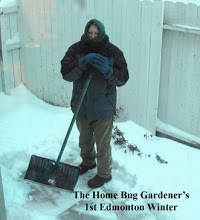
Finished sweeping yesterday's snow off the walkways, had my coffee, and now it's time to get back to work. Sunday should be, at least in part, a day of rest, even if a deadline is fast approaching. Chapters won't write themselves, of course, but this week looks like working at a computer would be preferable to being outside. Average weather in Edmonton is an oxymoron: Pacific Lows and Arctic Highs push back and forth showering us with extremes. This week looks to be a depressing and Vitamin D-free seesaw of snow, sleet, ice and sunless days. So how about a quick dissemble to a sunnier clime with an ancient photo of a Spitting Spider?
Looks like a week for the snow shovel and ice scrapper
I think this is the cosmopolitan Scytodes thoracica (Latreille, 1802) and, although she inhabited our closet in Brisbane, one might find a similar slowly stalking spitter in many closets in North America. The Spitting Spider spits silk from its chelicerae (fangs) to tie its victims down before eating them. At first this seems strange: silk should come from spinnerets at the other end of the body. But, like most things arthropods do, it is really the jointed limbs that are the key. The fangs are just the first pair of limbs modified for feeding: spinnerets are derived from couple of pairs of more posterior limbs. Arthropods are composed of a series of what were originally very similar segments, each with a pair of limbs and each with the genetic potential to produce silk (silk is, basically, an excretory product). Scytodes are unusual spiders only in that they have turned on the silk producing abilities of the segment bearing their fangs.
More than somewhat alien-looking and silk issues from either end
But in a sense, this is reverting to what most silky arachnids do. Pseudoscorpions and mites, for example, also produce produce silk from their mouthparts and some mites use silk to trap prey (Spinibdella, a genus of snout mites being one such). Pseudoscorpions use their silk to make nests in which to hide away, as do many mites.
Silken cells under bark and some exposed pseudoscorpions
Of course, the gardener's least favourite mites, spider mites, also spin silk, but from their second pair of limbs, the pedipalps. Unfortunately, spider mites feed on plants and not on each other, but use silk much like many arachnids - to make nests and even to disperse on the wind - a method analogous to ballooning in spiderlings.
Two-spotter Spider Mites resting, moulting, and laying eggs in their web 
Come to think of it, we tend to assume what is most common is normal. Spiders are our common experience of silk spinning in arachnids and arthropods in general, but they are the only ones I can think of that produce silk from limb remnants near the middle of their body (over time, the spinnerets have become less limb-like and moved rearward - see the 'living fossil' Mesothelae). Tarantulas were once rumoured to produce silk from their feet, but this hypothesis seems to have come from too much Spiderman and not enough experimental rigour. Even caterpillars produce silk from their mouthparts and the only insect that I know of that has silk producing legs (Embioptera) uses its front feet.
Sticky feet yes, but not silky
Well, enough bludging for a Sunday morning - but not all in vain. I discovered a lapse I'd make yesterday about where silk in sea spiders (Pycnogonida) comes from - and learned that spiders are stranger than I thought.