Sunday, March 20, 2011

Orsodacne: A Mysterious Trip through a Coleopterous Quagmire


Reputedly, the Vernal Equinox is tonight at 23:21 UTC or 11:21 PM Universal Time Coordinated, or Greenwich Mean Time if you aren’t a universalist. I’m an Albertan at the moment, so I take it to be about 3 hours from now at 5:21 PM Mountain Daylight Savings Time on the day after the ‘super’ full moon. Perhaps I’m wrong – only clouds and snow fill the sky at the moment: no sign of spring nor of super moons nor of spring bugs. Alas, without bug blogs I wouldn’t be seeing any bugs at all.

But bug blogs are more than just for bug perving, they also can be educational and in this particular rumination I will be surprised, embarrassed, philosophical, historical, avoiding guillotines, becoming mired in nomenclatorial confusion, and dying around mastodons in my search for the truth. It all began with the latest Inordinate Fondness beetle blog carnival at Wanderin Weeta’s where what should I see but a mystery Home Bug Garden (HBG) beetle! Forget the snow, a Canada Day reminiscence by the BugWhisper himself led to my surprise – and also my embarrassment. My one and only submission to Inordinate Fondness, one bugless and miserable day in February 2010, turns out to be disgraced by a “mystery chrysomelid” that is neither mysterious nor a chrysomelid. What we have is a failure to recognize Orsodacne atra (Aherns, 1810), currently placed in the family Orsodacnidae (Ravenous Leaf Beetles).
 
Getting a family wrong is always embarrassing, but learning a hypothesis is false is the best way forward in science. I’ve been a scientist for a long time and long ago got used to being wrong and having to pick myself up and start all over again. In this particular case, however, I seem to have slipped on a long and illustrious trail of coleopterous confusion.

To me (and others), Orsodacne has the gestalt of a Chrysomelidae (Leaf Beetles), and indeed that is where beetle-lucky Pierre André Latreille gave birth to the genus in 1802. Allegedly, Latreille had good reason to love beetles, since his coleopterophily saved him from the guillotine (see Wikipedia link). Since he also established the family group name Chrysomelidae in 1802, this would seem to be definitive and I should be embarrassed no longer. Thomson in 1859, however, decided a new family, Orsodacnidae, was needed for these peculiar beetles. Since then the splitters and the lumpers have tugged the ravenous leaf beetles back and forth between the families. This may be more than just taxonomic egos, because Orsodacne has all the characteristics of a basal member of the chrysomelid lineage (e.g. see Mann & Crowson 1981 - citation added) and its proper placement is not all that clear.

Confusion does not end there, however. Unfortunately, these beetles tend to be variable in colour pattern. For example, Steve Marshall in his Insects (p. 351) states without compromise: “Orsodacne atra, the only northeastern orsodacnid, has several color forms which have been erroneously treated as different species. At least 11 different species names have been given this species, of which only the oldest (O. atra), is correct. The other names are junior synonyms.”

So, now at least we know the right name for our beetle: Orsodacne atra (Ahrens, 1810)! Or do we – half the references I found use Orsodacne atra (Knoch in Ahrens, 1810). This would seem to imply that someone named Knoch (possibly the German naturalist August Wilhelm Knoch who died in 1818) actually deserves credit for the name and not the German entomologist August Ahrens (1779–1867)?  This is getting way beyond my level of nomenclatorial expertise, s [Having acquired a higher level of nomenclatorial knowledge since first posting, I can say (Ahrens, 1810) is wrong, (Knoch, 1810) correct, and (Knoch in Ahrens, 1810) the most useful authority citation.] So I think I’ll just be glad that the genus is clear and stable.

But is it – NO! Apparently the species that Latrielle designated as the type for Orsodacne is not all that clear either. Although he tried to remedy the problem in 1810 by designating Chrysomela cerasi Linnaeus, 1758, as the type species, this is somewhat irregular under the rules of nomenclature. Thus, in 2000 H. Silfverberg felt it necessary to appeal to the International Commission on Zoological Nomenclature (Case 3103) to conserve Latrielle’s designation. Fortunately for us, two years later the ICZN agreed (Opinion 1989).
 So, at last we have a more or less stable name – but what does this beetle do? Silfverberg’s (2000) application states “Species of Orsodacne are pests on cultivated plants”. From the name of the type species (cerasi) I think it safe to assume that the adults or larvae or both feed on cherry, but finding information on the feeding of any Orsodacne in the scientific literature seems to be difficult. If they are a pest, then they must be minor ones, because the sad fact is that the more an insect impacts on humans, the more scientists study it.
 Can we say anything about O. atra? Well, the HBG beetles were ravenously eating pink panda pollen. Pink panda is a hybrid between a strawberry and a cinquefoil, both members of the Rosaceae. Insects of Alberta reports that adults of this beetle also feed on a member of the Rosaceae, the Provincial Flower the wildrose (usually interpreted as Rosa acicularis), and on the pollen of other woody plants. Barrett & Helenurm (1987) report this beetle common on bunchberry (Cornus canadensis) (below).
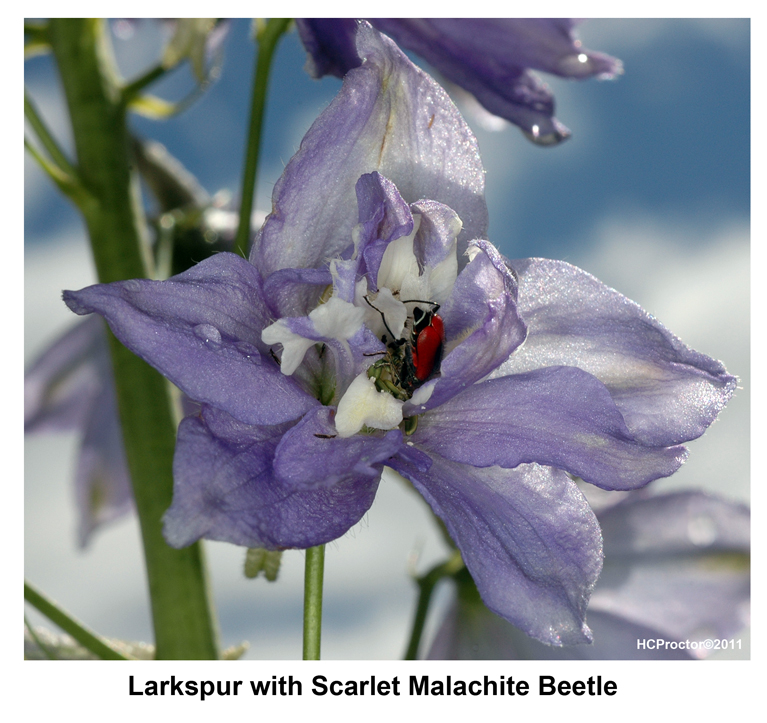
 That was all I could glean from a fairly extensive search of the primary scientific literature and unfortunately that leaves us in the dark about the larval habits. Insects of Alberta reports “Little is known about the larval stages” and this seems to be true. So, a mystery – but the solution comes from an unexpected source - paleoentomology. Thanks to the Geological Society abstracts of Robert E Nelson and his colleagues that are available on the web we can add the knowledge that adult O. atra used to hang around with mastodons in New York and on the coast of Maine about 11,000 years ago – and also that the larvae feed on willow (Salix spp.). So, with lots of flowers in the Rosaceae (like the white Scotch Rose above) and Cornaceae, and a large and rapidly growing willow, there no real mystery as to why this beetle has taken up residence in the Home Bug Garden. However, I do still wonder why it is called a Ravenous Leaf Beetle and not a Ravenous Flower Beetle?
 
References:

Anonymous. 2002. Opinion 1989 (Case 3103). Orsodacne Latreille, 1802 (Insecta, Coleoptera): Chrysomela cerasi Linnaeus, 1758 designated as the type species. Bulletin of Zoological Nomenclature 59(1): 55.

Barrett S. C. H. & Helenurm K. 1987. The reproductive biology of boreal forest herbs. I. Breeding systems and pollination. Can.J. Bot. 65: 2036-2046.

Mann, J. S. & Crowson, R. A. 1981. The systematic positions of Orsodacne Latr. and Syneta Lac. (Coleoptera Chrysomelidae), in relation to characters of larvae, internal anatomy and tarsal vestiture. Journal of Natural History, 15: 5, 727-749.

Silfverberg, H.2000. Case 3103: Orsodacne Latreille, 1802 (Insecta, Coleoptera): proposed conservation by the designation of Chrysomela cerasi Linnaeus, 1758 as the type species. Bulletin of Zoological Nomenclature 57 (2): 94-96.

Tuesday, March 1, 2011

Australian of the Week: Agarista agricola (Donovan, 1805)


This Winter is definitely getting to me. Snow yesterday, -31 C this morning (and -39 at Elk Island), -30 and snow tomorrow. Although the Alberta Lepidopterist Guild had an entertaining Feralia Symposium this weekend and Terry Thormin, snug on Vancouver Island, is already posting new insect pictures on the Albertabugs, it looks like it will be many more cold, cold weeks until the first flies of spring. Rather than carp about the cold, though, I’m instituting a new semi-weekly feature in which I get to reminisce about a warmer land: Australian of the Week. Many of these pictures will have been scanned from 35mm film, but that was the technology at the time.

First up is the Joseph’s Coat Moth Agarista agricola (Donovan, 1805), from the biblical story (or the Dolly Parton song if you prefer). This is a large moth – and it flies during the day when its bright colours tell potential predators just how bad it tastes. Most brightly coloured diurnal moths are probably loaded with nasty chemicals (or at least pretending they are) – and they seem to be popular on bug blogs like Beetles in the Bush and Myrmecos Blog this week.

This particular Joseph’s Coat Moth fell victim to Heather’s camera in a vineyard outside Stanthorpe, Queensland. Stanthorpe is in the Granite Belt – Queenslands best wine country. If you really like red wine, then this is faint praise, but only because the competition is the Coonawarra, Yarra Valley, Eden Valley, Western Australia, Mornington Pennisula, and so on. The Granite Belt wine probably has the potential to be as good as that from the Barsossa Valley, usually about the best Australian wine I can afford in Alberta bottle shops. The Joseph’s Coat Moth is native to Queensland, where it feeds on native vines in the grape family (Vitaceae), and now and then, introduced grape vines.
Alberta has its own colourful day-flying moths that are now more or less in the same family with the Joseph’s Coat Moth. Well, who knows, the taxonomy of the Noctuoidea seems to change daily. Currently, the Police Car Moths I posted on last summer and the equally attractive Ctenucha virginica (Esper, 1794) are in the Erebidae (subfamily Arctiinae). The Joseph’s Coat Moth had its own subfamily in The Insects of Australia, Agaristinae, and maybe it still does, but I’m not sure in what family it currently resides. Should I try to find out or open a bottle of Australian wine to toast the new feature? Ah, if only all choices were so easy!

Sunday, February 13, 2011

Sunday Psyllids


 Thanks to everyone who offered supportive emails and comments over the last few weeks. They were much appreciated. Even without family tragedies, I find this time of the year, February through March, the most bleak and difficult in Alberta. The winter has dragged on, the holidays are past, and it will still be two or three months until there is more than the faintest signs of life escaping from the icy shell. Sometimes one has to dig deep to find some winter bug interest.
 The winter weather here derives mostly from the struggle between cold Arctic air masses moving south and warmer, moist Pacific air masses trying to force their way over the Rockies. Every now and then the Arctic air breaks away and drifts further south, bringing storms and snow to the US, but often letting in enough Pacific air to give us a brief thaw and a view of an overly optimistic fly, spider, or lacewing basking in the faint sun. The few days of warmth are appreciated, but the false springs are soon gone and below zero weather reigns again. Under the snow, however, there is a lot going on, and it is always worthwhile to shovel down and see what is up. On our last snow-delving trip to the Moose Pasture, we found something unexpected - a superfamily of tiny (3 mm) bugs we didn’t know we had – jumping plant lice Psylloidea.
 In Australia, I would have called these lerps, or if being more formal, psyllids, but neither is technically correct. A lerp is actually a sugary covering of the larvae of some psylloids and a much appreciated food for some Australian birds, such as the infamous Bell Miner (Manorina melanophrys). You don’t have to go to Australia to see lerps – California is close enough to see the The Redgum Lerp (Glycaspis brimblecombei) devastating introduced gum trees. But fortunately no one has introduced the Bell Miner or it’s similarly aggressive but more flower-loving cousin the Noisy Miner to North America. The latter is slightly larger than a North American Robin, more aggressive than the Mockingbird (but lacks any musical ability), hangs out in gangs, and vigorously beats up and chases away any perceived competitor or threat. But at least they don’t farm psyllids.
'Psyllid' seems to be hanging on as a common name, although the Psyllidae of my youth is now Psylloidea (‘psylloid’ is a bit pedantic) and contains a number of families, depending on the authority. I follow Ian Hodkinson, not just because he did time in Alberta, but because he and J. Bird revised the subfamily Livinae (Aphelaridae) that includes my two snow-bound specimens. These psyllids are not lerpy, instead the larvae form galls on sedges (Carex) and rushes (Juncus). Some Livia species have been collected overwintering on conifers. The two I collected were from the litter of a white spruce under 40 cm of snow. Since psyllid workers don’t seem to have spent much time looking for their bugs under snow, it is possible that, at least in Alberta, this protected winter habitat is the actual overwintering site. Neither psyllid quite fits a described species, but little is known of the biology of psyllids unless they are pests. Seasonal polymorphisms are known in other psyllids and usually related to diapause, so I may have an overwintering morphology of a described species. Galls, polymorphisms, secret diapause sites, I never thought that such tiny bugs would prove such a welcome winter respite!
Thanks to The Atavism in New Zealand for opening my eyes to the new Psylloidea in a November post that prepared me to recognize them (I surely would have ignored them otherwise). While thinking of the southern hemisphere, let me say I’m happy to learn that Bunyip Co and A Snail’s Eye View (and her padymelons) survived Yasi and are back to blogging. I hope that is the last of the giant cyclones they have to experience.

For more on psyllids see:
Hodkinson ID. 2009. Life cycle variation and adaptation in jumping plant lice (Insecta: Hemiptera: Psylloidea): a global synthesis. Journal of Natural History 43: 65–179.

Hodkinson ID & J Bird. 2007.Sedge and rush-feeding psyllids of the subfamily Liviinae (Insecta: Hemiptera: Psylloidea): a review. Joumal of the Linnean Society  128: 1-49.

Saturday, February 5, 2011

Some Flowers for Tina

 
 I started the HomeBugGarden for two reasons: I needed an excuse to ruminate on what I could and could not contribute to invertebrate conservation in a small urban lot and I wanted to showcase some of my wife’s excellent photography. The first thing I learned during this endeavour was that although I had spent 40 years learning and practicing some aspects of the biological sciences, some of my most basic assumptions were not very scientific.
 That discovery was interesting, if disconcerting, but since I had decided to give up the profession of a tenured professor of the truth, in favour of one puttering around in a garden, the discovery seemed of but academic (or rather chewing-the-cud) interest.
 Discovering that things one always assumed were true were not, however, does tend to make one question other aspects of their lives. I’m not really ready to throw over most of these other convictions, but I am prepared to be neutral about them: maybe they are valid and maybe not. I’m pretty sure that when I die I will not go to heaven and God will not explain to me exactly what happened to the dinosaurs, but I am willing to suspend disbelieve about how successful others may be in their search for the truth.
 Perhaps I am merely maturing as a scientist – learning what questions can be addressed by the scientific method and which ones cannot. Perhaps.
 In any case, life marches on, relentlessly. I suppose I know this in the abstract sense, and more immediately in the recent deaths of several of my wife’s relatives. For the last 40 years or so, however, I have tried to keep a very broad buffer between me and my genetic family (the Pacific Ocean worked well).
 I come from a fairly dysfunctional family – and I think my brothers and sisters would mostly agree with this assessment – but not totally dysfunctional. Minor civil wars aside, my brothers and sisters have kept on mostly civil terms. We all dispersed from our natal home, but all the others have been drawn more or less back. Creepy, as if invisible spider web pulled us all back home, but I have resisted the pull. No kudos to me; though, rejection is always easier than accommodation, and I am the distant one.
 I thought that one day, perhaps, I might go back and get to re-know my family. There’s some saying somewhere about paths and good intentions, and I’m sure I’m stumbling down several of them at the moment, but in this case the good intentions never happened. Now it is too late, at least for my closest sister.
 A few months ago, my sister Tina was diagnosed with a cancer. Her emails were invariably cheerful and upbeat and the treatments seemed to offer hope. Then, suddenly last weekend, she was hospitalized with breathing problems. Here last emails told us not to worry, but on Friday she died.
That was very sudden, and all good intentions to the contrary, I will never get to show Tina the Home Bug Garden. I think she would have liked it. Although not an insectophile, she was interested and always sending me pictures of things she or her daughter Tessa had found in the backyard, in the driveway, in the bath tub, in the basement ... 
 Even if Tina would have just tolerated the bugs, I’m sure she would have like the flowers. So, here is my way of saying goodbye to my sister – a feast of flowers that I never got the chance to show her.

Friday, December 24, 2010

Merry Christmas from the Home Bug Garden


The Dragonfly Woman has a nice post on what insects you might see on a white Christmas. The only one of those true insects that we have recorded in the Home Bug Garden, a winter stonefly in the family Taeniopterygidae, is from the day after the last frost on 5 May 2005. Although the Last Spring Frost has since moved closer and closer to the end of May (with a light frost on 1 June of this year) along with the snow, we like to think that we will some day see early springs and winter snowflies without snow again. Meanwhile, we really should start looking for ‘snow fleas’ (aka springtails, Collembola). With the snowpacks we have been getting, it is highly likely that lots of tiny arthropods are going about their business under the snow where temperatures may be hovering around freezing and that some of these will follow the tiny channels to the surface where they can offer us a bit of diversion over the long, long winter.
Meanwhile, on reviewing the HBG portfolio, it looks like the beetles are the bugs with the most Christmas colour, so here follows a small sampling of festive red, white, and green from over the years. We’d also like to wish all of our fellow bug bloggers, those obsessed few who have challenged the stereotype of blogs as cesspools of political invective and made each morning’s readings an uplifting experience, a Merry Christmas & Happy New Year. Among that long list, we’d especially like to thank Ted MacRae at Beetles in the Bush – our first visit each morning; The Bug Whisperer – our local hero, the multi-talented Adrian Thysse; the anonymous, always interesting, and often annoying Bug Girl’s Blog; and finally, the master of bug blogging, the one and only Myrmecos (aka Alex Wild). To each and all bug bloggers a joyous and interesting bug-filled New Year.


Saturday, December 11, 2010

Rugged up until Spring: A Mammalian Digression

 By the calendar it isn’t winter yet, but winter weather closed down the last lingering greenery in the Home Bug Garden in November. Temperatures plunged to -29 C (-20 F) and the North Saskatchewan River froze over 3-4 weeks ahead of schedule. Other than the occasional fungus gnat in the bathroom or spider in the basement, that is it for this year’s bugs: same for the Moose Pasture. Last weekend the snow at the MP wasn’t quite deep enough for snowshoes, but the thermometer had registered -32 and even birds were few and far between. The only sign of insects were the honeybee hibernation hotels. So, my choice this Saturday morning is either shovel the snow off the driveway or invent a post on the HBG. If only all of life’s choices were so easy!
 One thing still in evidence at the Moose Pasture last weekend were its mammals. And since there were mammals, of course, there were arthropods, because mammals are a year-round tropical beach for their arthropod ectoparasites. Well, at least for those that take up residence, as opposed to just stopping by for a meal (fair weather fiends). Ditto for the Home Bug Garden’s mammals or at least those that live outside. We HBGardeners like to think of ourselves as bug-free zones and, except perhaps for the transient mosquito and resident follicle mites (and let’s just not think about them) we are and so are our house-bound cats. But that isn’t true of the ‘native’ mammals: each is the potential home to several species of lice, fleas, mites and ticks.
 So, let’s take Middle Earth Garden’s question one step further and see how similar the HBG is to the MP in terms of mammal habitat for bugs. Now, we don’t actually do much mammal collecting, so our estimate will be mostly theoretical, but it seems a reasonable comparison (and much better than shoveling the driveway).
 If you were to look out at the front of the HBG this morning, you’d see a garden covered in snow and crisscrossed with tracks. Among these are a few cat paws, bird claws, and squirrel scratches, but the vast majority are contributed by one animal: the White-tailed Jackrabbit (Lepus townsendii).
 Jackrabbits are born ready to run and adults don't make burrows, but get by with resting in a slight depression in the soil or snow, so their contribution to the arthropod fauna would be limited to their ectoparasites (mammals that den or burrow are much more arthropod friendly). These are big hares – to 5.4 kg (12 lbs) and over 2 feet in length – and they pay no attention to cats and little attention to people. Dogs do give chase, but with top speeds of over 70 kph (Wood et al. 2006), one tends to feel sorry for the dogs (unless they are trampling the garden). If a dog, or more likely a coyote, does get close, jackrabbits are capable of sudden near 90 degree turns – and their black tipped ears go one way while their bodies go the other, with the coyote left snapping at a vanished ear and the jackrabbit vanishing in the other direction.
 While limited to open areas and rare outside the City (<1 per 4 km2), White-tailed Jackrabbits thrive in residential areas of Edmonton with densities averaging about 4 per km2 in the winter (Woods et al. 2006) or about 1300 shrub snipping hares. I regularly see a half dozen or more of these nocturnal munchers during my pre-dawn walk to work. Anything in the Rosaceae except spiny roses seem to be a preferred winter browse, so every autumn I have to spend a day putting wire cages around the saskatoons, cherries, crabapples, and chokeberries or they will be eaten down to the snowline by spring. In comparison, the Moose Pasture has no jackrabbits at all, but does host a few Snowshoe Hares (Lepus americanus). These also are nocturnal, but somewhat smaller and prefer forested cover. I sometimes see one in the River Valley and we often see their tracks at the Moose Pasture, but they do not make it into the HBG.
Coyotes (Canis latrans), however, do occur both here and at the MP, although only as transients in the HBG. Some estimate that 600 reside in the City. I see one every now and then on the way to work or coming home late at night and always make a point of giving it a chase (well, I try to look threatening anyway). Attacks on people, usually children, joggers, or someone walking a meal (aka small dog) are rare but increasing in frequency as coyotes learn to associate people with food rather than fear (Timms et al. 2004). Coyotes may eat more house mice than house cats, but the telephone poles littered with posters of missing cats bear mute testimony to another aspect of their diet. At the MP coyotes are very common - it sounds like 4 packs (probably male-female pairs with young) are within howling distance - and their tracks, turds, and the occasional bloody remains of dinner are everywhere. Since coyotes also dig dens, as well as produce feces and bits of carrion, they contribute significantly to the arthropod fauna of the Moose Pasture. We watch them watch us, but in the country they know that people are dangerous, so we camp amongst them with little concern.
That attitude would be inappropriate for the two largest carnivores in the region. Both cougars and black bears wander through the Edmonton River Valley on occasion, but were generally considered extirpated south of the River. That is no longer true and our MP neighbours, especially the beekeepers, were treated to a bit of ursine drama two summers ago. Fortunately, no one was hurt and losses were limited to bees (wiped out) and damage to homes (and to bears) and to Disneyesque views of Nature. The new hives are now protected by scarebears (apparently somewhat effective), electric fence (ineffective), and relocation to the middle of cleared agricultural areas (very effective if you have such land).
The cougars have yet to cause a problem (but see David Barron’s excellent book) and probably subsist primarily on the large population of White-tailed Deer (Odocoileus virginianus). Mule Deer should also be in the vicinity, but we have yet to see any. Larger, but not as numerous, is the largest member of the deer family: the Moose (Alces alces). We have at least 5 moose that wander the MP, but fortunately for our shrubs, none in the HBG and only rarely have we seen deer nearby. In the spring after the snowpack melts, the ground at the MP is covered with piles of decomposing moose and deer pellets that support a diversity of beetles and flies (and fungi).
 Although moose are potentially dangerous, they are more likely to hurt us if we crash our car into them, then if we upset them some other way. In Alberta, you are far more likely to be killed or maimed by a car, then by all of the wildlife put together (including West Nile Virus vectoring mosquitoes). However, the Moose Pasture does have one significant wildlife danger to those camping there – being crushed by a beaver-felled tree.
Of all of the mammals in Alberta other than people, beavers clearly have the greatest impact on the environment. They also probably contribute more to arthropod diversity than any other mammal. They build and inhabit large, permanent lodges along with their fleas, parasitic beetles, and a host of detritivores. The meadows they flood eliminate some insects, but the new marshes support hosts of dragonflies, damselflies, water bugs, beetles, and more.


The trees beaver fell are a bonanza for beetles, flies, parasitic wasps, and anything that likes to nest or hide in decomposing wood. Beaver love aspen and will clear it as far from water as they feel safe. This opens up browse for moose and deer, but also spots for herbaceous perennials to bloom and feed more bees, wasps, beetles, butterflies, and moths. The cleared, sun-warm ground is a boon for ants and ground nesting bees and wasps. If you like arthropods, then you should love beavers – just don’t set your tent up anywhere near an aspen or poplar.
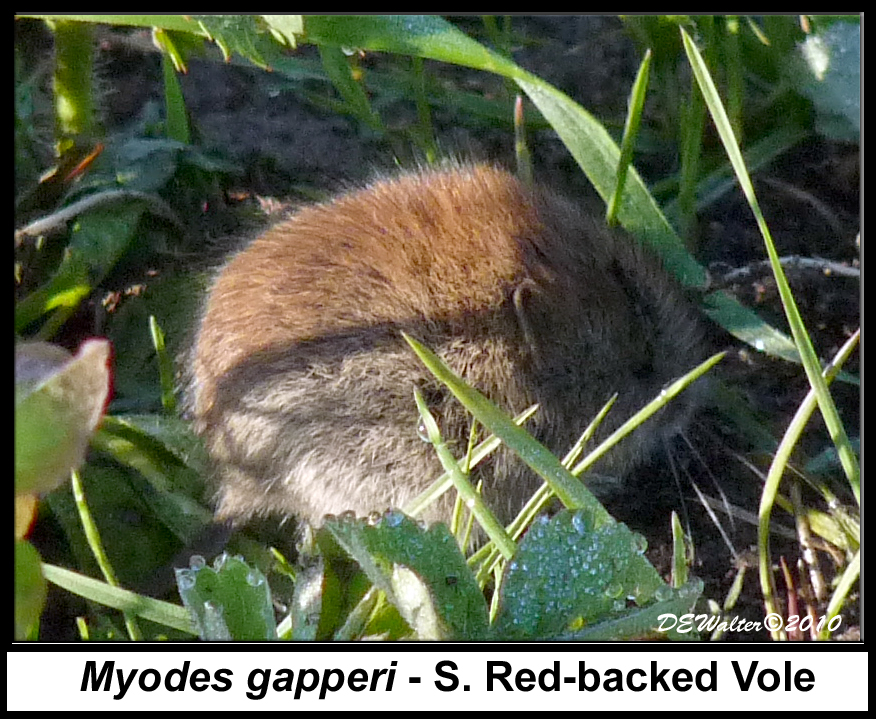
 Muskrat benefit from the marshes beavers create and smaller rodents benefit from the open areas covered in herbs and grasses. Deer Mice build burrows and our bumblebees like the abandoned burrows for nesting sites. Voles with their mites and fleas graze on the grasses and herbs that sprout amongst the stumps and most everything is both changed and generally more diverse when beaver are present.
This beneficial effect is especially true during one of the frequent droughts in the Parkland when lush, verdant areas are restricted to around beaver ponds. Porcupines may benefit indirectly, since they like birch and beaver don’t, so the prevalence of birch may increase with beaver present (and with that all the birch-loving insects).
 Beaver are a bit ornery and noisy (it takes a lot of gnawing to bring down a tree – which can make for a restless night), and if you like trees and meadows they are harder to appreciate, but as far as mammals go, they seem a boon for arthropod biodiversity.
Well, I suppose that is enough effusion about beavers for the moment. The Home Bug Garden has no Castor canadensis and few of the other mammals that inhabit the Moose Pasture. Alberta has about 90 species of 'native' mammals and almost half of them (>40) show up at Elk Island National Park, so several more of these will show up at the Moose Pasture if we get serious about finding them.
Not all of these would be welcome in the Home Bug Garden, and I would put deer and Deer Mice at the head of that list.
Even without these peculiarities of taste, mammal-driven biodiversity gets short shrift in the Home Bug Garden. Except, of course, for the only mammal more potentially arthropod biodiversity friendly than the beaver: the naked ape! In my own small way (and usually well clothed) I have made this small lot more diverse and bug-friendly and I guess that will just have to do for the mammal contribution for the moment. Good fences make for good neighbours, and the fewer mammals in the HBG, probably the better for all.
Baron D. 2005. The Beast in the Garden: The True Story of a Predator's Deadly Return to Suburban America. W. W. Norton & Company.

Timm RM, Baker RO, Bennett JR & Coolahan CC. 2004. Coyote Attacks: An Increasing Suburban Problem. pp. 47-57, in: Proc. 21st Vertebr. Pest Conf. (R. M. Timm and W. P. Gorenzel, Eds.) Published at Univ. of Calif., Davis.

Wood JR, Krenz J & Boyd-Zhang T. 2006. Urban White-tailed Jackrabbits of the Edmonton Region (1992-2002). pp. 119-133, in: RW Wein (Ed). Coyotes Still Sing in My Valley. Spotted Cow Press.