Friday, September 23, 2011

Aculeata Agonistes: When hornets are not


Dolichovespula adulterina - a blackjacket and a social parasite

At various times over the last few years, the Home Bug Garden has been blessed with the visits of 10 species of social wasps* – all members of the vespid subfamily Vespinae. Paper Wasps in the subfamily Polistinae, such as the Polistes species common in much of North America, do not occur in Edmonton. Perhaps the introduced European Paper Wasp Polistes dominula (Christ, 1791) may be able to survive our winters, but so far it hasn’t shown up and the nearest Polistes species is in southern Alberta.
Polistes dominula an introduced and spreading paper wasp
 Most years, if not exactly welcome, hornets and their kin are greeted with some interest by the HBG, at least early in the season. Mostly hornets go about their business hunting insects. Some times their prey are pests and sometimes not (e.g. hover flies), but all in all they are as interesting and unassuming as most of the insects in the HBG. 
Yellowjacket worker chewing-up insect prey (a planthopper of some kind)
Telling one species of wasp from the other isn’t easy, except for the Bald-faced Hornet Dolichovespula maculata which is about twice the mass of the next largest social vespine. It is also black and white – but so are other species of both Dolichovespula (D. adulterina - see picture at top) and Vespula (V. consobrina) and yellow and black species occur in both genera too.
A Bald-faced Hornet - the largest blackjacket
 The easiest way to tell the two genera apart is by close inspection of the area between the eye and the mandible. Just what one would like to do – stick your nose in the face of a hornet! Dolichovespula have a relatively large distance between the bottom of the eye and the top of the mandible and Vespula have eyes that almost meet the mandibles. I’m sure one can get pretty good with practice, but for most of the summer being too nosey runs one a strong risk of getting stung.
A Dolichovespula - eye and mandible well separated
 As the summer progresses yellowjackets, blackjackets, and hornets become more and more common. Towards the end of the season, their numbers seem to explode for a few weeks – and then they are gone. This year, though, their appearance was much delayed and when they finally arrived, only three species were present: D. maculata, D. arenaria, and V. pensylvanica. The first and the last of these can be pretty annoying – they will scavenge and so anything you eat or drink is of interest to them – and if you get one annoyed enough, you may encounter the venom delivery machinery at the end of the female workers.
Vespula pensylvanica Western Yellowjacket worker
 At the moment, though, the risk of being stung is pretty low, at least in my backyard. We haven’t had a hard frost yet, so worker wasps are still active, but 95% of the yellowjackets in my backyard for the last week or so have been males. You can easily tell a male wasp from a female, because males have antennae with 13 segments and females have only 12! Also, the males have 7 apparent abdominal segments and females only 6. Easy right? If all else fails, there is a bioassay. If you capture a wasp in your hand and then experience a sharp and violent pain (followed by a strong systemic reaction and death if you happen to be allergic), then you probably have a worker (the new queens mysteriously disappear soon after mating). If not, you may have a male.
Male (note 13 segmented antennae, 7 segmented abdomen) Western Yellowjacket
 The last time I was stung by a vespid, an Australian paper was in the genus Ropalidia, I experienced a strong local reaction. That may not mean much – in Australia a variety of ants, wasps, and bees stung me – but it may indicate a developing allergy. It is always best to avoid being stung. That is one reason I stomped the male in the picture below with the exposed claspers. With claspers instead of a sting, I was pretty sure I had a male, but calling it a hornet made less sense.
A male -  the claspers prove the point

 *Home Bug Garden Vespine Wasps:
Dolichovespula adulterina (du Buysson, 1905)
Dolichovespula arenaria (Fabricius, 1775)
Dolichovespula maculata (Linnaeus, 1763)
Dolichovespula norvegicoides (Sladen, 1918)
Vespula atropilosa (Sladen, 1918)
Vespula austriaca (Panzer, 1799)
Vespula consobrina (de Saussure, 1864)
Vespula germanica (Fabricius, 1793)
Vespula pensylvanica (de Saussure, 1857)
Vespula alascensis (Packard, 1870)

Friday, September 16, 2011

How to Know a Fly, Part 1: ‘Thread horns’ of the Nematocera

Thread horn meets deadly threads: Male Chironomid Midge
Autumn is upon the Home Bug Garden. The days are shortening, the sun noticeably dimmer, the warmth of August gone, and the diversity of insect life noticeably reduced. It is time to start girding the mind with memories to hold together over the long, long, insect-free months until next spring.
Sylvicola sp. (Anisopodidae) - a Wood Gnat
Well, not completely insect-free. A larder beetle or two and may be a spider beetle (and certainly house spiders) or a meal moth will pop-up now and then. And there is always the chance that something new and interesting will emerge from hibernation to be found batting at a winter window. Also, once the potted plants are moved back in doors, the inevitable hidden aphid will break dormancy and overrun an herb or flower. The pots too will mete out a miasma of tiny midges into the winter atmosphere – the fluttering of sciarid flies.
Dark-winged Fungus Gnat (Sciaridae)
One way to never finish anything is to be always starting new projects. The HBG already has several series that are more or less moribund. When was the last Sunday Sawfly? Wednesday Wildflower? Australian of the Week? Well, my excuse is I’m pretty much out of new pictures of identified sawflies to display. Also, I rationalize that the bug season is the time to wallow in the diversity, not to reminisce about flowers or Australia. That's for the interminably long winters. So, in this season of transition, here is a new series – ‘How to Know a Fly’. In contrast to the other, open-ended series, I envision this one as discrete – probably 5 parts – and I hope to have it finished before Christmas. Absolutely. For sure.
A March Fly (Bibionidae) in September
In ‘How to Know a Fly’, I intend to deal with what I see as one of the major impediments to insect conservation: the difficulty of knowing the true name of an insect. Although all insects may be equally interesting, in a bug garden some insects should be more equal than others. Or, to paraphrase Hamlet, would anyone want a garden grown rank with weeds? Clouds of mosquitoes or swarms of flesh flies emanating from someone’s backyard are unlikely to advance the cause of insect conservation.
A Crane Fly (Tipulidae) - aka Daddy Longlegs
For example, can you distinguish a Crane Fly from a giant mosquito? An Anopheles mosquito wriggler from that of a harmless Dixella midge? An Ochlerotatus mosquito tumbler from the pupa of a predatory Chaoborus midge? When I started our pond I knew craneflies from mosquitoes, but not the others – and mistakenly executed many of the ‘more equal’ flies before deciding that I should learn the names of the insects that I was killing. I thought I would be learning mosquito names, but instead I learned midges.
Psychoda sp.  - a Moth Fly (Psychodidae)
And on this point hangs one of the contradictions of insect conservation – to know an insect you often need to kill it and mount it on a pin. This isn’t true of birds – there are many well illustrated guides to birds and a pair of binoculars and some patience is usually all one needs to learn a name. This is also true of a wildflower – picking apart a flower is usually the worst one need do (well, sometimes you need the roots). But even with butterflies, determining the actual species name may involve capturing a specimen.

March Fly with a name - Penthetria heteroptera (Say, 1823)
Field guides do help and one can be reasonably sure of the identity of at least the family and sometimes the genus of an insect by comparing live bugs or pictures to plates in books or surfing the incomparable BugGuide. But there are orders of magnitude more insect species than birds, most bugs are much smaller than even the smallest bird, and there are many insects more confusingly similar than the worst fall warblers. In most cases, learning the true name of an insect will require a specimen, microscope, and an often intimidating thing called a ‘key’. That is how the March Flies above got their name.
Name that midge
 A key, of course, can unlock a door – or a mystery – or point to something significant, as in a ‘key character’. On our path to learn the true names of flies, the first key character is the form of the wings. In spite of the official name for the order of true flies, Diptera (‘two wings’), most dipterons actually have four wings, at least in an evolutionary sense, but the hind wings are modified into a nob like structure called the haltere. Only the front wings look wing-like, and hence, Diptera.
Gall Midge (Cecidomyiidae) showing wings and halteres

Aspen Leaf Galls probably cause by an Harmandiola Gall Midge
In insect identification, keys usually come composed in pairs called couplets. People like dichotomies – dividing others into friend or foe, for example. That is simplistic – most people are neither and one’s enemies’ enemies may be temporarily friends – but it makes for simple choices. Identification keys are built of such dichotomous and contrasting sets of choices.
A bad fly, but a true fly, but better known as a mosquito.
If I were to write a key to distinguish true flies from other orders of insects, then the early couplets might run like this (X’s refer to parts of key not given, numbers indicate go to that numbered couplet):

1. Wings present ... 2
 - Wings absent ... X

2. Thorax with two pairs of membranous wings ... XX
 - Thorax with one pair of membranous wings ... 3

3. Membranous wings on mesothorax; metathorax with pair of knob-like structures ... 4
 - Membranous wings originate on metathorax; mesothorax with leathery or shell-like processes that cover the wings at rest (e.g. beetles, grasshoppers) or small knobs (Strepsiptera) ... XXX

4. Mouthparts usually present, often well developed and may form beaks, sponging structures, or an elongate proboscis; tarsi usually with 5 segments ... Diptera
 - Mouthparts absent; tarsi with 1-2 segments ... Hemiptera, Coccoidea (male scale insects)
Our identification hanging by its couplet
Notice that there is only one correct path to the Diptera – at each couplet you must make the correct choice or you will end up in the wilderness of X’s. Also, although less obvious, this key will not help you if your fly has no wings, if they are either broken off or they never developed. Some parasitic flies in the Family Hippoboscidae, for example, either never develop wings (e.g. sheep keds) or shed there wings once a host has been found. Then again, you must have an adult fly to use this key – and for every fly you find there once was a maggot and a pupa with no wings that cannot be identified here.
Gilled maggot of a Crane Fly floating in the HBG Pond
And what does one do next upon knowing you have a fly? Why then it is too another key and another key until one either gives up, runs out of keys, or arrives at a species.
Crane Fly with 'thread horn' antennae
 I think we’ve gone on about long enough today, but I would like to end with the great dichotomy of the Diptera. Most of the insects we think of as flies belong to the suborder Brachycera – horse flies, deer flies, bottle flies, bot flies, carrion flies, flower flies, bee flies, robber flies, house flies, and the like. Characteristically, these ‘short horn’ flies have short antennae - usually with 7 or fewer segments and often highly modified. What used to be the other half of the dichotomy, the Nematocera, have longer antennae, typically with 8-14 segments, and these antennae tend to be simple segmented lines (although sometimes highly plumose). We call some of these flies (e.g. crane flies), but more often call them midges, gnats, and mosquitoes. Still they are real flies and usually welcome in the Home Bug Garden (mosquitoes, black flies, and biting midges excepted).
An army of Aphidoletes aphidimyza - a Gall Midge that doesn't gall

As is often the case with dichotomies, the Diptera cannot be divided so simply. The Nematocera is not a natural group, but more the not-brachyceran flies. One of my favourite nematocerans is the Aphid Midge Aphidoletes aphidimyza (Rondani, 1847) – a Gall Midge (Cecidomyiidae) that makes no galls, but eats honeydew as an adult and aphids as a maggot. It eats aphids so assiduously that this midge is marketed as a biological control agent for aphids in greenhouses. It slays its way through the aphids that pester my Evans Cherries too.
Aphid Midge maggots consuming Black Cherry Aphids
Not satisfied with being just a great biocontrol agent, the Aphid Midge also exhibits a fascinating behaviour: it thumbs its thread horns at the normal nemesis of flies - the spider in its web. Those midges in the pictures above (and below) have not come to a sticky end (like the unfortunate male chironomid midge at the beginning of this post), but are hanging around in hopes of  a good time. For not only does the Aphid Midge dangle safe from predators among the sticky threads, but it conducts its orgies in spider webs. Van Schelt & Mulder (2000) found that when spider webs were available, more female midges were mated and more eggs laid. Pretty interesting for an innocuous little midge.

References


Jeroan van Schelt & Sandra Mulder. 2000. Improved methods of testing and release of Aphidoletes aphidimyza (Diptera: Cecidomyiidae) for aphid control in glasshouses. European Journal of Entomology 97: 511-515.

Wiegmann BM et al. 2011. Episodic radiations in the fly tree of life. Proceedings of the National Academy of Sciences of the United States of America, 108 (14), 5690-5.


Saturday, September 3, 2011

Water, birds, and the comforts thereof


Yesterday, we attended a memorial service for a friend who died suddenly and I was struck by how strongly water figured in the songs, poems, and images that were used to help us grieve and heal. The most poignant was of our friend’s relatives in Holland writing her name in the sands of a beach and watching as the waves washed it away. We don’t have a beach, but our friend Karin was a great lover of nature and of gardens. So it seems appropriate to remember her by taking a break from the usual emphasis on detail and contemplate the broader pattern of how water can contribute to backyard biodiversity.
 One of the most diversity-enhancing aspects of the Home Bug Garden is the pond. Urban yards are not water-rich habitats but many insects and other invertebrates spend part or most of their lives in fresh water. Many others need an occasional sip to quench their thirst, to help build a nest of mud or carton, or to keep a nest cool on hot days. Songbirds need insects to eat, water to drink, and – even on the coldest days – seem to relish a bath.
 Our pond is small (1x2 m), and not very deep (~0.5 m), but it is a permanent feature and has the bubbler burbling from May into October. The pump and filter keep the water relatively clean, the bubbler aerates and, while not completely masking the city noise, does provide some amelioration. The bubbler also provides a convenient drinking fountain/bath for those so inclined.
 We enhanced the appeal of the pond area to birds with the addition of a low, Japanese-style water basin along side. During wet periods, puddles in the back lane provide an alternative, but a permanent bath makes for regular visitors from the vertebrate world. If you let cats wander your garden, then a low water basin is not a good idea, but we don’t and a tall fence and consistent response to trespassers makes for a safe avian retreat.
 The umbrella of the golden willow and surrounding shrubs, and the shelter of bog plants and emergent vegetation (mostly sedges and rushes) make the backyard pond a pleasant way stop for migrating songbirds and a regular hangout for the locals. Without the woody vegetation for cover, perching, and drying out, we would see far fewer birds and we can only wonder at how such a diversity of migratory species manages to spy out our tiny lot and stop by for a drink and a bath.
 We had several years before the pond was operational and even longer before the vegetation was high enough to provide sufficient cover for comparison. Before then our ‘migrants’ were mostly sandhill cranes, geese, and the like flying high overhead with not even a stray feather making it into the yard. Since then we have observed a half dozen species of warblers and an equal number of non-resident sparrow and finch species stopping by for short rests. Swainson’s Thrushes are now regular spring and fall visitors and unexpected guests keep surprising us – Western Tanager, Townsend’s Solitaire, Varied Thrush, Western Wood Peewee, Yellow-breasted Flycatcher, and even a Wilson’s Snipe.
 Some of the migrants may linger for a week or more, but urban yards do not provide adequate habitats for most of these birds to nest and rear a brood. Still, we have a respectable dozen or so local residents using the fountain, bath, and pond: American Robins, Chipping Sparrows, and House Wrens settle in for the summer; Downy Woodpeckers and White-breasted Nuthatches stop-by irregularly; and chickadees (both Black-capped and Boreal), Red-breasted Nuthatches, Blue Jays, Magpies, House Finches, and unfortunately, House Sparrows, are to be found year round.
 I don’t suppose our fauna is anything to get a real twitcher excited, but by providing cover and a consistent supply of water, we have increased our own enjoyment of our backyard tremendously. Perhaps we also contribute a small bit towards avian conservation. However, as anyone who has watched a chickadee, robin or blue jay take a bath would know, we clearly contribute a great deal to our avifauna’s enjoyment of life. 
 To Karin, who made the lives of all she met so much more enjoyable, we close with this quote from a song sung in her remembrance yesterday:

“I am flying, flying
Like a bird ‘cross the sky.
I am flying, passing high clouds,
To be with you, to be free.”

From “Sailing”, by Gavin Sutherland

Wednesday, August 31, 2011

Summer Flies & My Favourite Weed

August is going out on a cold and dreary note. The dropping temperatures and yellowing leaves remind us that soon the Frost Monster will be slashing at the Home Bug Garden plants and animals. The first to go will be the South American Solanaceae: tomatoes, tomatillos, ground cherries, potatoes, and peppers. Tonight it is supposed to drop to between 5 and 3 C, depending on which Edmonton airport you live closest to (HBG is midway between). And I’m eyeing all those green tomatoes and yellow peppers and wondering how optimistic I should be.
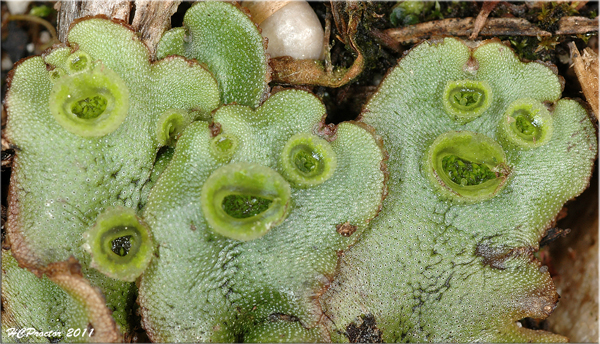
One plant that won’t pay much attention to the Frost Monster will be my favourite weed: the thallus forming liverwort Marchantia polymorpha Linnaeus. Many liverworts look much like the mosses with which they used to be grouped, but marchantia looks more like a lurid green lichen with tentacles (females) or parasols (males) than your typical bryophyte. It does well on wet soil and may annoy greenhouse owners and some gardeners.
I suppose if I were trying to grow ferns but all I ended up with was more marchantia, then I might be annoyed too. As it is, I chop it up when it is in the way and try to appreciate it when it is growing in some more appropriate space, like around the base of the bird bath.
 Some people think that flies are pesky too, but other than ineffectively swatting at an importune muscid or calliphorid we try to get along with the higher Diptera.
Flies will likely be the first active insects next spring, so I think I’ll say goodbye to summer by revisiting some of the smaller and more interesting flies of the year.


 And lets not forget the bugs that will soon be memories too.


Saturday, August 20, 2011

Mugging with Monochamus


I’ve been religiously reading Compound Eye and trying to improve my photographic technique while sticking with my convenient point-and-shoot camera. I think I’m getting a few pictures that speak more to the strengths of my camera than to my desire to document a species, as with the long-horned beetle above and its impressive antennae. But I had a bit of a letdown this morning when I saw that the Edmonton Journal article on the White-tailed Bumblebee has eschewed my pictures in favour of my wife’s (although still attributing the picture to me). Oh well, my bee pictures were for documentation anyway, but this beetle view was for fun.
 One advantage of a point-and-shoot is one-handed snaps as above, a more difficult feat with a heavy SLR. The White-spotted Sawyer Beetle, Monochamus scutellatus (Say, 1824), is probably better known in Alberta as the Tar Sands or Oil Sands Beetle. When a conifer is damaged, a variety of volatile chemicals are released, and sensors in the long antennae allow the female beetles to track down a good tree in which to lay their eggs. The larvae then burrow in the wood for a couple of years. Apparently the tar sands emit similar turpentiny smells and keep the beetles a buzz.
 Sawyer beetles are rather large: the White-spotted Sawyer above was about 2.5 cm long with an antennal span of 7-8 cm. I once had a job sawing off all the limbs, one by one, from the ground to the top of live, standing fir trees. I still remember the shock when large sawyer beetles would crash into me while I was dangling 30 or 40 feet above the ground. It did make one appreciate their safety ropes. The beetles may have appreciated the results of our work – a limbless tree that looked more like a telephone pole – but I don’t think the poor poplar branch boring longhorn beetle (Oberea quadricallosa LeConte) above will be able to appreciate much of anything without its antennae. Who knows what disaster befell the beetle, but it may have been ants tending aphids and objecting to its feeding on a poplar leaf. As you may note from the clarity of the picture, this one came from my wife's Nikon SLR.

Monday, August 15, 2011

Bumbling with Bombus: the late lucorum

A new insect in the Home Bug Garden, unless it is a new mosquito, is always a welcome occurrence. But when it comes in a group that we thought we knew pretty well, it is especially interesting. Last week this largish white-tailed bee arrived - just after I had just told a colleague in Calgary, that we don't have them here in the HBG.
You would think that bumble bees (aka bumblebees) would be fairly well known. They are large, brightly coloured, industrious, more or less likable insects and well known for being good pollinators. Many dozens, perhaps hundreds, of scientific studies have been conducted on North American bumble bees and one would hope that the scientists were sure of their bee species. However, bumble bee colours are not to please us, but to warn potential predators that they taste terrible and have a large sting to boot. It helps to get the message across to birds and other insectivores when bees look more or less alike - hence the convergence in colour patterns that makes, for example the tricoloured bumble bees, so difficult to tell apart. This is officially known as Müllerian Mimicry (as opposed to Batesian Mimcry where tasty, harmless animals tend to look like nastier ones) and it occurs among the white-tailed Bombus (Bombus) species too.
The complex of white-tailed bumble bees has variously been called the terrestris-complex or the lucorum-complex after two well known Eurasian bumble bees. However, in 1990 two Swiss scientists and one from Calgary got together to show that the 'lucorum' in North America had different enzyme loci from European lucorum, but ones identical to the more mysterious Bombus moderatus Cresson, 1863, known from Alaska, the Yukon, the old Northwest Territories, northern British Columbia and down the Rockies to Jasper and Banff (the southernmost record) in Alberta. More recently it has shown up in Calgary and is featured at Robert Bercha's Insects of Alberta. Now this bee seems to have colonized Edmonton.


Thus we seem to have a name for our mystery Bombus - but unfortunately B. moderatus was identical in the enzyme loci to several other named Bombus species including one with an older name Bombus cryptarum (Fabricius, 1775). More recent studies by Andreas Bertsch and his colleagues have shown that Bombus moderatus from Alaska and Alberta and B. cryptarum from Europe have very similar, although not identical, 'barcodes' (a region of the mitochondrial gene cytochrome oxidase I). So, eventually what was once known as Bombus lucorum and now probably better called Bombus moderatus, may one day be called Bombus cryptarum.


Update: The BugWhisperer has found Bombus moderatus in his garden in Edmonton. Also, a friend collected several males to the west of Devon last Friday (19 August 2011). That is a probably a good sign, or at least will be if new queens of B. moderatus soon follow. Yesterday I noticed a number of males of what may be Bombus rufocinctus at my fireweed. I guess the bees think summer is coming to an end.


References


Berstch A. 2010. A phylogenetic framework for the bumblebee species of the subgenus Bombus sensu stricto based on mitochondrial DNA markers, with a short description of the neglected taxon B. minshanicola Bischoff, 1936 n. status. Beiträge zur Entomologie 60: 471-487.

Scholl A, Obrecht E & Owen R. 1990. The genetic relationship between Bombus moderatus Cresson and the Bombus lucorum auct. species complex Hymenoptera: Apidae). Can. J. Zool. 68: 2264-2268.

Update: Thanks to Cory Sheffield for pointing out this beautifully written article by Robin Owen at Mount Royal on Bombus moderatus.


Thursday, August 11, 2011

Aculeata Agonistes: Yellow-faced Bees (Hylaeus)

Hylaeus is a large genus (~900 species) of mostly very small bees (5-6 mm long is common) in the family Colletidae. They are worldwide in distribution and especially diverse in temperate to subtropical Australia. Hylaeus also do reasonably well in the temperate to boreal areas of North America (55 species north of Mexico). Tatiana Romankova of the Royal Ontario Museum estimated that at least 13 species of Hylaeus occur in Ontario (Romankova 2007) and 7 of these species may also occur in Alberta. She provides a key to the species in Ontario, but I’m not sure how useful it would be here, since we probably also have species not represented in the East.
Most Hylaeus nest in cavities such as hollow stems, beetle galleries, or nail holes in wood. So, planting shrubs with hollow stems or making drilled-bee homes should help to attract them to your yard. Some species have more specific nesting sites such as empty plant galls or the cavities in volcanic rock (Michener 2007). The latter habit is probably useful in Hawaii where Hylaeus is the only genus of native bees. Sixty different species are known in the Hawaiian Islands today and they appear to have arisen from the successful colonization of the Island of Hawaii by one species (probably from Japan or another part of eastern Asia) about a half million years ago (Magnacca & Danforth 2006).
Hylaeus are very unusual bees. They have few of the branched body hairs that are the definitive character that separates bees from their close relatives the hunting wasps. They also lack the specialized tufts of hairs (scopa) or leg basket (corbicula) that other bees use to collect pollen. In fact, they are so wasp-like that one species has been used to fool entomologists on a Monday Night Mystery at the Myrmecos Blog. Bees are just a branch of the hunting wasp lineage and so the ur-bee must have been rather waspish.
Are Hylaeus, then, among the most primitive bees? Not according to a recent molecular phylogeny of the Colletidae (Almeida & Danforth 2009). Instead, Hylaeus species appear to be relatively recently derived within the Colletidae and their particularly un-bee-like appearance and habits are relatively recent evolutionary innovations. This includes behaviours such as ingesting both pollen and nectar that they carry in their crop and use to provision their nests with the liquid mixture. This is very similar to what Pollen Wasps (relatives of the yellow jackets: Vespidae, Masarinae) do, but both cases seem to be parallel derived behaviours and not vestiges of the proto-bee.

Hylaeus species are known to visit a variety of flowers for nectar, and since the pollen is not easily collected out of the bees, it had been assumed that the bees are pollen generalists as well. However, Virginia Scott (1997) studied three species of Hylaeus in Michigan and found that all were specialized on pollen from members of the rose family (Rosaceae). The hard outer coating of pollen survives digestion and Dr Scott had the fun job of collecting Hylaeus larval fecal pellets, making slide mounts, and identifying the pollen. Much of scientific research consists of equally fun jobs, but I hope Dr Scott developed an appreciation for the wonderful form of pollen grains. In any case, hers is the only good study on the pollen habits of Hylaeus that I could find. At her study site cinquefoils (Potentilla), blackberry and its relatives (Rubus), and meadowsweets (Spiraea) were the preferred foods.


The Home Bug Garden has many Rosaceae, including representatives of all three genera, at least in the old sense of Spiraea which included goatsbeards (Aruncus) and Queen-of-the-prairie (Filipendula). We also have many bushes with hollow stems, holes drilled into logs and boards, and are graced by some of The BugWhisperer’s experimental bee hotels. Perhaps all of these have come together in this rather dreary summer to make the Home Bug Garden a good habitat for Hylaeus.


References:

Almeida EAB & Danforth BN. 2009. Phylogeny of colletid bees (Hymenoptera: Colletidae) inferred from four nuclear genes. Molecular Phylogenetics & Evolution 50: 290–309.

Magnacca KN & Danforth BN. 2006. Evolution and biogeography of native Hawaiian Hylaeus bees (Hymenoptera: Colletidae). Cladistics 22: 393–411

Michener CD. 2007. The Bees of the World, 2nd Ed. The John Hopkins University
Press.

Romankova TG. 2007. Bees of the genus Hylaeus of Ontario (Hymenoptera: Apoidea: Colletidae). J. ent. Soc. Ont. 138: 137–154.

Scott V. 1997. Pollen selection by three species of Hylaeus in Michgan. Journal of the Kansas Entomological Society suppl. (1996): 195-200.