Friday, February 10, 2012

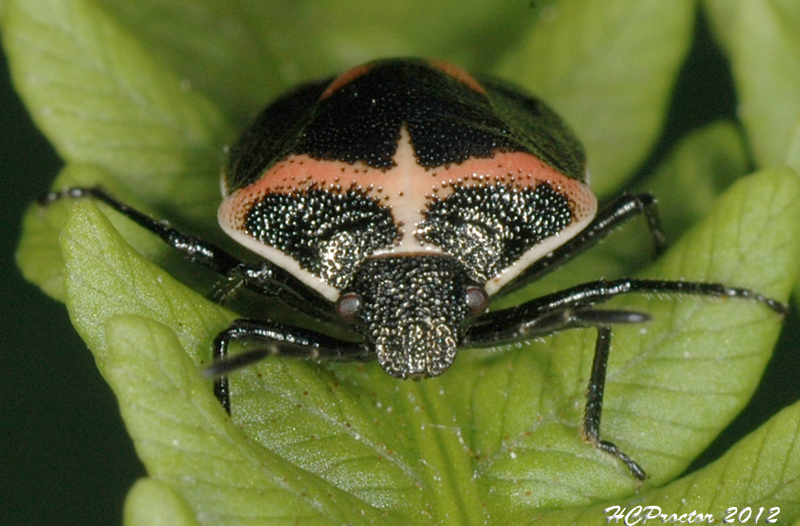
Friday Bug: Ebony Bug Corimelaena

Ebony Bug on goldenrod
Time flies quickly when you are bug blogging. Here it is another Friday and time for a bug post. In the interests of brevity, I offer you an Ebony Bug, Corimelaena sp. (family Thyreocoridae). And brief it is - about 3 mm long. Looking somewhat more like a beetle than a bug, and reputed to feed on flowers, seeds, and fruits of many plants, this is still a welcome addition to the garden. They are common enough in the summer, but never associated with any noticeable damage - the perfect garden herbivore.

For some reason not at all obvious to me, Ebony Bugs used to be called Negro Bugs (and still are in most texts). I've been trying to decide how I would feel if there were a family of pale bugs with red noses that were called 'Caucasian Bugs'. I've decided it would be strange, but people are strange and I'd probably just scratch my head and go about my business. But then, I do like bugs and not everyone feels that way.

Wednesday, February 8, 2012

Wild Flower Wednesday: Alberta's Provincial Flower

Longhorn Beetle  Clytus ruricola  probably doing a fair job of pollinating an Alberta Wild Rose
What better way to re-start Wildflower Wednesday than with the official Provincial Flower of Alberta: Prickly Wild Rose Rosa acicularis (aka Arctic Flame)? Well, there are roads reputed to be paved with such good intentions. I've assumed our wild roses were acicularis, but a little bit of research shows that there are actually 4 species of wild rose reported from Alberta.
Flower colour varies within a species and in age of bloom, but this bumble bee is a good pollinator: Bombus ternarius
 The USDA lists Rosa acicularis, arkansana, blanda, and woodsii in Alberta. Unfortunately, the USDA maps show distributions only by state/province. If the species is there in said political entity, then the whole province gets coloured-in. Finer details like ‘does it grow on my land’ are obscure. Still, painful experience assures me we don’t have Smooth Wild Rose (R. blanda) – it has few thorns. Also, the above ground canes of insidious thorns persist, so it seems unlikely we have Prairie Rose (arkansana), which dies back each winter.
Looking more globular than pear-shaped,
these hips are probably Rosa woodsii
That leaves us with the Provincial Flower, Prickly Wild Rose, and the other, just as prickly, Wild Rose (Rosa woodsii). For most characters, these species overlap – and in fact they hybridize - so intermediate forms may be common where they overlap in distribution (aka where I live). The easiest way to tell these species apart is by the distribution of prickles and glandular hairs in relation to the stipules, but this is getting pretty technical and not possible to resolve from photographs. I will say that I did key out one plant to acicularis, but most of the pictures I have on hand seem more likely woodsii. I probably have a mix of both species.
Added bonus - prickly leaf galls caused by
minute gall wasp Diplolepis bicolor
Seems like I will need to wait until next summer to do a more thorough analysis of what wild roses our lands are supporting, including the one started from a cutting that is now occupying a good portion of the backend of the Home Bug Garden. Until then, take my word for it – both are excellent for pollinators and both host a diversity of other interesting insects. One great example, is a tiny wasp (Diplolepis bicolour) that causes Prickly Rose Gall on the leaves. And these galls, in turn, host other insects. You can barely discern one to the left in the picture below - another tiny wasp artfully inserting its eggs into the gall - probably so its larvae can eat the wasp that made the gall.
Tiny chalcidoid wasp putting its eggs into a Prickly Rose Gall
Colourful fungi like the rose rusts (Phragmidium spp.) also make use of our wild roses. As long as they leave our domestic roses alone, I don't think I mind the rusts eating the wild roses.
Aecial stage of rose rust on Wild Rose (probably R. woodsii)

Monday, February 6, 2012

Myco Monday: Eyelash Pixie Cup

Scutellinia scutellata
As part of my continuing efforts to serve my vast (imaginary?) readership, and also demonstrate that I can just shut up and blog, I introduce another new and semi-regular feature: Myco Monday. And what better way to start off than with a lurid red wink from a Eyelash Pixie Cup Scutellinia scutellata (L.).
Black 'eyelashes' on margin of cup
Don't expect too much from these posts - just a pretty fungus or two and maybe a comment from the mushroomer's bible - "Mushrooms Demystified" - by David Aurora. In this case he doesn't say much re their edibility "much too puny to be of any importance". That's because they are only about a centimetre in diameter. Although ascomycetes, like the morels, these are not on anyone's list of delectables. I don't know of any insects or mites that eat the Pixie Eyelash Cups either, but you can find them on moist, rotting logs. Although small, they are larger than many cup fungi and always a pleasure to find.

Saturday, February 4, 2012

(Self) Pollinator of the Week: Cave hortulanus Impatiens capensis!

A jewel and a weed!

In my experience, New Year’s resolutions rarely make it through January. One of mine this year has been to expand my ‘social media’ output (in preparation for a symposium here in November). This means learning Google+, increasing my rate of posting at my blogs, and analyzing what other bug bloggers are doing. One thing I’ve noticed at other bug blogs is that those that maintain a high rate of posting tend to keep most posts short and sweet – a picture and a paragraph or two.
Jewelweed or Touch-Me-Not
 In contrast, my posts tend to be long and wordy. Inevitably, what should have been a pleasant weekend hour posting a picture or three and some ruminations on insect conservation morphs into a weeks-long struggle with the literature. These habits come from too many years of lecturing and are hard to break.
Ruby-throat hummer - likes Jewelweed and is probably a good pollinator
 Of course, this is the fun part of bug blogging – learning something new – and then telling someone about it. But I have folders filled with uncompleted posts that turned out to be far more complicated than I had expected or where some critical facts or photographs were unavailable or where I just ran out of free-time and energy. At least I got paid for lecturing: blogging is supposed to be a hobby (i.e. relaxing).
Attractive, but especially so to insects & hummingbirds
 So, here’s my New Year’s Resolution: learn to shut up and blog. Regular weekly posting themes seem to work well unless you run out of images (e.g. Sunday Sawfly). So, Friday Bug has been up two weeks now (and weeks of pictures to go) and today I am starting Pollinator of the Week.
Fly on flower: probably less than it seems
 For ‘Pollinator’ to make any sense, though, I will need to make clear the difference between an insect on a flower and pollination. The picture above is more likely of a root-maggot fly resting on a flower, than a pollination event. In previous years, I would have spent the next week or two trying to determine how much was known about anthomyiid flies and pollination. This year I am considering that approach irresolute.
Bumblebee & Jewelweed:
begatting as in the Bible
 The bumblebee (Bombus vagans), however, is clearly covered in pollen and doing its best to show the Jewelweed (aka Spotted Touch-Me-Not, Impatiens capensis) a good time. 
Seedpod - begat through an ecosystem service
That is what pollinations is all about – moving plant sperm (aka pollen) to receptive female parts (aka stigmas), and setting seeds. In the case of Touch-Me-Nots, these seeds come in a pod that at maturity will explosively discharge the seeds upon a touch - scattering most over good distances.
Touch-Me-Not touched (one seed retained)
 But if the soil is too dry or otherwise unsuitable, Jewelweed can suffer from erectile dysfunction – the flowers fail to open and release their pollen. Unfortunately, crosspollination is only an option for Jewelweed, not a necessity – they also indulge in cleistogamy – self-fertailzation within closed flowers.
Not yet open, but not cleistogamaous
 Spotted Touch-Me-Not is a great wildflower that is attractive to bees and hummingbirds. But it is also a weed. Thanks to its ability to explode its seedpod and fling its seeds far and wide, it will rapidly colonize any damp spot in the garden.
Cleistogamy - these flowers will never look better
 Even if the plant can only grow a few centimeters tall, it can generate new seeds through cleistogamy and continue its conquests. The only sign of salvation showed up last year – a sawfly found on the Jewelweed. Unfortuantely, finding an herbivore on an herb is no more informative than finding an insect on a flower. We didn’t observe the sawfly feeding and found only one, so possibly it was in transit to hibernating in the soil.
Sawfly on Jewelweed - maybe help is on the way
 Cave hortulanus is Latin for ‘Let the gardener beware!’ This applies to Jewelweed. Although not hard to pullout, Jewelweed is so prolific and self-regenerating, that your garden will soon have a permanent understory of bloomless weeds. Best leave this one in the wild.
Jewelweed where it belongs
Note: this is one of those posts that I started last year and never finished, but Wednesday Wildflower will also be making a comeback - hopefully in a less prolix form than this post.

Friday, February 3, 2012

Friday Bug: Ice Boatmen

April gathering of the Water Boatpeople

Bugs in the family Corixidae are called Water Boatmen and they are nice bugs, or at least won’t bite you as many water bugs are wont to do. Instead they row through the water collecting algae, small invertebrates, and fine organic material. In another sense, though, corixids are annoying: they are the most diverse water bug family in Alberta, but also the most difficult to identify to genus and species.
Sun + dark bodies = melt
 Most Water Boatmen (and Boatwomen) overwinter as adults and mate in the spring. Here in Alberta you can find clusters of them melting out of lake ice in late spring (these shots are from April). Their dark bodies warm and melt the ice around them, presumably giving them an advantage in finding the first mates. These bugs have been to BugGuide, but are still unidentified beyond family. A tough, but interesting group.

Friday, January 27, 2012

Friday Bug: Cosmopepla and Stachys

Two Twice-stabbed Stinkbugs do their thing on a bed of Hairy Hedgenettle
Bug blogging is fun, but also a chore that I find hard to keep near the top of the list of things to do. A major reason for that is my tendency for prolixity and another is that once I start a post I tend to get interested, dig deeper, and blather on. I guess those two reasons are actually one and the same and the solution obvious: a day with only short, simple posts. Here's a bug: isn't it pretty (not a question).
More 2-stab bugs with flowers
 So, here’s my new attempt to increase my productivity but reduce my prolixity: Friday Bug. First up is the Twice-Stabbed (i.e. two blood-red spots) Stinkbug now correctly known as Cosmopepla lintneriana Kirkaldy, 1909 (but with one of those long and complex nomenclatorial histories that I tend to run on about – short story: it was once Cimex carnifex Fabricius, 1798, then Pentatoma bimaculata Thomas,1865; and later and best , but wrongly, known as Cosmopepla bimaculata (Thomas, 1865)).
Twice-stabbed is a point of view
One of the interesting things about the Twice-Stabbed Stinkbug is that it seems to prefer to mix sex with flowers and so one has the opportunity to obtain colourful images. One can even find aggregations of butt-to-butt bugs on flowers; perhaps, as a result of males emitting a chemical scent that attracts females (and perhaps other competing males).
Bugs with purving crane fly
 Additionally, of course, stinkbugs are interesting because they stink. Krall et al. (1999) can tell you all about the chemical composition of the stink glands (aka metathoracic glands). More interestingly, they observed bugs have a good deal of control over their metathoracic glands and can shoot off one or the other or both if they so desire. Also, they nicely demonstrate that birds and a lizard are repulsed by bugs with full stink glands (but not with depleted glands).
Pasque flower seeds spark bug passion
Apparently, Ted MacRae’s cat likes to eat Twice-stabbed Stinkers, but in general, the bright black and red colouration and stink gland chemicals probably act as warning and revulsion to visually orienting vertebrate predators.
Yes, I smell and taste bad: Beware!
On a final fine note, the Twice-Stabbed Stinkbug has actually been studied in Alberta – and even better – the brief paper is now freely available.
Just hatched on a pea leaf - not a good sign
Only a few entomological journals are open access – Psyche and The Florida Entomologist come to mind. But the late, great Quaestiones Entomologicae has now joined these ranks thanks to the generosity of the many authors who have made their papers available under Creative Commons Attribution-Noncommercial-Share Alike 3.0 United States License and Kipling Will at the University of Califonria Berkeley who digitized the papers.
Twice-stabbed nymph in flower cluster
The Twice-Stabbed Stinkbug is a host generalist, but feeds almost entirely on seeds. So, finding them on your peas is not good, but on your garden flowers, not so bad. In Alberta, one preferred host is hedge nettle Stachys palustris. Well, that is what I thought anyway, but it isn’t only bug names that change. It seems former subspecies is now considered a distinct species by some: Stachys pilosa – Hairy Hedgenettle.
New & improved Stachys pilosa
In any case, except in New Jersey where a subspecies of S. pilosa is considered endangered, hedgenettle is doing fine and Twice-stabbed Stinkbug can’t be considered much of a pest. However, there is a crop species of hedgenettle – the Chinese Artichoke (aka Crosne, Chorogi) Stachys affinis.
Chinese Artichokes in Year III - a good crop for those who don't need to eat much
I’ve been trying to grow Chinese Artichoke for the last three years here in Alberta. The good news is that so far they have overwintered. The bad news is the tubers haven’t gotten very big (about half of marketable size) and the plants have never flowered. Our growing season is too short. On the other hand, no flowers = no seeds. So, Twice-stabbed Stinkbug will never be a pest and crosnes never a weed (they are naturalized in New York). Well, not a short and sweet post, but at least done and on Friday.
Crosne yield after 3 years (less nibbles)

References:

McDonald JD. 1968.  The life history of Cosmopepla (Thomas) (Heteroptera: Pentatomidae) in Alberta  Quaestiones Entomologicae 4 (2): 35-38.http://nature.berkeley.edu/%7Ekiplingw/QE%20documents%20for%20public/McDonald%201968%20QEv4n2%2035_38%20CC%20released.pdf

Krall BS; Bartelt RJ; Lewis CJ; et al. 1999. Chemical defense in the stink bug Cosmopepla bimaculata . Journal of Chemical Ecology 25 (11): 2477-2494   DOI: 10.1023/A:1020822107806
http://www.ars.usda.gov/research/publications/publications.htm?seq_no_115=100746

Sunday, January 15, 2012

Clivia Foodweb: Part II

Simple Food Chain: bulb - mite - mite
A few weeks ago I introduced the actors in the unfortunate demise of one of my favourite bulbs, a hybrid Clivia. Above is a simple food chain showing the relationships between the three most important species. Red arrows point to the consumer from the organism being consumed: what is eating what. The primary miscreant in this story is the Bulb Mite Rhizoglyphus robini Claparède, 1869. Bulb Mites are major pests of stored bulbs and of field crops such as onions. The predatory mite Gaeolaelaps aculeifer (Canestrini, 1884) is known to be an effective biological control agent. Well, the most abundant predatory mite in my Clivia pot turns out to be this same predator. So why did my bulbs still rot and die?
Bulb Mites don't eat just bulbs
Well, one reason is that Bulb Mites don't just eat bulb tissue. In fact, they would probably starve if all they had to feed on was healthy bulbs. Instead, they vector microbes that rot the bulbs and are attracted to small wounds on a bulb which they inoculate with disease causing microbes. Bulb Mites get most of their nutrition from these microbes. The bad (and opportunistic) microbes eat the bulbs. The predatory mites can do little to save a bulb that is already being eaten by microbes, but they may reduce the population of mites enough so that other healthy bulbs do not get infected.
A more representative food web
A second reason that the Predatory Mites may not have saved my Clivia is that they are not specialist predators on Bulb Mites. Gaeolaelaps aculeifer are very aggressive and will attack and eat any small arthropod or worm that they can overcome. The soil extracted from the Clivia pot had lots of tiny worms and tiny arthropods to distract the Predatory Mite from doing its job. Soil has many bacteria and fungi that live off of nutrients that leak out of roots or are present in humus and these microbes are necessary to healthy soil. These microbes are the primary foods of most of the small mites, springtails, and worms that live in pots with healthy plants.
Actors in the Clivia soil food web
Each of the three representations above of what is eating what have gotten more and more complex. The first is a simple food chain that represents the most important elements of the story if your primary interest is growing healthy bulbs. The first level of the chain is a primary producer (Clivia) that captures sunlight and makes plant matter. The second a primary consumer, the Bulb Mite. The third a secondary consumer, the Predatory Mite. Each of the next two representations of the feeding interactions adds more reality and complexity: a simple chain becomes more like a web of interactions. But the Clivia extractions had a dozen species of arthropods: 8 species of mites, 2 of springtails, and 2 of rove beetles.
A soil food web based on Clivia bulbs
This is the best that I can do to enumerate the feeding interactions in one pot of soil with a couple rotting Clivia bulbs. The good news is that except for the two species of bulb mites, the other animals are harmless or beneficial. The Rove Beetles are probably the top predators in this system - munching on all the smaller arthropods and worms. But I haven't found any papers that give details of their diets other than that Anotylus insecatus is known too feed on bulb maggots. Besides, if I had to draw in arrows linking the Rove Beetles to their probable prey, then things would really get messy. But, that's the way Nature operates.