Showing posts with label Australian of the Week. Show all posts

Wednesday, February 19, 2014

A Big Wig in the Moth World: Emperor Moth

Emperor Moth Syntherata sp.
The rains continue to scuttle-by the Gympie Region, so the rainy season so far has been a bust. But outside the relic rainforest regions, the climates in Australia always tend towards drought and flood with years of 'normal' rainfall not all that normal. The last few years have been flood in southeast Queensland, so drought is to be expected sooner or later. Last night, though, it looked like relief was in sight. A heavy cloud cover blew in, the moon disappeared, the humidity rose, and it looked perfect mothing weather until the rains came. The mothing was quite good, but the rains never came.
Underside of "Empress" Moth
Most of the moths were still on the small-size, but a handful of the medium-sized fluttered in and two on the large end of the spectrum: an as yet unidentified underwing and this striking Giant Silk Moth (Saturniidae). She is a bit battered, but still rather majestic with a wingspread of 12cm or so. She is a member of the genus Syntherata, either S.  janetta (White, 1843) or the more recently described S. escarlata Lane, Edwards & Naumann, 2010.  Apparently, the females are highly variable and the new species is difficult to separate from the old.
A pair of mystery moths of the micro and macro persuasions
So, although the garden is bone dry, I now have a handful of pictures of mostly attractive and interesting moths to try to identify and learn about. The most difficult are the so-called micro-moths:  a large number of families of small to tiny moths. Identifying them usually requires pinning with the wings spread and dissection of the genitalia. That is too barbaric for me (aka it's too much work), so I will putter around with the more accessible macro-moths. The (~4cm long) macro-moth above maybe in the family Cossidae, but if so it is one of the smaller members of the family that includes the Witchity Grubs. Unknown moths are always more fun, at least up to a point: they are a great excuse to while away the hours looking at pictures of one of life's most colourful groups of animals. 

Reference
Lane DA, Edwards, E.D.; Naumann, S. 2010. A revision of the genus Syntherata Maassen, 1873 (Lepidoptera: Saturniidae) within Australia, with the description of three new species, and description of their life histories. European Entomologist  3(1): 1-41.

Sunday, March 24, 2013

Home Bug Garden: Austral Version

Toothed White Banded Moth

There is a land far, far away, where the summers are as long as an Alberta winter and the winters as mild as an Alberta summer. Once, long ago, I inhabited such a dreamland. I was content with the land, if not the job, but the Home Bug Gardener's other half was content with neither and longed for the cold, dark whiteness of the North. White is a funny shade: it reflects all light and so seems to dominate the mind. For example, the large Toothed White Banded Moth Donuca orbigera (GuenĂ©e, 1852) above is more brown than white, but is not known as the 'brown-banded white moth'. It is related to the Alberta Underwing Moths (Noctuidae: Catocalinae) and the Fruit-piercing Moths that are such pests here. Larval hosts for the caterpillars of this moth are apparently unknown, but may possibly be trees in the genus Acacia.
Glasswing or Little Greasy Butterfly
Sometimes white can fade away to nothing but a smear (or a mess, as in the Alberta thaw) as with the Glasswing or Little Greasy Acraea andromacha (Fabricius, 1775). For some reason, the scales are shed from the front wings of this Nymphalidae butterfly (related to the Monarch, Painted Ladies, Satyrs - but in a different subfamily - Acraeinae). Caterpillars feed on the leaves of Passionfruit vines (Passiflora) and Spade Flower (Hybanthus spp.). Believe it or not, Spade Flowers were once put in the genus Viola and are still retained in the Violet family.
A Spade Flower, possibly Hybanthus enneaspermus 
Not all Queensland butterflies are white or greasy (although some Papilionidae also have transparent front wings). Most are quite spectacular, for example the Common Eggfly  Hypolimnas bolina (Linnaeus, 1758).
Male Eggfly showing eggs in wings
This is another Nymphalidae and in the nominate subfamily. It is a large butterfly and the males patrol territories about 30m long on gravel roads and trails in the hereabouts (near Miva, Queensland). The upper surfaces are brilliantly iridescent purple in the sun.
A female Eggfly, Sunshine Coast Hinterlands version
In contrast, the female is spectacular too, but looks nothing like the male. Here in the Sunshine Coast Hinterlands, she may be trying to look like a cross between a Lesser Wanderer and an Orchard Swallowtail. I don't know, but the female morph varies geographically and tends to look like distasteful crows (Euploea - another genus of Nymphalidae).
Love Flower  Pseuderanthemum variabile
In Queensland, the Eggflies use a plant with a vaguely violet-like flower as their primary host - the Love Flower Pseuderanthemum variabile. Although these plants look a bit like violets and grow on the forest floor, they actually belong to the family Acanthaceae. You can watch the females seemingly ovipositing in the ground near the plants. Or, perhaps, they are just practicing. In Australia, one must always test one's assumptions.
A Dainty, Dingy or Small Citrus Swallowtail
For example, consider the butterfly family Papilionidae, better known as Swallowtails. Above is a female of Papilio anactus Macleay, 1826. This butterfly goes by a number of nome de plumes, but I prefer 'Dainty'. But 'swallowtail' wherefore art thou? Clearly this 'swallowtail' is laying eggs on the orange tree out back, but swallowtail seems to be stretching a point. In Australia, it is always a good idea to leave your preconceptions behind, if visiting from a more northern locale.


Sunday, January 13, 2013

Adventures in Spider Misidentification: Spitting Scytodes

Spitting Spider Scytodes cf thoracica (Latreille, 1802)
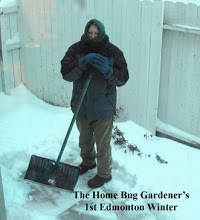
Finished sweeping yesterday's snow off the walkways, had my coffee, and now it's time to get back to work. Sunday should be, at least in part, a day of rest, even if a deadline is fast approaching. Chapters won't write themselves, of course, but this week looks like working at a computer would be preferable to being outside. Average weather in Edmonton is an oxymoron: Pacific Lows and Arctic Highs push back and forth showering us with extremes. This week looks to be a depressing and Vitamin D-free seesaw of snow, sleet, ice and sunless days. So how about a quick dissemble to a sunnier clime with an ancient photo of a Spitting Spider?
Looks like a week for the snow shovel and ice scrapper
I think this is the cosmopolitan Scytodes thoracica (Latreille, 1802) and, although she inhabited our closet in Brisbane, one might find a similar slowly stalking spitter in many closets in North America. The Spitting Spider spits silk from its chelicerae (fangs) to tie its victims down before eating them. At first this seems strange: silk should come from spinnerets at the other end of the body. But, like most things arthropods do, it is really the jointed limbs that are the key. The fangs are just the first pair of limbs modified for feeding: spinnerets are derived from couple of pairs of more posterior limbs. Arthropods are composed of a series of what were originally very similar segments, each with a pair of limbs and each with the genetic potential to produce silk (silk is, basically, an excretory product). Scytodes are unusual spiders only in that they have turned on the silk producing abilities of the segment bearing their fangs.
More than somewhat alien-looking and silk issues from either end
But in a sense, this is reverting to what most silky arachnids do. Pseudoscorpions and mites, for example, also produce produce silk from their mouthparts and some mites use silk to trap prey (Spinibdella, a genus of snout mites being one such). Pseudoscorpions use their silk to make nests in which to hide away, as do many mites.
Silken cells under bark and some exposed pseudoscorpions
Of course, the gardener's least favourite mites, spider mites, also spin silk, but from their second pair of limbs, the pedipalps. Unfortunately, spider mites feed on plants and not on each other, but use silk much like many arachnids - to make nests and even to disperse on the wind - a method analogous to ballooning in spiderlings.
Two-spotter Spider Mites resting, moulting, and laying eggs in their web 
Come to think of it, we tend to assume what is most common is normal. Spiders are our common experience of silk spinning in arachnids and arthropods in general, but they are the only ones I can think of that produce silk from limb remnants near the middle of their body (over time, the spinnerets have become less limb-like and moved rearward - see the 'living fossil' Mesothelae). Tarantulas were once rumoured to produce silk from their feet, but this hypothesis seems to have come from too much Spiderman and not enough experimental rigour. Even caterpillars produce silk from their mouthparts and the only insect that I know of that has silk producing legs (Embioptera) uses its front feet.
Sticky feet yes, but not silky
Well, enough bludging for a Sunday morning - but not all in vain. I discovered a lapse I'd make yesterday about where silk in sea spiders (Pycnogonida) comes from - and learned that spiders are stranger than I thought.

Thursday, April 5, 2012

Australian of the Week: Mystery Oedomerid Maybe

Spring in the Home Bug Garden - 5 April 2012
To paraphrase what a friend of Samuel Clemens allegedly said several times, 'the Home Bug Gardener often complains about the weather, but never does anything about it'. Well, after today's heart-attack cum hernia snowstorm, I'm doing something: indulging in nostalgia for a warmer climate without tons of snow that need moving.
Sulphur-crested Cockatoo - Qld version of snow
I once saw frost in Brisbane, in an open field on a cold winter morn, was once snowed on while driving on the New England Tablelands, and saw snow on the ground in the Snowy Mountains, Victorian Alps, and Tasmania. That is where snow belongs as far as I am concerned - on the ground and NIMBY! Sure you can see paddocks white with sheep or cockatoos in Queensland, but snow is as rare as the Aurora Australis.
False Blister Beetle - Lamington National Park
So here is a bit of colour from a long lost and much lamented research site, an oedomerid beetle from Lamington National Park (named after the Lord, not the possibly eponymous pastry). Allegedly this beetle (scanned in from an old slide film image) is Agasma semicrudum. But neither the all-knowing Google nor the Web of Science can confirm this and the only citation in the latter is a 20 year old paper in the Young Entomologist's Society Quarterly*. The genus Agasma was moved from the Malacodermidae to the Oedomeridae by Arthur M. Lea in 1909 (London Transactions of the Entomological Society: 45-251), apparently in a small taxonomic spat with a T. Broun (1909. Annals & Magazine of Natural History Series 8, 3: 223-233; 385-415). After this transformation, however, our mystery red and black beetle seems to disappear until the Young Entomologists had a go. Perhaps some beetle fancier can offer some advice?
Food and defence: chrysomelid larvae bums outward on gum leaf
Speaking of Queensland beetles, I used the above picture of a group of grubs of a leaf beetle (Chrysomelidae) as an example of group-feeding/ communal defence in lectures for several years. I always wondered what they might be, and now Myrmecos has offered a possible answer: Paropsisterna. We do have chrysomelid grubs that feed on tree leaves here in Alberta, but they seem to do so singly, so probably lack the cyanidic bums. Willows are a good place to look for them - once the trees have leaves and the snows are well and truly gone.
Chrysomelid grub on willow (probably Chrysomela sp.)
Well, I've had my rant and my rest from shovelling, and now it is time to sand the walkways so the neighbours and ourselves can walk them tomorrow without falling on our bums.
Grevillea coccinna, King's Park, WA

*Mawdsley, J. R. 1992. A new example of mimicry in Coleoptera from Australia. Young Entomologists' Society Quarterly 9(3):21-24.

Saturday, March 3, 2012

Australian of the Week: Blue-eyed Nymph

Blue-eyed Lacewing from Brisbane

As I was contemplating the dreary grey and white morning, and thinking of blow flies, I realized that I hadn’t had an Australian of the Week posting for quite some time. That series was designed to take me away from winter for a moment, and such a moment is now needed. So, herein I present an oldie but goodie: Nymphes myrmeleonoides Leach, 1814, the type species of the family Nymphidae. The original picture was taken with an old-fashioned SLR camera and captured on a material called ‘colour-slide film’, so this is really a bit of nostalgia. The original slide was digitized on an ancient scanner, so the transfer isn’t the best, but will have to do.
Hatched eggs of Nymphes in 'horseshoe' array 
Nymphes appears to be from the French for ‘nymph’, one of those delightful spirits that animate Nature. And these large, antlion-like nerve-winged insects (Neuroptera) are rather delightful. Nymphes eggs are one of the mysteries that I encountered when I first arrived in Queensland – horseshoe arrays of small white blobs on threads. At first I thought they were fungi, but once I saw the tiny gremlins that hatched out of them, I had a better idea. Alas, we have only another old, scanned slide of hatched eggs to offer, but Tony Knight at the Australian Museum has better pictures on offer.
Golden-eyed Chrysoperla chi
 In Alberta, we have no Blue-eyed Lacewings, but we do have a number (four genera, 9 species) of Green Lacewings (Chrysopidae) that often have delightfully golden eyes. Their larvae aren’t as gremlinish as those of Nymphes or antlions, but have their own bug geeky attractiveness.
Aphid lion - larvae of Green Lacewing
 Members of the Nymphidae currently appear to be restricted to Australia, New Guinea, and Lord Howe Island, but in the Jurassic ranged across most of the World. In the early Eocene, a Nymphes apparently lived in North America (Archibald et al. 2009). Alas, no more.
Chrysoperla oculata
 References:

Archibald SB, Makarin VN & J Ansorge. 2009. New fossil species of Nymphidae (Neuroptera) from the Eocene of North America and Europe. Zootaxa 2157: 59-68.

Garland JA & DK Mce Kevin. 2007. Chrysopidae of Canada and Alaska (Insecta, Neuroptera): revised checklist, new and noteworthy records, and geo-referenced localities. Zootaxa 1486:  1-84.

Sunday, April 10, 2011

Australian of the Week: Net-casting Spider

 Winter has somewhat relaxed its grip these last two weeks, enough so that at least one blue-bottle fly. probably Protophormia terraenovae Robineau-Desvoidy, 1830, has been on the wing. After work I’ve been sitting in a lawn chair in a spot of sun in a puddle of snowmelt determined to generate the first Vitamin-D of 2011 and the bluebottle stops by to see if I’m winter kill or not. You’d think from the species name, that the fly (aka Northern Blowfly) would be restricted to the New World, but it is holarctic in distribution and relatively well known for its forensic uses and myiasis problems in livestock and wildlife.
 The fly is too wary for me to get close enough for a good shot with my point and shoot camera, but is familiar enough to induce daydreams about what might happen to the fly if it were in my former backyard in Brisbane, where a striking diversity of spiders were in residence year-round. One of my favourites was the Net-casting Spider, a species of Deinopis, probably Deinopis subrufa L. Koch, 1879. These are ambush predators that dangle from a scaffold web by their back two pairs of legs while holding a densely woven net in the front two pairs. Any insect that wanders or flies too close is snared and eaten. This behaviour has also earned them the name Retarius Spider from the Roman gladiators who fought with a net, trident, and dagger. Another name is Ogre-faced Spider – because of the very large median eyes that no doubt help coordinate the net-casting. We don’t seem to have a good frontal picture, but Robert Whyte has posted a striking portrait on flicker.
  April 5th marked the first observation of a Milbert’s Tortoiseshell Butterfly (Aglais milberti) in the backyard with its bright colours and intriguing white tips to its antennae. A lone Ring-billed Gull showed up on 31 March and a Robin yesterday (9 April), so in spite of the deep snow pack and cooler than normal temperatures, spring does seem to be in the air. In my records (which only go back to 2005), the Ring-billed Gulls always show up in the last week of March – and since they are large and loud, they are hard to miss. The tortoiseshell sightings are more variable (5-17 April), but these depend on the happy coincidence of a sunny day and time for me to enjoy it. The Robin, and a couple of Honkers that showed up on April Fool’s Day, are both within the two week window in my records, so at least the animals around here think spring is coming at more or less the normal time. Time to set up a couple of blue bird houses at the Moose Pasture and then start shoveling the snow away from the house foundations. The water level is already getting close to the top of the holes in the basement floor.

Tuesday, March 1, 2011

Australian of the Week: Agarista agricola (Donovan, 1805)


This Winter is definitely getting to me. Snow yesterday, -31 C this morning (and -39 at Elk Island), -30 and snow tomorrow. Although the Alberta Lepidopterist Guild had an entertaining Feralia Symposium this weekend and Terry Thormin, snug on Vancouver Island, is already posting new insect pictures on the Albertabugs, it looks like it will be many more cold, cold weeks until the first flies of spring. Rather than carp about the cold, though, I’m instituting a new semi-weekly feature in which I get to reminisce about a warmer land: Australian of the Week. Many of these pictures will have been scanned from 35mm film, but that was the technology at the time.

First up is the Joseph’s Coat Moth Agarista agricola (Donovan, 1805), from the biblical story (or the Dolly Parton song if you prefer). This is a large moth – and it flies during the day when its bright colours tell potential predators just how bad it tastes. Most brightly coloured diurnal moths are probably loaded with nasty chemicals (or at least pretending they are) – and they seem to be popular on bug blogs like Beetles in the Bush and Myrmecos Blog this week.

This particular Joseph’s Coat Moth fell victim to Heather’s camera in a vineyard outside Stanthorpe, Queensland. Stanthorpe is in the Granite Belt – Queenslands best wine country. If you really like red wine, then this is faint praise, but only because the competition is the Coonawarra, Yarra Valley, Eden Valley, Western Australia, Mornington Pennisula, and so on. The Granite Belt wine probably has the potential to be as good as that from the Barsossa Valley, usually about the best Australian wine I can afford in Alberta bottle shops. The Joseph’s Coat Moth is native to Queensland, where it feeds on native vines in the grape family (Vitaceae), and now and then, introduced grape vines.
Alberta has its own colourful day-flying moths that are now more or less in the same family with the Joseph’s Coat Moth. Well, who knows, the taxonomy of the Noctuoidea seems to change daily. Currently, the Police Car Moths I posted on last summer and the equally attractive Ctenucha virginica (Esper, 1794) are in the Erebidae (subfamily Arctiinae). The Joseph’s Coat Moth had its own subfamily in The Insects of Australia, Agaristinae, and maybe it still does, but I’m not sure in what family it currently resides. Should I try to find out or open a bottle of Australian wine to toast the new feature? Ah, if only all choices were so easy!