Showing posts with label updates. Show all posts

Friday, August 10, 2012

Friday Phymatorama: Not as simple as it looks

Ambush Bug eating Cabbage White on Canada Thistle
This is the kind of picture any biological control entomologist or food-web modeller can instantly understand. The biocontrol person may see a natural enemy (the American Ambush Bug Phymata americana americana Melin, 1930) feeding on a pest (the Cabbage White Butterfly Pieris rapae (L., 1758)). If they are particularly perceptive, they also see that the pest is a potential pollinator of another pest, the misnamed Canada Thistle  Cirsium arvense (actually a native of Eurasia introduced here). So, the ambush bug is doing double duty. The food-web modeller might see it a little different: predator (bug), herbivore (butterfly), and primary producer (thistle), the typical three trophic-level food chain.
Ambush Bugs transformed into pests
Let's change the set-up slightly and look at another thistle. Here the female ambush bug (guarded by a smaller, darker male) is feeding on a Honey Bee (Apis mellifera L., 1758). The food web modeller doesn't see much different here, although they may wonder if the bugs would be better modelled as parasites of the plant (they are eating its pollinators). But, Hey! That's one of our bees! That bug is a pest, not a biocontrol agent/ natural enemy!
A slight change of focus turns good bugs bad
Let's change focus slightly again and look at another thistle plant. Here another pair of ghoulish bugs have a flower fly (Family Syrphidae: Helophilus sp.) by the tongue and the female bug is draining out its life's blood. Many flower flies are our friends, their maggots eat aphids, but this one's larvae feed on rotting vegetation. So, this is a more neutral interaction for our biocontrol person: the use of an alternative prey by a natural enemy/ pest of bees, depending on their perspective. This does complicate our food web model, though, the adult fly is an herbivore (feeding on pollen and nectar), but the larva is a detritivore (feeding on microbes and detritus), so a fourth trophic level needs to be added to the model as well as some omnivory (defined as feeding at more than one trophic level). The bugs are getting some of their energy directly from the detritivore level (as well as the herbivore level).
Flower fly that should've watched where it put its tongue
Let's shift focus slightly again, to another unfortunate fly. Here another pair of ambush bugs are feeding on a thick-headed fly (Family Conopidae), in this case Physocephala furcillata (Williston, 1882). Well, really the female bug is feeding and the male looking out for any other males that might be interested in his perch (but males aren't above sneaking a bite or two).
Ambush bugs feasting on a thick-headed fly
Our biocontrol specialist is likely to see this as more alternative prey behaviour. Good for keeping a predator around to feed on Cabbage Whites or bad if they are feeding on Honey Bees. But for the food-web modeller, this is just another complication.
Thick-headed flies mimic wasps, but are parasites of bumble bees
For our thick-headed fly is not a detritivore, but a fast-flying, wasp-mimcking parasite of bumble bees. They lay eggs on the bumble bees while they are in flight and the parasitic maggots eat out the bumble bees insides over a matter of a few weeks. This means we have to add another trophic "level" to our model - number 5 (detritivore, plant, herbivore, predator, parasite), at least as a concept, and because a predator feeding on a parasite is taking energy to one trophic level above the parasite (which in this case is functionally equivalent to our predator). 
Helophilus mimics a bee, but functions as both bee and detritivore (and dinner)
All of this is very destabilizing to our model food web: the more links (especially those between more than two levels), the more likely the model is to crash. And all of this comes from just looking at what one species of predator is doing on one afternoon in one field and on one plant. Imagine trying to model all of the interactions that must be going on in that one field with its dozens of plant and many hundreds of insect species. No wonder most modellers prefer to sit at their computers and play with their models and leave the real food webs to the bugs.
Not seeing eye-to-eye, but looking for the same thing: dinner

Saturday, July 28, 2012

Moth Week 6: Blacklighting for Moths - Updated

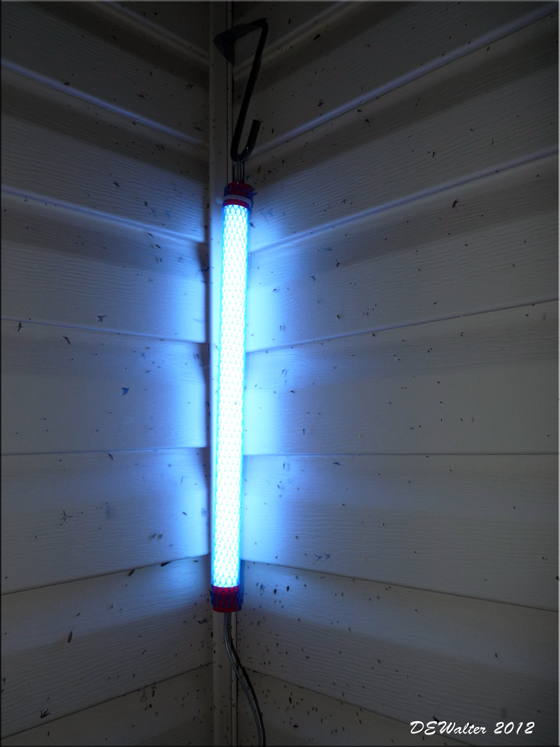
UV light source + a light background = Blacklight Trap
As Moth Week flutters towards a close, the Home Bug Gardeners decided to do something we haven't done for years: blacklight for bugs. Insects that fly by night are often attracted to lights and ultraviolet light is a strong attractant, especially for moths.
Fatal attraction: Moth danced into a stupor at the Blacklight Ball 
Feltia jaculifera (Guenée, 1852), the Dingy Cutworm
All you need is a an ultraviolet light source; some power to run it; a light-coloured background (a sheet or a wall will do); and the ability to stay awake after sundown. We used the corner of the porch on our cabin in a pasture outside town (Gopher Hill) and a portable power source to keep our light glowing for about three hours.
Midge and Moth resting Feltia herilis (Grote, 1873) aka Master's Dart, Herald Dart
We didn't actually last the three hours - gardening is hard work, and sleep comes easy in the country - but we were able to see a diversity of interesting insects, including numerous mysterious moths. The one above is probably the adult of a cutworm, but we were without moth expertise last night and pretty  much in the dark as to who was whom. So, we just oohed and aahed and clicked and wondered what they might be.
Pretty brown moth Caenurgina cf erechtea (Cramer, 1780) - probably the Forage Looper (possibly the very similar Clover Looper)
It is probably more fun if you go blacklighting with someone who knows their moths, but it being Moth Week, the experts are all busily engaged in holding their own events. We had weeding and watering to do at our country garden. There's no electricity there, but we had a portable light and power source. That and some wine was all that was needed for an entertaining Friday night fully in spirit with Moth Week.
Interesting Beige Moth Mythimna oxygala (Grote, 1881) the Lesser Wainscot
We expect to be able to identify many or even most of the moths we took pictures of last night through the wonders of BugGuide, Powell & Opler's Moths of Western North America, and our friends in the Alberta Lepidopterists Guild
Pale Beauty Campaea perlata Guenée, 1858
We did see a few we knew from out backyard, like the Pale Beauty, but most were mysterious. Probably several are agricultural pests, but for the evening, we were quite happy to admire the better side of their natures. A few of the moths were still resting on our porch the next morning. So, in a a sense, the fun continued into the dawn hours.
Probably a Prominent resting between lacewing eggs, but actually a Tufted Thyatirin Pseudothyatira cymatophoroides (Guenée, 1852)
Serious mothers collect specimens and pin them up, but we're more on the moth-appreciation side. Even scientists need hobbies and taking pictures of moths seems a pretty fun one at the moment.


UPDATE: Thanks to Gary, Libby, and all the others at the Alberta Lepidopterists Guild for their providing identifications for the previously unknown moths in bold above.
Gopher Hill - the eponymous high point in our plot of pasture

Wednesday, May 9, 2012

Wildflowers of the week: Canada Buffaloberry & Beaked Hazelnut

Female flowers of a willow
 Spring has finally started popping in the Home Bug Garden, but in the bush things are still a bit subdued. Coltsfoot and Creeping Buttercup are adding some colour, and this week, wild violets, but most of the forage available to the bees is much less easy to notice - the catkins of shrubs and trees, willow and hazelnut in particular.
Tiny flowers of Canada Buffaloberry
 Among the moose grazed hazelnuts, however, is one shrub with more flowery, if tiny, blooms, Shepherdia canadensis (L.) Nutt., also called Russet Buffaloberry. Last week we mistook it for hazelnut, but this week, with the leaf-buds burst, we were quite clearly wrong. The scale-like appressed hairs that cover buds, stems, and leaves should have clued us in - Elaeagnaceae, the Oleaster family that includes things like Wolf Willow (Elaeagnus commutata) and Russian Olive (Elaeagnus angustifolia). 
Moth sipping at Buffaloberry flower
 The catkins of Beaked Hazelnut Corylus cornuta Marsh. also are 'in bloom', but not very flowery. We've managed not to even notice them until this year, when we corrected our misidentified Buffaloberries. Eventually, they do yield small hazelnuts - tasty if difficult to extract.
Beaked Hazelnuts
 We originally intended to plant Beaked Hazelnut in the HBG to provide some wildlife food and the odd snack. That was before red squirrels decided to colonize our attic, though, and on second thought we decided not to do any more to encourage them. There is nothing like removing 1557 spruce cones from attic insulation to make one appreciate that maintaining a distance from wildlife is in both our interests.
Nymphs of a hazelnut lace bug
 Another reason we decided against planting Beaked Hazelnut is that in the bush it is heavily infested by lace bugs (apparently Corythucha coryli Osborn and Drake, 1917) and look quite ratty by the end of summer. If the lace bug populations are out of control in the bush, where presumably their parasitoids and predators are abundant, then they are likely to be just as bad or worse in an urban garden.
Adults of Corythucha coryli

Saturday, February 11, 2012

Adventures in Spider Misidentification: Tegeneria not

Mystery Basement Spider
Although we have a caveat in the sidebar (HBG Names & Claims) about the ids on this blog and our openness to suggested corrections, we've had few alternative hypotheses offered. Ted MacRae and Matthias Buck helped on occasion, but I can't think of any others offhand. Such an absence of feedback can lead to a sense of complacency and a mistaken feeling that one knows what one is doing.
Tegenaria not!
Last December I had a post on what was afoot in the basement wherein I featured a picture of what I thought was an immature Barn/Sink/Basement Funnel Weaver Spider Tegenaria domestica. I arrived at this conclusion because I knew we've had the spider in its funnel webs in the basement for years and after consulting the information on BugGuide, I decided it was close enough and what else could it be anyway? But fortunately, last week John Sloan discovered the HBG and was good enough to tell me that I was probably wrong.
Not an upside-down Funnel Weaver
To John, the legs didn't look right but were reminiscent (e.g. here) of a family of spiders not known to be in Alberta: the Pimoidae. This spider family is on the West Coast and our guest room in the basement has hosted many visits by West Coast relatives and scientists - so colonization by suitcase is well within the realm of possibilities. I think the match looks good, both the habitus of the spider and the upside-down habit in the web, but as John pointed out Pimoidae is close to the Linyphiidae - a family of mostly tiny spiders that is very diverse in Alberta.
Pimoa or Linyphiidae: Lepthyphantes cf nebulosus
Our Mystery Basement Spiders are only about 4-5 mm long (chelicerae to spinnerets) at the moment and probably just juveniles. We'll be hoping that some make it to adults so that we can send them to John for a more authoritative identification. But wait - there is more! John has offered several other corrections to past posts and I have updated those posts and will be sharing more Adventures in Spider Misidentification with you in the future. Everyone is invited to join in and help (mis)identify a spider.

UPDATE: Thanks to Alberta Bugs, Robin Leech, and ultimately and authoritatively, Don Buckle - we have a winner: definitely Linyphiidae and most likely Megalepthyphantes (Lepthyphantes) nebulosus - a spider that likes people (synanthrope).

Thursday, December 22, 2011

What's afoot in the Winter in the Home Bug Garden?

Young Basement Spider Tegenaria domestica
I've always found the first official day of winter somewhat strange, coming as it does, months after winter actually starts. I guess there must be some rhyme or reason to picking the solstice as the beginning of winter instead of say, Winter Hump Day. In much of the world today would be well on the way to Spring. Not in Edmonton, though, we've still a long way to go if previous years are any indication.
A typical March in the Home Bug Garden
So what is the arthropod addict to do with so many more months of winter in the way? Well, our friend John Acorn has come up with the Arthropod Winter Challenge! How many living arthropods can we find in Alberta in the winter? John thinks we can find more arthropod than bird species. Well, inside our house that certainly is true - first look around found three species of arthropods including the half grown Funnel-web Spider (Agelenidae) at the top. That is not quite fair to the birds - we have none to compete - but outside? Yes, there is a cornucopia of arthropods outside that brave the winter weather - but you need to look very closely for them and for many you need to put your nose to the ground.
Microarthropods from a few handfuls of spruce litter under the deep snows of last winter
All gardeners know that a good blanket of snow protects their plants from winter extremes, but even in very cold climates a good snow cover can also capture enough warmth for the tiny animals (microarthropods, nematodes, tardigrades, etc.) and microbes that live in the soil to go about their business. A few degrees above freezing is all they need; but so far, snow has been relatively scarce in Edmonton this winter and so no layer of relative warmth has been trapped. And, while I've enjoyed the less than usual shovelling, it has put a bit of a damper on my response to John's challenge.
A Fairy Wasp (Mymaridae, Polynema sp.) from under last winter's snow
Well, we Edmontonians know that good weather rarely lasts long and I expect that in the New Year I'll have a chance to see quite a bit more snow. I'll take comfort in knowing that under that snow my plants will be safer and there will be tiny arthropods having a good time, like the Fairy Wasp above. This tiny wasp - 0.6 mm long from head to tip of its ovipositor -  is a parasite of the eggs of leafhoppers. Bad news for baby bugs, but good news for the garden.

Sunday, May 23, 2010

Rain, Snow & Arachnophobia: An Ode to Spiders in the HBG


As I expected, yet another cold front has hit Edmonton. Below normal and wet is dragging through its 6th day and making a muddy mess of the May Long Weekend – traditional time to plant-out one’s annuals & veggies here on the northern edge of Zone 3. Oh well, the basement spiders don’t seem to mind the snow mixed with rain. The wet grey does tend to bring out the green and certainly has been good for all the plants I’ve already impatiently planted-out. No frost yet and we wish Itztlacoliuhqui full speed south (from the predictions, though, tomorrow morning is iffy). I’ve dead-headed the spent tulips and daffodils, but it is too muddy and cold to do more. Perhaps I should be doing responsible things like Spring cleaning, and then there is that mountain of unfinished work, but instead I’ve been irresponsibly indulging myself in the bug blogs.
Best discovery so far, thanks to an old 2008 post by Chris Taylor at Catalogue of Organisms has been Attercopus fimbriunguis - a Devonian fossil on the way to (or perhaps just in) the spiders. Problematic characters include a whip-tail, no distinct spinnerets (but fossil silk), and no poison glands (although modern segmented spiders apparently never had poison glands and at least one more modern family, Uloboridae, does without them). According to the Wikipedia article (at least at this moment) the generic name is from the Old English attorcoppa for "poison-head", clearly a misnomer in this case.

Fear of “poison-heads” is called arachnophobia – and it is true that most modern spiders produce venom. Few, however, have venoms that we need to be afraid of, which makes the apparently widespread fear of spiders amongst bug bloggers even more interesting. Today’s surprise confession was from the Dragonfly Woman, but it reminded me that arachnophobia runs the bug blog gamut from the bug-photography god-like heights of myrmecos to rock-bottom-up The Geek in Question. “Very interesting” (as former colleague and mammal-tooth-fancier Gordon Sanson might put it).
The Dragonfly Woman’s story comes from her teenage years and a fishing spider in her pool. So, perfect chance for me to drag up our own cherished male Dolomedes triton hanging out around our year old pond. Alas, I fear the male found no fair female and had to bugger off to an uncertain future (probably a more common fate for wandering male spiders than being eaten by their objects of desire). My wife and I, however, were delighted that he stopped by and only wish that more and bigger spiders would take up residence. Yes, we have no Arachnophobia (but are considering buying a dvd of the movie – which features an impressive cast of mostly Australian spiders, a moderately entertaining [if factually confused] script, and good, campy acting).
So, before I get serious about not enjoying my wet weeked and get out my kneepads and start cleaning out the lower kitchen cabinets, let me showcase a few of the interesting spiders that have been lurking around the Home Bug Garden. This is Alberta, so usually the only big scary spiders occur in the Autumn (especially the Jewel Spider) or in the basement (and those introduced buggers, Tegenaria domestica, and perhaps a hobo or two, do get big, hairy, and disconcerting - although the cats like them). Also, smaller spiders seem more likely to ignore a big black camera being poked at them, and so, are more photogenic.
Actually Araneus trifolium - gemmoides has two humps on its abdomen
The discerning viewer will note that all of the pictures are credited to my wife. That’s because she has the great Nikon and macro lens, not because I tend to stand a metre behind her saying “go on, get closer, it won’t bite”. Also, many are wandering males – again, “very interesting”, but in this case, I think, not unexpected. Movement and moving on to digital immortality are not unconnected.


Actually a theridiid - probably Crustulina sticta 


Tetragnatha is the correct spelling

Phylonetta impressa (formerly Theridion impressum)


Thursday, August 27, 2009

Biodiversity Gone Bad: Hornets in the Home Bug Garden (updated 19 Sept 09)


Home bug gardening isn’t the most easily understood avocation. At work my colleagues make fun of me not wanting to kill the insects in my yard. My revolving neighbours on one side, a rental, persistently think that I am a botanist. No many how many times I tell them I’m a bug gardener, it just doesn’t compute. The neighbour on the other side has known me 7 years now and I thought she understood. But, when I proudly proclaimed to her last week that I had identified 9 species of hornets and yellowjackets from my backyard, she seemed nonplussed, or perhaps creeped-out.

Before someone goes running for the bylaws or the bug spray, let me make one thing perfectly clear: as far as I know, I don’t have any hornets or yellowjackets nesting in my yard. In fact, on the first cold night after finding a bald-faced hornet nest on the fence this Spring, I nuked it. The yellowjacket queen that tried to nest under the garage was first flooded, then buried and, those efforts proving entirely ineffectual, finally netted and smashed. There may be a nest hidden somewhere on my lot, but based on the trajectories of the visiting hornet workers, I’d say I have my neighbours to thank for my astonishing vespine diversity.

And an astonishing diversity it is – it looks like most of the hornet species likely to be found in this part of Alberta are lurking within flying distance of my backyard. Not only that, but they find the Home Bug Garden entirely worth a regular visit. This conviviality is no doubt due to two aspects of the garden: ready access to water and lots of umbels. Actually, there may be a corymb or a cyme or two, and there are certainly some corymb-like (yarrow) and otherwise racemose (goldenrod) clusters of composites that attract wasps, but as I repeatedly tell my neighbours in the rental, I’m really not a botanist. In any case, the umbels clearly get the most attention from simple umbels (milkweed) to compound umbels (dill, lovage, caraway, chervil). The good news is that most of the wasps fooling around on flowers are males – and these can not sting - and most of the ones that can are really more interested in bugs than in people.


Wasp is a general term, but for most people it refers to the social members of the family Vespidae that have the ability, and the willingness, to sting repeatedly when disturbed. This is mostly a behaviour of the workers – the reproductively suppressed females – who have no problem jabbing their modified egg-laying organ (ovipositor) into your skin and injecting lots of toxic and allergenic chemicals. Although it is possible to die of envenomization from wasp stings, almost every one who dies after being stung is a victim of anaphylactic shock and a single sting can kill a susceptible individual. Queens are much bigger than workers, and so more intimidating, but are usually only seen in early Spring and briefly in the Fall. Male wasps are harmless flower philanderers, but look pretty much the same as the workers (actually, they have longer antennae and one extra abdominal segment, but when you have a yellowjacket wanting to share your pop, these aren’t the easiest characters to see). So generally, keeping safe means keeping away from nests and from foraging workers.


The family name Vespidae comes from Vespa, the Latin for wasp, and also the genus name for the Giant European Hornet – a truly large wasp, large enough to feed on honeybees and yellowjackets when it feels like it, pretty intimidating in person, and also having the garden-unfriendly habit of girdling twigs so that it can feed on sap. Unfortunately, the European Hornet, Vespa crabro, was introduced to North America and is well established – but fortunately for Edmontonians, only in the East. Easterners also are well familiar with the paper wasps in the genus Polistes, but the only Albertan species, Polistes aurifer, appears to be limited to the south. That’s good, because Polistes nests are often placed on shrubs, fences, window wells, and other places you are likely to stick your hands without looking, and if you blunder into one, you will get covered by stinging wasps. What we Edmontonians get are Vespula (‘little wasp’) and Dolichovespula (long little wasp – they have a rather long face). Species of Dolichovespula tend to nest above ground in those grey football-like paper nests and species of Vespula tend to nest below ground in old rodent burrows or the like, but there lots of exceptions, especially when it comes to taking advantage of hollow spaces in human habitations.

Before I get into the specifics of my HBG wasps, let me highly recommend these two publications (from which I will borrow information freely):
Identification Atlas of the Vespidae (Hymenoptera, Aculeata) of the northeastern Nearctic region by Matthias Buck, Steve Marshall, and David Cheung in the Canadian Journal for Arthropod Identification
The Yellowjackets of America North of Mexico. by RD Akre, A Greene, JF MacDonald, PJ Landolt, and HG Davis. 1981. Agriculture Handbook, 552. United States Department of Agriculture, Science and Education Administration, Washington D.C. 102 pp.

UPDATED 19 September 2009: Large V's of gruking sandhill cranes have been flying south over the Home Bug Garden; orange-crowned and yellow-rumped warblers and white-throated sparrows have been splashing around the bird bath; and the leaves are yellowing fast. Yellowjacket season will soon be over, perhaps next week, as frost is threatening. Time to polish up this post and bid adieu to some of our least loved bugs.

No new species to add to the HBG, but Insects of Alberta has records for the Arctic Yellowjacket (Dolichovespula norwegica (Fab., 1781) ) from Calgary, so I'm a bit envious. From the picture, I'd say that 'yellowjacket' is a bit of a misnomer - looks like a blackjacket to me - but nothern populations of vespids (including the solitary species) can tend towards 'ivory' markings.

To continue with the lack of good news, I have been able to confirm that the Evil European Wasp, Vespula germanica, is a member of the HBG vespifauna. The confirmation comes via the male genitalia (no pun intended, or at least not initially), so breeding populations are here in Edmonton. Excess confirmation for this colonization event came the very same day as the HBG event, when a nest was nuked at work and turned out to be V. germanica.

On the good, or at least interesting, news side, I have discovered (more likely rediscovered) a behavioural difference between the males of Dolichovespula and vulgaris-group Vespula. The former are the flower philaderers: greedy, flower frolicking, poseurs in aposematic bands.   The latter, at least for V. pensylvanica and germanica, are very mysterious delvers into the foliage of forget-me-nots - and seem not at all interested in flowers. Details are added below by species.


The Bald-faced Hornet - Dolichovespula maculata (Linnaeus)

These are our largest hornets, the only common black and white ones, and have a definite sense of entitlement. If you try to swat one away, it is more likely to buzz you, than to acknowledge your superiority and move on. They have attitude, but after a few minutes of in-your-face fancy flying, usually find better things to do. The workers take honeydew and other sugary things like pop, but mostly prey on live arthropods (especially flies visiting flowers in my garden) and sometimes preferentially on other hornet species. I watched one bald-faced wrestle another to the ground. I suppose I should have waited to see who won and what happened to the loser, but I was so shocked by the lack of sisterly solicitude that I stepped on both on them. Why can’t wasps just learn to get along? Anyway, the big, grey nests can be found up to 20m above ground in trees but also in or on human structures and in hollow trees. If you come across a nest, I advise you to leave it alone. Let someone else win the Darwin Award.

The Aerial Yellowjacket - Dolichovespula arenaria (Fabricius)

These are about half the size of the bald-faced hornets, and the more typical yellow and black in colour (see plate a few paragraphs above), but otherwise have similar behaviours. Nests are usually in shrubs or trees from near the ground to high in the canopy or in or around our homes. Workers are mostly interested in catching other insects for dinner, so they aren’t the worst guests at a picnic, but like any social wasp, if you disturb their nest, you are in for a bad time. The males are a constant presence on goldenrod and swamp milkweed throughout the late summer.


Northern Aerial Yellowjacket - Dolichovespula norvegicoides (Sladen)

This is my second favourite backyard wasp, mostly because workers are rare and inoffensive and the rest are harmless males feeding at flowers. Also, little is known about their biology except they tend to have aerial nests in trees and shrubs. Rare and mysterious is always more interesting than common and nasty. Males are common on swamp milkweed and early goldenrod in mid-August, but seem to disappear in September.


The Parasitic Blackjacket - Dolichovespula adulterina (du Buysson)

This is by far my favourite backyard hornet because it is the only obligate social parasite in its genus in North America (adulterina is now considered the proper name for the arctica in the USDA book). ‘Obligate social parasite’ means a queen D. adulterina infiltrates a nest of the Aerial Yellowjacket early in the season before the workers emerge, sneaks in its own eggs, and eventually kills off the yellowjacket queen. Now what more could you ask for in a hornet? Additionally, the males are an attractive ivory and black colour and pretty much mind their own business as they pollinate my plants.


The Blackjacket - Vespula consobrina (de Saussure)

Species of Vespula in our region fall into two species groups: the annoying vulgaris group and the laid-back and innocuous rufa-group. The Blackjacket and the next species, the Prairie Yellowjacket, are the only members of the rufa-group I’ve found in my yard to date. The Blackjacket looks a bit like a half-pint Bald-faced Hornet or a Parasitic Blackjacket but has a short face and slight differences in patterning. Like the rest of the rufa-group, these hornets are primarily interested in eating insects and aren’t likely to bother you. Actually, they have never bothered me, but I did kill a worker to confirm the species identification (and alleviate the snickering at work).

The Prairie Yellowjacket - Vespula atropilosa (Sladen)

This is the rarest of my backyard hornets and I don’t have any pictures. Edmonton is near the NE limit of its range. They nest mostly in rodent burrows or in rotting stumps and logs and have an interesting ichneumonid parasitoid, Sphecophaga vesparum burra (Cresson), that lives in its nests and parasitizes its pupae. In Washington State, 80% of Prairie Yellowjacket nests may be infested with the ichneumonid (which also goes after vulgaris-group wasps). Males wander into the HBG on a regular basis, but are difficult to document because they don't seem to have either the flower philandering or forget-me-not delving behaviours of the others. The few I have captured have been on-the-wing or resting on foliage.


The Western Yellowjacket - Vespula pensylvanica (de Saussure)

This is the main pest yellowjacket in my yard and probably in most of Edmonton, although we are near the northern limit of its range (apparently de Saussure had problems with his spelling as well as his distributional information since this wasp does not occur in Pennsylvania). The workers are aggressive, and although they do forage for insects, they also are attracted to dead animals including that burger, hotdog, or roast pig you are trying to eat at a barbie. They like soft drinks too (but seem to give wine a pass) and when you swat them away, they give you the buzz treatment. Nests are built in hollow walls and attics, as well as underground (probably what was trying to nest under my garage this Spring). They have a truly incredible parasitoid – the trigonalid wasp Bareogonalos canadensis (Harrington) – but that is a story for another post. The primary source of Western Yellowjacket mortality in my yard appears to be me, so there are lots of them buzzing my flowers for prey and my barbecue for meat.

Male Western Yellowjackets show an interesting behaviour in the HBG: they seem to like the foliage of forget-me-nots (Myosotis sylvatica). Actually, the foliage is a low and dense garden bed composed of forget-me-not, coltsfoot (Petasites palmatus), and bunchberry (Cornus canadensis), but the males are mostly landing on the forget-me-not (but that is most of the cover).

Once they land, the males crawl into the foliage and disappear. I've put my nose to the ground and watched a couple and they don't seem to do anything other than walk on the plants and perhaps apply their mouthparts to the leaf surface now and then. What is going on? I haven't a clue, but there is no sign of honeydew, queen yellowjackets, or any other obvious attractant, including prey (which presumably they aren't interested in anyway).

I missed these males for a long time, because I assumed they were workers, but nope, they are all males - and none are showing up on flowers. Very interesting - and this is also were I picked up a male V. germanica, so it may be a vulgaris-group behaviour. My current favourite hypothesis is that the males are collecting a plant compound that makes them attractive to females, but it took two glasses of wine for that idea to pop up, so in my current sober state I find it dubious.

The Vulgar Yellowjacket - Vespula vulgaris (Linnaeus)

In its European incarnation, this is the species that gives its name to the nasty vulgaris-group. Ours may actually be a different species, but it has all of the unfortunate behaviours that result in yellowjackets being unwanted guests. Workers go after a wide variety of human foods and kill the occasional bug when they are bored. Nests are usually subterranean but are sometimes also built in rotten logs or stumps, forest duff, hollow walls or even in trees. This is one of the two species of yellowjackets that have been introduced to Australia and New Zealand where they have become an ecological disaster and very annoying pests. In my yard Vulgar Yellowjackets were common earlier in the year, but have now been almost entirely replaced by Western YellowJackets and the next species.

The Evil European Wasp - Vespula germanica (Fabricius)

This species is the horror introduced into New Zealand early on; Hobart, Tasmania in 1958; Maryland, USA in 1968; around Melbourne, Victoria in 1977; and elsewhere around the World on various dates in its unending drive to conquer all. It does well it urban areas, seems to like to eat all the things we like to take on picnic, scarfs up all the sweets it can, and is very aggressive in taking its share of the meal. Nest are usually subterranean but are also built in hollow walls, in roofs, attics, and any other place where it can find an acceptable cavity. The species looks similar to the Western Yellowjacket and especially so here where the Western colour pattern can overlap that of the European Wasp. So far, I’ve collect three probable germanica workers in my yard, but it would be nice to catch a male and confirm that this wasp has indeed reached Edmonton and that we aren’t just seeing a melanistic form of the Western Yellowjacket. Or would it? Well, whatever would be nice, unfortunately I have collected a male, and the genitalia never lie. Males, or make that the one male I have collected, have a similar forget-me-not behaviour to the Western Yellowjacket (see above).