Showing posts with label bulbs. Show all posts

Saturday, September 15, 2012

Sun-loving Marsh Flies, Frost, Tomatoes & Bulbs

Marsh-loving Helophilus Flower Fly on Thistle
When the bees start to go and it's mostly flies at flowers, frost is on the way. One of the more common and colourful at the moment is a hover fly / flower fly in the genus Helophilus (possibly fasciatus Walker, 1949). I always assumed that 'Helo-philus' meant 'sun-loving', and seeing the flies bask on sunny leaves during the summer reinforced this delusion. As a result, I constantly misspell the genus as 'Heliophilus' and found very strange images when googling. This morning I decided to check my assumption and found that 'helo' is Greek for marsh. As BugGuide notes, this probably refers to the larval habitat and I hope that proves my pneumonic, I mean mnemonic.
Siderno Hybrid Tomato: tasty, productive, and begins early
This morning it was a nippy +4 in the Home Bug Garden and there's a good chance it will sink to Zero tonight. Yesterday was spent collecting the last of the Tumbler and Siderno Tomatoes from the tubs scattered around the sunnier parts of the Garden and reinvesting their spent soil into a new bulb bed. That leaves me with only one bed of tomatoes to cover tonight.  I highly recommend the Siderno for those who like fresh tomatoes in their salad, but have limited space and short seasons: highly productive, good size for salad or snack (mostly 10-20 g) and early. The photo above was taken on 19 August and the first ripe tomatoes harvested on 6 August. Even with the hail, slug-heaven rains, and unrecorded snacking, the two plants in this tub yielded 7.5 kg of tomatoes.
Front yard bulb map - overcrowded and out-of-date
The potting soil used for the tomatoes could be refreshed and used again next year, but no sense in encouraging the flea beetles and other pests. I usually turn the potting soil into the dense clay to make new beds for herbaceous perennials and bulbs. Unfortunately, the HBG is check-a-block with bulbs already (about 2000 have been planted over the years) and due to poor record keeping I'm not too sure where bulbs have died out (orangy colour in the map above) or are on their last legs. I'm pretty sure none of the Lady Jane's (Tulipa clusiana var. chrysantha) survived last winter, the southwest corner was  generally tulip-free, and the Red Emperors (Tulipa fosteriana) have been looking more impoverished than imperious the last few springs. I suppose I should have taken a photo in May, but it somehow doesn't occur to me until Fall that I should have records of areas without flowers. Oh well, I guess some careful hand-digging will let me lever in a few more bulbs. Time to get to work.
Tachinid fly enjoying a Smooth Aster (Symphyotrichum laeve) 

Friday, May 4, 2012

Friday Bees

A Digger Bee (Andrena possibly milwaukeensis) at Colfsfoot
Spring is always slow to come to the Home Bug Garden, but when it finally arrives, it is nice to see some repeating patterns. The same Digger Bee species (Andrena cf milwaukeensis Graenicher, 1903) captured in the picture above on 2 May 2007 is active again this May 4th and joined by three other bee species.
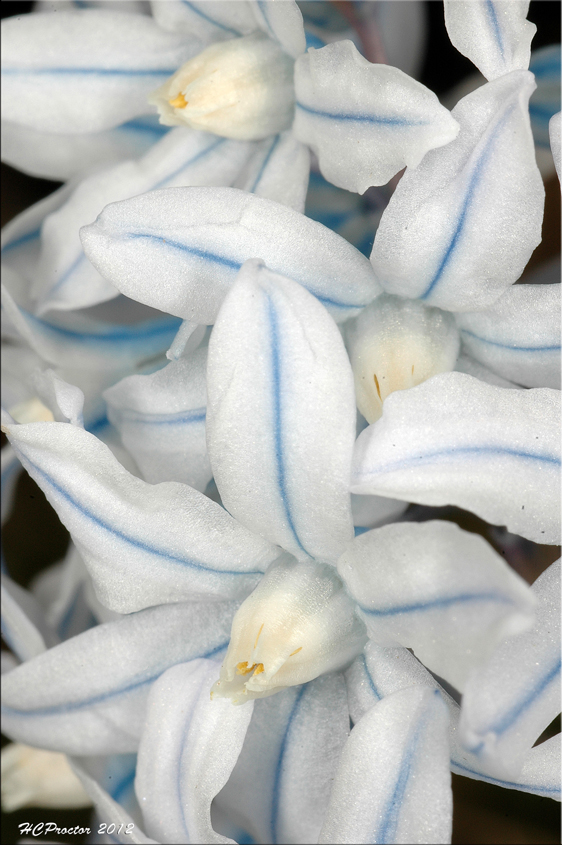
Striped Squill
The Striped Squill (Puschkinia scilloides libanotica) are the busiest at the moment, probably because they are in full sun. The queens of two early bumble bees, the Tricoloured (Bombus ternarius) and the Half-black (B. vagans or perplexus), stumble through the spikes of striped flowers with a loud buzz or two of warning, much as they did last May and many Mays before.
Tricoloured Bumble Bee at Striped Squill last May 7th
Not all is exactly as before, or at least I can't claim that is so. The fourth species of bee seems to be a largish Halictidae (Sweat Bee). Large for a Sweat Bee is not much - perhaps a tenth of the mass of a bumble bee queen - and this one is a bit skittish, so perhaps we never noticed it this early in the season before. But we do have one from mid-summer that looks very similar, so I'll leave off with that in case some other gardener would like to know what it looks like. If Mrs HBG gets a good picture of the Spring form, I'll post it for comparison.
Halictus Sweat Bee from July 2009

Sunday, January 1, 2012

The Clivia Food Web: Part I

Natal Lily (Clivia hybrid) in flower 
Bulbs are one of the Home Bug Gardener's obsessions. Not that most bulbs are especially useful plants for promoting insect conservation in the Aspen Parkland of Alberta, but anticipation of the blooming of the 2000 or so spring bulbs that inhabit my yard does help fight off the winter gloom. The most spectacular of my bulbs, however, blooms in the Fall - a Clivia hybrid given to us by a friend. Or rather I should say bloomed in the Fall, which it did in 2010. Last Autumn, though, they could barely muster a few yellowed and sickly leaves. Still I brought the pot inside when the frosts came (Natal Lily hails from Southern Africa) and hoped for the best.
Rove Beetle from Clivia pot - Anotylus insecatus
When a plant starts looking sickly there is often an arthropod or a microbe to blame (or an incompetent gardener) and when one finds an insect associated with a sick plant it is easy to assume the worst. The small (4.5 mm long) rove beetle above, Anotylus insecatus (Gravenhorst, 1806), is both an invasive alien insect and associated with rotting bulbs - so finding it in my Clivia pot was not encouraging. However, the beetle is probably a predator of bulb maggots and other pests (see Campbell & Tomlin 1983) and not a pest itself. Still, as Fall became Winter and no new growth or flower stalks appeared, something would seem to be rotten.
Clivia pot worms, insects, springtails, and mites
A few weeks ago I repotted the Clivia - and yes, half the bulbs were rotting - and sent the soil and slimy bulbs off to the University for extraction. All you need to extract arthropods from soil is an incandescent light bulb, a funnel, a screen, and a small container that fits the stem of the funnel. From these simple ingredients you can assemble a Berlese Funnel (aka Tullgren Funnel) and start learning about the animals that live in soil. As the light bulb dries out the soil, the animals follow the moisture gradient down, pass through the screen, and tumble into the collecting container. Berlese funnels work best for arthropods, but some worms and snails will come through too. The Clivia pot turned out to have a lot of inhabitants (see above): an earthworm (large worm at left above); another kind of rove beetle (black and about 4 mm long), as yet unidentified; several pot worms (Enchytraeidae - the small white worms mid-picture); and a host of springtails and mites. The good news: lots of harmless soil animals and no bulb maggots; the bad news: lots of bulb mites.

Unfortunately, most of the mites from the extraction were the notorious Bulb Mite Rhizoglyphus robini Claparède, 1869. Bulb mites do best in cold, wet weather - like last summer - and once a bulb is colonized, they are difficult to eliminate. But - the second most abundant mite in this extraction was a predatory mite in the genus Gaeolaelaps (also called Hypoaspis). Izabela Lesna and her colleagues in the Netherlands have shown that Gaeolaelaps aculeifer (Canestrini, 1884) can be an effective biological control agent of bulb mites. If only I had been a bit lazier and waited to repot the bulbs until later in the New Year, the problem may have solved itself. Still, I now have the makings of a map of the feeding relationships inside my former pot of Clivia - a food web. That sounds like a good project for the New Year and a chance to contribute to the Wildlife in Our Homes Project.
Mystery Rove Beetle from Clivia pot soil
References:
Campbell JM, Tomlin AD. 1983. The First Record of the Palearctic Species Anotylus insecatus (Gravenhorst) (Coleoptera:Staphylinidae) from North America.The Coleopterists Bulletin 37(4): 309-313. http://www.jstor.org/pss/4008251

Lesna I, Sabelis M, Conijn C. 1996. Biological Control of the Bulb Mite, Rhizoglyphus robini, by the Predatory Mite, Hypoaspis aculeifer, on Lilies: Predator-Prey Interactions at Various Spatial Scales. Journal of Applied Ecology 33(2 ): 369-376 http://www.jstor.org/pss/2404758

Saturday, October 31, 2009

CanBugs, CANPOLIN, Can Bulbs Survive


For those of you who answered the above pictured question with ‘where are the pollinators?’, well, that is a timely question as honeybees seem to be on the ropes and native pollinators in decline.


Or are they? Well, the truth be told, we don’t really know because with few exceptions we have pretty much put all of our bees in one basket. However, the time may be coming when the other 99% of pollinators – e.g. the for-get-me-not frequenting flower fly below– receive their due attention.


Flower flies (aka hoverflies, Syrphidae) were one of the pollinator groups that were well represented in presentations last week at the Joint Annual Meeting of the Entomological Society of Canada and the Entomological Society of Manitoba in Winnipeg. Usually I would consider attending such a meeting additional work, but this time it was vacation – perhaps the reason I had an unusually good time for a bug meeting. Not that sitting on one’s butt from 8 am until 5 pm listening to bug talks, not even with the aid of fly papers, is all that easy, but the friends, fine food, and Forks all made for a pleasant time. ‘Winterpeg’ was anything but wintry, the simple monument at Louis Riel’s grave among the Dutch doomed elms in the Saint Boniface churchyard strangely moving, and the bug science less debased by climate change hyperbole than has become usual. However, it was the plethora of papers on pollinators that made the meeting for me.


Anyone who answered the question in the picture above with the Laphria on the left (a robberfly, Asilidae) must have missed the doubly unfortunate damselfly and mites.


But if I were to ask harder questions, such as ‘what species is the bumblebee?’ or ‘how is it doing?’, I’d have no idea how to answer them.


Such ignorance, however, may be short-lived, thanks to the newly initiated CANPOLIN (Canadian Pollination Initiative). At long last the government seems to be getting serious about protecting this critical agricultural and natural ecosystem function. Let’s hope CANPOLIN can develop the basic tools and information Canadians need to answer basic questions about and to understand, utilize and conserve their pollinator heritage.


I hope to enlist the Home Bug Garden in this effort, and do what I can, but I don’t suppose I can do much this year. Winter is upon us in Edmonton. The trees are mostly bare, the ground cold and soggy, the days short, and what sun there is too weak to generate vitamin D. What a perfect time to plant Spring bulbs! Ha, well my bloody Dutch bulb growers seem to think so – the missing bulbs arrived yesterday in a box soggy with melting snow a month after the optimal time to put them in the ground.


Two hours after I got home, the bulbs were all planted in the long ago prepared beds or in pots as Adrian suggested (see Comments in previous post). I suppose I can look at this as an experiment. Hybrid tulips should have enough stored reserves to bloom next Spring, but probably won’t have enough of a root system to generate healthy new bulbs. As for the species tulips, grape hyacinth, and spring glories that made up most of the shipment, I don’t know, but I put in enough of these from local shops at the end of September to make a fair comparison. I'm just glad the ground thawed while I was in Winnipeg and I didn't have to break out the pickaxe.