Showing posts with label Pollinator of the Week. Show all posts

Friday, June 22, 2012

Bee-learned, not Bee-clowned: White-tailed Bumble Bee vs Globeflower

Bombus moderatus thinking about food
What does one do when a week of lectures need to be revised, a paper finished, hundreds of identifications proposed, dinner cooked, and a host of other chores gathers on the horizon? Why watch bees learn, of course.
The examination begins
Without flowers, flowering plants would have no offspring, or what they had would be monotonously similar clones from generation to generation. Ergo, one might assume that those plants that require insects for pollination would not be shy about initiating the mating dance. But many flowers seem to be of two minds, proclaiming 'here I am, come get me' but providing no obvious means of ingress. Bottle Gentians are one well known example of such coy flowers, and the European Globeflower seems to be another.
And she's in!
But things may not be all that they seem. In Finland and the European Alps, the Globeflower has been shown to have an obligate pollination relationship with Globeflower Flies (Chiastocheta spp., Anthomyiidae). Both sexes of the flies penetrate the flower, females lay eggs, and the resulting maggots eat the globeflower seeds. Globeflower must feed many of its offspring to maggots to ensure that some survive. That's all well and good (if creepy) in Europe, but how about in the Home Bug Garden where horticultural varieties of globeflower abound, but the flies seem to have missed the boat? One of the great advantages of bumble bees (Bombus spp.) as pollinators is that they can learn to pollinate even the most indifferent of flowers from beans to buzz pollinated peppers to bottled gentians to horticultural globeflowers.

Friday, June 15, 2012

Pollinator of the Week: A Buzzing Bonanza

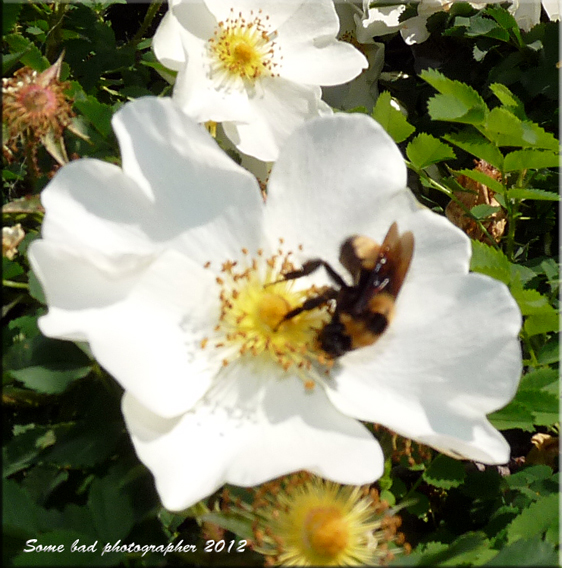
Scots Rose & White-tailed Bumblebee
June can be  beautiful month in Edmonton, or so they tell me. In my experience, the beauty comes in small doses, with the breaks in the clouds as rain-laden low after low rolls across. Oh yeah, I know, I'm always whinging about the weather here, but take a look for yourself.
When the sun does break through, though, things start popping. In the first two weeks of June, it is the Scots Rose (Rosa spinonissima 'Grandiflora') that pops the most. Our heirloom monster came with the house and is about 4 meters of spiny canes in every direction. Sometime between June 1st  and 16 June (the cold spring of 2009), the thorny mound becomes covered with large (7-8 cm diameter) single white roses - and bees galore, at least when the sun is shining.
The new, and currently most common, Bombus in town
Wednesday afternoon the sun was shining and the bees buzzing. The most common was also the most recent addition to the Edmonton Bumble Bee Fauna: the White-tailed Bumblebee, variously known as Bombus cryptarum, lucorum, and moderatus. The genetics seems to favour the latter, so that is what I am sticking with.
Red-belted Bumblebee Queen
Although apparently the most common bee at the Scots Rose - and with unusually large workers for this time of year - the White-tailed was only one of at least 6 species of Bumblebee harvesting the pollen and nectar.
Half-black Bumblebee worker
Second most common was old-reliable: the Half-black Bumblebee (Bombus vagans), both queens and new workers. But also present were queens of the Red-belted Bumblebee (B. rufocinctus - thanks to John Ascher for the id), the Tricoloured Bumblebee (B. ternarius), and a single queen each of the Yellow-banded Bumblebee (B. terricola) and what I'm tentatively calling the Black-and-Gold Bumblebee (B. auricomis). The latter seemed more interested in the lilacs, but was not above a blurry dive into a rose.
Maybe Black & Gold Bumblebee
But wait! There's more! A half-dozen or more other bees were also harvesting the bounty.
Halictus rubicundus - Banded Sweat Bee
A large and a small species of sweat bee (Halictidae) were zooming in and out and I'm pretty sure the larger one was Halictus rubicundus. She seems to lack a common name, but I will call her after her most striking character: the Banded Sweat Bee.
Leaf-cutting Bee Megachile sp.
A leaf-cutting bee was also in on the harvest, although collecting pollen on the underside of her abdomen, rather than on the hind legs. Then there were all the mystery bees.
Mystery bee in Scots Rose
Perhaps anthophorines, perhaps andrenids, perhaps halictids. Who knows? I think one may have been a yellow-faced bee and another an Andrena. There was so much rapid buzzing in and out that it was hard to keep track, but at least a dozen types of bee ended up in my notebook.
Probably a Digger Bee Andrena sp.
Alas, bees were not the only animals on hand to share in the bounty and not every bee made it home to its nest.
Digger bee becomes one with Misumena vatia
Oh well, it's not a Disney world in the Home Bug Garden, and there seemed bees enough for flowers and crab spiders.
Small worker of, maybe, B. centralis or flavifrons
Well, yet again, the showers have stopped for the moment and the sun is shining. Time to push through the wet vegetation and see if something interesting is buzzing about.
Rosa spinonissima 'Grandiflora'


Wednesday, March 14, 2012

2 for 1: Wednesday Wild Flower + Pollinator of the Week

Two for the price of one: Purple Peavine & Greenish Blue
Purple Peavine, aka Purple Vetchling, Veiny Pea (Lathyrus venous), stretches across North America to just barely make it into central Alberta, but I'm glad it does. A relative of the domesticated Sweet Pea (Lathyrus odorous), but without the selection for large and fragrant flowers, it still makes a fine wildflower.  Disjunct populations also occur on the West Coast; so perhaps, some earlier inhabitants of Alberta also liked these peas and took them with them on their wanderings.
Greenish Blue Plebejus saepiolus from above
The Greenish Blue (Plebejus saepiolus) is just one of the bewildering diversity of tiny 'Blues' that occur in Alberta including the Spring Azure, Western Tailed-Blue, Silvery Blue, Arctic Blue, Rustic Blue, Northern Blue, Acmon Blue, and so on. Every now and then we see enough characters to be reasonably sure of identity, but not often.
Mystery Blue
The caterpillars of the Greenish Blue feed on clovers (Trifolium spp.). Since Alberta has no native species of clover (the closest 'native' species occur in Montana and British Columbia), I suppose that means we owe our Greenish Blues to introduced, 'weedy' clovers. Most true clovers aren't really very weedy, but several are important crops and all a good source of nectar and pollen for bees and other pollinators. So, I prefer to think of clovers as nascent Albertans.
Red Clover - not a 'native'

Thursday, February 16, 2012

Pollinator of the Week: Megachile

Megachile the 'big lip' of bees
I hope that I am impressing someone with my ability to identify a bee seen only as a bum protruding from a flower. This should be especially impressive too, since the bee I'm claiming this is, a species of Megachile, belongs to a family defined by its  'big lip'. In old Greek 'mega' means something impressively large and 'chillo' means 'lip'. I could be wrong here, because 'chilli' also means a thousand (must be where we get our 'kilogram', kilometre'). But after working my way through the chapter in Charles Michener's massive Bees of the World (2nd Edition, Johns Hopkins University Press, 2007), I know these bees have 'a rectangular labrum that is longer than broad' - aka a big lip.
Snapdragon & Megachile with scopa
The reason that I can be fairly certain of the genus is because unlike many of the bees we are familiar with, species of Megachile do not use their legs to carry pollen, but the undersides of their metasoma (=+/- abdomen). Notice the dense brush of long yellowish hairs above (and also the large mandibles). This field of pollen-collecting hairs is called a 'scopa' (not to be confused with the card game popular in Italy, nor with 'scope' which is what the spellchecker insists on).
Megachile with full scopa over Eurybia conspicua
The abdominal scopa is, perhaps, better seen in my point-and-shoot moment of blurry glory above. The camera obviously preferred the flowers to the bee, but the picture is still illustrative. The common name of these bees, however, is not 'Yellow-bellied Bees', but Leaf-cutter Bees. Consider the large mandibles visible in the snapdragon pollinating bee above - very useful for cutting our circular bits of leaf or petal. These bees nest in burrows in wood and line their nests with plant material. I'm sure some people take offence at this behaviour and pay outrageous sums to have their gardens sprayed to save their roses from a trivial bee tax. In my garden Leaf-cutter Bees seem to prefer my peas, but I still have more than I can eat every year, so I do not begrudge them a safe haven for their young.
Megachile, I think, possibly a male
In fact, I have several of Splendor Awaits experimental bee homes. The only bees that made use of them last summer were Megachile species. A few wasps also seem to be interested, but I guess many of the bees in my backyard nest in the ground and patches of bare soil would do more to encourage them.
Adrian's bee hotels stuffed with leaf circles & baby bees

Saturday, February 4, 2012

(Self) Pollinator of the Week: Cave hortulanus Impatiens capensis!

A jewel and a weed!

In my experience, New Year’s resolutions rarely make it through January. One of mine this year has been to expand my ‘social media’ output (in preparation for a symposium here in November). This means learning Google+, increasing my rate of posting at my blogs, and analyzing what other bug bloggers are doing. One thing I’ve noticed at other bug blogs is that those that maintain a high rate of posting tend to keep most posts short and sweet – a picture and a paragraph or two.
Jewelweed or Touch-Me-Not
 In contrast, my posts tend to be long and wordy. Inevitably, what should have been a pleasant weekend hour posting a picture or three and some ruminations on insect conservation morphs into a weeks-long struggle with the literature. These habits come from too many years of lecturing and are hard to break.
Ruby-throat hummer - likes Jewelweed and is probably a good pollinator
 Of course, this is the fun part of bug blogging – learning something new – and then telling someone about it. But I have folders filled with uncompleted posts that turned out to be far more complicated than I had expected or where some critical facts or photographs were unavailable or where I just ran out of free-time and energy. At least I got paid for lecturing: blogging is supposed to be a hobby (i.e. relaxing).
Attractive, but especially so to insects & hummingbirds
 So, here’s my New Year’s Resolution: learn to shut up and blog. Regular weekly posting themes seem to work well unless you run out of images (e.g. Sunday Sawfly). So, Friday Bug has been up two weeks now (and weeks of pictures to go) and today I am starting Pollinator of the Week.
Fly on flower: probably less than it seems
 For ‘Pollinator’ to make any sense, though, I will need to make clear the difference between an insect on a flower and pollination. The picture above is more likely of a root-maggot fly resting on a flower, than a pollination event. In previous years, I would have spent the next week or two trying to determine how much was known about anthomyiid flies and pollination. This year I am considering that approach irresolute.
Bumblebee & Jewelweed:
begatting as in the Bible
 The bumblebee (Bombus vagans), however, is clearly covered in pollen and doing its best to show the Jewelweed (aka Spotted Touch-Me-Not, Impatiens capensis) a good time. 
Seedpod - begat through an ecosystem service
That is what pollinations is all about – moving plant sperm (aka pollen) to receptive female parts (aka stigmas), and setting seeds. In the case of Touch-Me-Nots, these seeds come in a pod that at maturity will explosively discharge the seeds upon a touch - scattering most over good distances.
Touch-Me-Not touched (one seed retained)
 But if the soil is too dry or otherwise unsuitable, Jewelweed can suffer from erectile dysfunction – the flowers fail to open and release their pollen. Unfortunately, crosspollination is only an option for Jewelweed, not a necessity – they also indulge in cleistogamy – self-fertailzation within closed flowers.
Not yet open, but not cleistogamaous
 Spotted Touch-Me-Not is a great wildflower that is attractive to bees and hummingbirds. But it is also a weed. Thanks to its ability to explode its seedpod and fling its seeds far and wide, it will rapidly colonize any damp spot in the garden.
Cleistogamy - these flowers will never look better
 Even if the plant can only grow a few centimeters tall, it can generate new seeds through cleistogamy and continue its conquests. The only sign of salvation showed up last year – a sawfly found on the Jewelweed. Unfortuantely, finding an herbivore on an herb is no more informative than finding an insect on a flower. We didn’t observe the sawfly feeding and found only one, so possibly it was in transit to hibernating in the soil.
Sawfly on Jewelweed - maybe help is on the way
 Cave hortulanus is Latin for ‘Let the gardener beware!’ This applies to Jewelweed. Although not hard to pullout, Jewelweed is so prolific and self-regenerating, that your garden will soon have a permanent understory of bloomless weeds. Best leave this one in the wild.
Jewelweed where it belongs
Note: this is one of those posts that I started last year and never finished, but Wednesday Wildflower will also be making a comeback - hopefully in a less prolix form than this post.