Showing posts with label updated. Show all posts

Friday, May 4, 2012

Friday Bees

A Digger Bee (Andrena possibly milwaukeensis) at Colfsfoot
Spring is always slow to come to the Home Bug Garden, but when it finally arrives, it is nice to see some repeating patterns. The same Digger Bee species (Andrena cf milwaukeensis Graenicher, 1903) captured in the picture above on 2 May 2007 is active again this May 4th and joined by three other bee species.
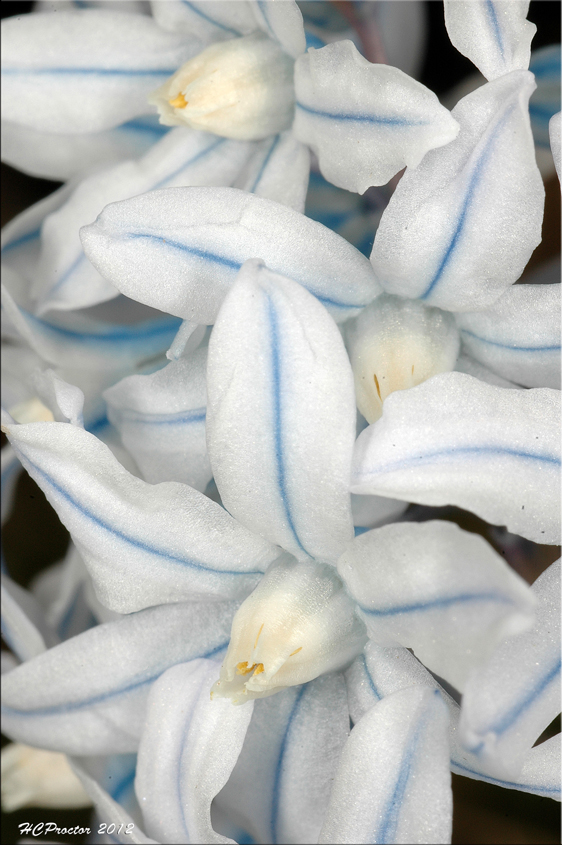
Striped Squill
The Striped Squill (Puschkinia scilloides libanotica) are the busiest at the moment, probably because they are in full sun. The queens of two early bumble bees, the Tricoloured (Bombus ternarius) and the Half-black (B. vagans or perplexus), stumble through the spikes of striped flowers with a loud buzz or two of warning, much as they did last May and many Mays before.
Tricoloured Bumble Bee at Striped Squill last May 7th
Not all is exactly as before, or at least I can't claim that is so. The fourth species of bee seems to be a largish Halictidae (Sweat Bee). Large for a Sweat Bee is not much - perhaps a tenth of the mass of a bumble bee queen - and this one is a bit skittish, so perhaps we never noticed it this early in the season before. But we do have one from mid-summer that looks very similar, so I'll leave off with that in case some other gardener would like to know what it looks like. If Mrs HBG gets a good picture of the Spring form, I'll post it for comparison.
Halictus Sweat Bee from July 2009

Saturday, February 25, 2012

Not Yet Native of the Week: Gladiolus imbricatus

A gladiolus for Zone 3

As my mythical long-time readers would know, I have been wont to ruminate on the native/alien dichotomy over the years. I’ve chewed the cud long enough that I have pre-digested the problem to my own satisfaction, swallowed my solution, and am ready to spread the results over my gardens and see what happens.
Gladiolus imbricatus
 Yes, native plants can be very nice and tend to be good for native insects and birds, but they alone do not a garden make and some are definitely mistakes (e.g. Jewelweed, Wild Strawberry). Yes, some horticultural creations are monstrosities, and any exotic plant has the potential to escape and grow where we’d rather it didn’t, but if you exercise reasonable caution (e.g. bird and wind dispersed seeds are bad), they do make for a much nicer and no less bug-friendly garden. Also, and I know some might find this controversial, some naturalized former exotics probably fit into their new systems rather well and increase the functionality (e.g. diversity, resistance to disturbance, recovery from disturbance) of the ecosystem.
Bombus vagans or perplexus and European Gladiolus
 Of course, if you define your ecosystems as if they were fixed and immutable and, in North America at least, created before European colonization, then you would probably take umbrage at any plant growing outside its proper place. I don’t share that particular belief system, but I do worry about letting loose something that may damage the environment. This was brought home to me the other day while reading a somewhat obstreperous review of Doug Tallamy’s book Bringing Nature Home (see Books in the Bug Garden sidebar) and the comment flurry at Gardening Gone Wild.
Leaf-cutting Bee enjoying a glad
 One thing that I realized was that I haven’t really done well by the Home Bug Garden exotics. So, herein I start a new series “Not Yet Native of the Week” wherein the pros and cons of plants not yet (or newly) part of the Alberta flora are considered. First up is the flower that enshrouded the ‘big-lipped bee’ in the most recent Pollinator of the Week, the only gladiolus that seems to be able to tolerate Zone 3 winters: Gladiolus imbricatus L. – variously called called the European, Red, or Turkish Marsh Gladiolus. Anyone who has grown the large hybrid gladioli (which need Zone 8 or better to ‘perennialize’) may be surprised to learn that there is a species that can survive our winters, but it is true. A friend gave me a handful of corms in 2006 and I’ve had a small patch ever since.
A denizen of wet meadows and marshes
 The fact that the leaf-cutting and bumble bees like the flowers is good, but also leads to seed pods which I regularly deadhead. This doesn’t stimulate more flowers, but does ensure that tiny gladioli don’t start sprouting here and there. Is that actually possible here in Zone 3?
A pleasant addition to an artificial meadow masking some squash and tomatoes
 Several gladioli are naturalized in North America, but G. imbricatus is not among them and none are listed as noxious weeds. If one casts their net somewhat wider, though, you find that this is not true in other parts of the World. Australia has several gladioli that have invaded roadsides and more intact native habitats and are considered important environmental weeds. I well remember coming across wild gladioli along the trails in Kings Park in Perth – and the disappointment on learning that these spectacular 'wild' flowers were weeds.

Where Gladiolus imbricatus is considered native (SE Europe and Turkey), it can be either a weed of cultivation or a rare meadow plant deserving protection. And, of most interest to us Zone 3ers, in Finland it is listed as a ‘casual alien’. So, I think I will continue to deadhead my gladioli and not plant them where they might escape into a wet meadow or marsh, but I certainly won’t grub them out.

Sunday, May 15, 2011

Bumbling with Bombus: Queens & Cuckoos

 It seems to have jumped from winter to summer in the Home Bug Garden. We had three straight days of sun and +20 C temperatures in a row – unusual even in the summer. We may get three more, but the winds are so blustery that one has to hunker down to enjoy the sun. That seems to be true of the bees too: strong winds keep them low to the ground, but fortunately at this time of the year that is where most of the flowers are. The queens of the early emerging bumblebees spent the first few warm days search every nook and cranny for nest sites, but now have settled down to serious foraging.
Actually, this is most likely Bombus perplexus - perplexing indeed
 The queens of at least three species of bumble bee are braving the windy HBG at the moment, all members of the subgenus Pyrobombus. We talked about Bombus vagans perplexus, one of the black and yellow bumble bees, last year when first working out how to be sure we were looking at the apparently threatened Bombus  (Bombus) terricola. They featured in my first Bombus Cartoon. The other Pyrobombus, however, are yellow, orange, and black – and the queens of two of these are both early emerging and very similar in appearance: B. huntii and B. ternarius. I know that workers of both species foraged in the HBG last year – the workers are a bit easier to tell apart – but the only difference I can find between the queens is that in ternarius the black on the thorax extend posteriorly on the scutellum (see Bombus Cartoon Mark II below).
 As we all know, I’m a bit camera-challenged and the wind hasn’t helped a bit, but I’ll offer a couple of blurry Bombus ternarius pictures in support of the identification. At least one smaller queen with yellow followed by three abdominal stripes of orange also passed through – most likely Bombus centralis – but the wind carried her away faster than I could start up my point-and-shoot.
 Lots of smaller hairy bees have also been out and I believe they belong to the genus Andrena – a complex group with lots of species. Along with the Bombus queens, these bees clearly liked foraging at Coltsfoot (Petasites palmatus) and Siberian Squill (Scilla sibirica 'Spring Beauty'), and the Bombus also went after the Striped-Squill (Puschkinia scilloides 'libanotica') voraciously. Tulips, except Tulipa tarda, seem of little interest to the bees and the large Dutch crocus accounted for all but one or two of the crocus visits that I saw (and the smaller crocus out numbered the Dutch crocus by about 20:1). 
 So, I guess I’ll just have to consider the hybrid tulips, daffodils, and smaller crocuses for me and the rest for the bees. However, there was one bee at the squill and coltsfoot that I’m not so sure I was happy to see, although it represented a new HBG record – a species of Nomada
 These wasp-like bees are cuckoos – the females enter the nests of other bees, lay an egg, and their grub eats up all the host bee’s provisions (this is called cleptoparasitism – same root as in kleptomania). I suspect it is the Andrena that will be robbed (blurry below, better one here from a previous May).