Showing posts with label Bombus. Show all posts

Sunday, June 16, 2013

Bumbling with Bombus: Chives, Bumblebees & Corrections

Three queens of the Tricoloured Bumble Bee at Chives flowers
As herbs go, Chives (Allium schoenoprasum) isn't one of my favourites. I find it rather mild and usually too tenuous for my palate. As flowering onions go, though, Chives is attractive and reliable. Even better, the bees love it. On Friday, one of my patches of Chives in the country (at Gopher Hill) had a dozen bumble bee queens nectaring.
Also known as Orange-belted Bumble Bee Bombus ternarius
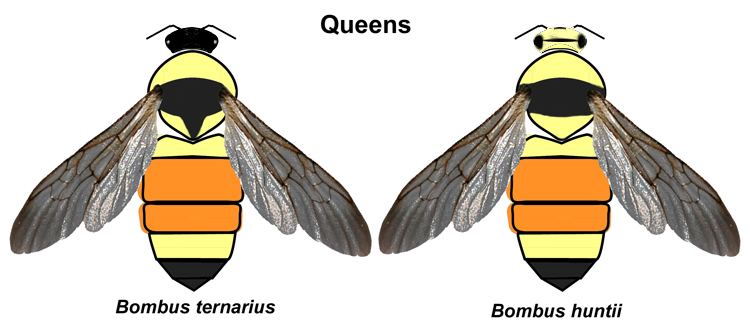
The most abundant of these bees, and probably the easiest of all Edmonton area bumble bees to learn, was a half dozen Bombus ternarius the Tricoloured Bumble Bee. The only other Bombus here with a pair of orange bands between two yellow ones on the abdomen is Hunt's Bumble Bee (B. huntii) and this bee lacks the black triangle pointing back on the thorax and has yellow hairs on the head and face (usually black in ternarius, as above, but not always).  The black triangle is a 'key character' amongst the orange-banded bees.

Hunt's seems to be fairly rare here, but the Tricoloured is very common. In the foothills and mountains, e.g. around Calgary, the Forest Bumble Bee B. sylvicola can look very similar, but usually has two yellow bands behind the orange ones.
Half-black Bumble Bee Queen Bombus vagans or rufocinctus?
More easily confused are the two Half-black Bumble Bees that we have in Edmonton, the 'true' Half-black (B. vagans) and the Perplexing Half-black (B. perplexus - aka Confusing Bumble Bee). I've buggered these up before, but now can usually tell them apart. The local B. perplexus seems to arrive earlier in the spring and has only a small, circular area of black between the wing bases and the yellow on the side of the thorax is interrupted by black. Bombus vagans has more extensive black between the wing bases and uninterrupted yellow under the wings - and often some yellow hairs on the posterior abdomen (nice character when present). [Update - and just to keep us guessing, the ever variable Bombus rufocinctus also has a half-black morph.]
Perplexing Half-black Bumble Bee queen Bombus perplexus

Friday, June 14, 2013

Weather Whinging, Camouflage, Violets & Mosquitoes

Bombus rufocinctus queen climbing Jacob's Ladder in a rare ray of sunshine
Those of you who make a habit of reading this blog already know that I make a habit of whinging about Edmonton's weather. Although I have taken every opportunity to point out its failings, the Weather has yet to improve one bit. I give up! If it wants to rain every day in June, then let it. Instead here are a few interesting bugs and flowers from those rare moments between showers. Goldenrod is a great flower for insects, and so, always a joy to see in bloom (even though it means 'summer' is ending), but not especially interesting before it blooms - except this year. 
What the ...? 
Synchlora aerata (Fabricius, 1798), otherwise known as the Wavy-lined Emerald is a new visitor to the Home Bug Garden. Or at least I think it is - the first one I saw looked more like bits of leaves stuck in a spider web than a caterpillar and I wonder how many I'd missed in the past. Also known as the Camouflaged Inchworm (aka Looper), this geometer larva likes to eat a variety of composites - and adorn itself with bits of leaves and flowerheads. Many geometer caterpillars do very good imitations of twigs or are pale green with light longitudinal lines that blend into vegetation, but this was the first I've seen that dresses up the better to not be seen. Miklos Treiber studied some of these caterpillars and found the process was more or less continuous - as the fragments dried out the inchworm added new bits of plant (using a glue-like substance from its mouth).
Synchlora aerata (Fabricius, 1798) inching along
Anyway, there is lots of goldenrod, gayfeather and Joe Pye Weed in the Home Bug Garden, so the Camouflage Inchworm should feel right at home. Also popping up in a brief bit of sun is another native plant, the Prairie Violet Viola pedatifida. 
Prairie Violet Viola pedatifida
Also called the Crowfoot, Birdfoot or Larkspur Violet because of its dissected leaves, unlike most violets, this one likes it relatively hot and dry - gravelly hillsides and prairie grasslands being it usual habitats in Alberta. 'Hot and dry' are not appropriate terms for a garden in Edmonton, but two of the three plants I put into the southwest corner of the Home Bug Garden survived the winter and bloomed. 
AKA Crowfoot, Birdfoot and Larkspur Violet
Finally who can resist the charms of Edmonton's most famous flying insect, the mosquito. We bug paparazzi flock to them whenever we see them and try to annoy them as much as they annoy us. Here's one mugging for two cameras.
Two views of one mozzie.

Tuesday, May 14, 2013

And the bees are back too

Bombus rufocinctus Queen at Elephant Ears

This last week has seen bumble bees (preferred to 'bumblebees' by some) on the wing in central Alberta. All flying at the moment are fall-mated queens newly emerged from hibernation and intending to found new colonies. This one is a queen of a red morph of Bombus rufocinctus nectaring at the flowers of an Elephant Ear (Bergenia cordifolia).
T2-3-4 red-orange = Red-banded Bumble Bee (B. rufocinctus)
One of the more variable and confusing of the local species, the Red-banded Bumble Bee has numerous colour morphs. Like many insects with a noxious taste (and bad taste rather than the ability to sting is thought to be more important), bumble bees that tend to look like each other are more likely to be left alone to go about the business of raising a family. This is called Müllerian mimicry. Unfortunately, bees that all want to look alike leave many a bee-afficionado scratching their head when trying to put a name on them.
Bombus moderatus Queen wishing I would go away
Names are important, especially scientific names, if we want to keep track of species. Ten years ago when the Home Bug Garden was starting to take form, we had regular visits from the Yellow-banded Bumble Bee Bombus (Bombus) terrricola. Since then that species has become very rare, perhaps gone (I think I saw a queen at the Royal Alberta Museum last week). But a new Bombus (Bombus) has come along, Bombus moderatus (aka cryptarum). I suppose that is a good thing, a White-tailed Bumble Bee (or Cryptic Bumble Bee if you prefer obscure common names) is an interesting addition to the pollinator fauna, but what's up with the Yellow-banded? 
Andrena milwaukeensis Graenicher, 1903, tanking-up at Coltsfoot. Seemingly too small and obscure for a common name, would we miss it if one spring it didn't show up?
Of course, bees too shuffle off their mortal coils - should that give us pause? Does it make sense to get all flustered about the decline of a bug, even one with a generally nice reputation and useful lifestyle like a bee? Sure plants need pollinators, but aren't there plenty of them out there? Well, seeming not so much as there used to be in places like the United Kingdom and North America. 
A fat cat secure in its knowledge that food will always miraculously appear
If a bee disappears will we miss its buzz? Not unless we can put a name on the buzzer. For most bees that is not such an easy thing, but hope is on the horizon, at least for bumble bees. A new citizen science project for North Americans is about to take wing: Bumble Bee Watch (http://bumblebeewatch.org/) and a new field guide will soon be out:
Williams, P., L. Richardson, R.Thorp & S.R. Colla. (To be released spring 2013) A Field Guide to the Bumblebees of North America. Princeton University Press.
From sun to rain in 13 hrs: So long sunny weekend
Now, if the weather would only cooperate. It isn't only cats and people that enjoy sunny weekends. This is a critical time for the spring bees - all are starting their nests and need some sun and warmth to fly and to encourage the flowers to bloom. Alas, this is Alberta.

Friday, August 3, 2012

I just want to bee ... left alone

Newly emerged Bombus moderatus looking for a night's rest in a daisy
Bug Girl tells me that my idea of a post defending Spiderman's wrist-spinning abilities based on what we know about hox genes and what we don't know about radioactive spider venom would be a traffic fatality. Well, the Home Bug Garden has never been about high traffic, just musing about urban biodiversity and trying to stay sane in Zone 3, but maybe I'm getting too serious. Ergo, a new (and probably ephemeral) series for those of us who just want to bee left alone.
Some day maybe she'll be a queen, but it's a long time until next May
And who better to kick off the series, then our very own recent colonist Bombus moderatus (or is it cryptarum? Only the genes know for sure). This newly emerged adult female showed up the other night in the cool evening between storms looking for a place to sleep. It's nearing the end of summer in Zone 3 and the successful bumble bee colonies are producing mostly reproductives: males (drones) and females (next year's queens). A few workers continue their job of collecting pollen and nectar, but most of the bumble bees you see at flowers from now until frost will be drones. Now and then you may find a large and brightly coloured queen wannabe. She'll have to load up on carbos and find a place to outlast predators, parasites, and the long cold winter. If she survives until May, then she has a chance to found her own colony and be a queen, but right now she can only dream.
To sleep, perchance to dream ...


Wednesday, July 18, 2012

Of Sloughs and Sogginess

Weather 1, Home Bug Garden 0
If you've read this blog for any length of time, you may have noticed that I tend to complain about the weather. Well, the weather, House Sparrows, and noisy neighbours, in about that order. Last night we had really noisy weather and neighbours: first the thunder, lightning, and deluge (3rd of the last week) and then car alarms blaring from 3 am until I dragged myself up to go to work at 5. When I realized I would need hip waders to get to the train, and that the cars bobbing around in the street were the source of the unending alarms, I stopped feeling angry at the neighbours and went and looked at my basement.
What does a 6-legged basement spider do in a flood?
What I saw was water and a sad spider, missing half its legs on one side, clinging to the basement wall above the wet. Not being able to claim I was missing a quarter of my limbs, it was time to start bailing and mopping. After Mrs HBG explained to the TV crew that we live in what used to be a slough, she put on her gum boots and slogged off in search of a train. I bailed and mopped and moped and then curled up on the dry spot on the bed (did I mention that the cat peed on the bed last night?) and dreamt I was in Queensland (where much worse floods occurred last year).
A pair of Perplexing Half-Black Bumble Bees ignoring the rain
And when I awoke, if not refreshed, at least dry, rather than continue to mope, I learned two new bugs from before the deluge. The first, Bombus perplexus, is a tentatively welcome addition to the Home Bug Garden. They do have a bit of a reputation for being aggressive, but so far they haven't bothered me. Unfortunately, they are very similar to the Half-black Bumble Bee Bombus vagans, so a bit of an id challenge.
Red Turnip Beetle Entomoscelis americana
The second is very colourful, but a pest, but not the pest I feared: the Lily Beetle. The HBG sports a number of lilies including a native, but mostly aliens raised from seed, donated by friends, or on found sale at a nursery. I never thought I'd become a lily lover, but they do have their charm.
Lily raised from seed awaits the deluge
Instead of a Lily Beetle, the HBG sported a Red Turnip Beetle. These eat crucifers such as cabbage and canola, and given how yellow with canola the countryside is at the moment, it is surprising that we haven't encountered them before. I suppose I will need to keep watch over my kohlrabi, but I know the worms of the Cabbage White will get them first, so why worry.
Bad, bad broccoli worm

Friday, June 15, 2012

Pollinator of the Week: A Buzzing Bonanza

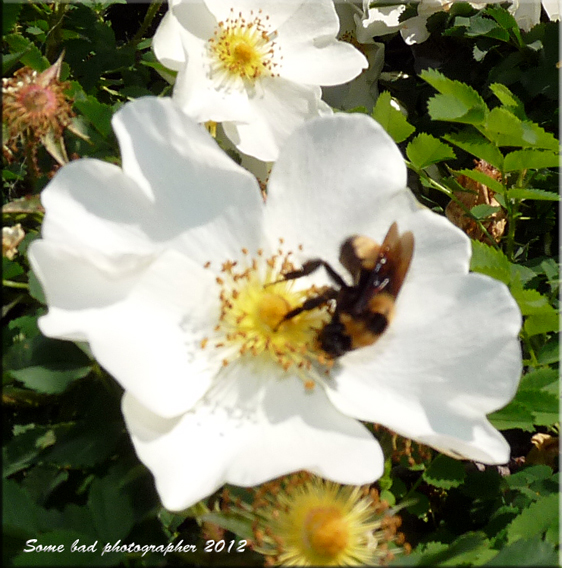
Scots Rose & White-tailed Bumblebee
June can be  beautiful month in Edmonton, or so they tell me. In my experience, the beauty comes in small doses, with the breaks in the clouds as rain-laden low after low rolls across. Oh yeah, I know, I'm always whinging about the weather here, but take a look for yourself.
When the sun does break through, though, things start popping. In the first two weeks of June, it is the Scots Rose (Rosa spinonissima 'Grandiflora') that pops the most. Our heirloom monster came with the house and is about 4 meters of spiny canes in every direction. Sometime between June 1st  and 16 June (the cold spring of 2009), the thorny mound becomes covered with large (7-8 cm diameter) single white roses - and bees galore, at least when the sun is shining.
The new, and currently most common, Bombus in town
Wednesday afternoon the sun was shining and the bees buzzing. The most common was also the most recent addition to the Edmonton Bumble Bee Fauna: the White-tailed Bumblebee, variously known as Bombus cryptarum, lucorum, and moderatus. The genetics seems to favour the latter, so that is what I am sticking with.
Red-belted Bumblebee Queen
Although apparently the most common bee at the Scots Rose - and with unusually large workers for this time of year - the White-tailed was only one of at least 6 species of Bumblebee harvesting the pollen and nectar.
Half-black Bumblebee worker
Second most common was old-reliable: the Half-black Bumblebee (Bombus vagans), both queens and new workers. But also present were queens of the Red-belted Bumblebee (B. rufocinctus - thanks to John Ascher for the id), the Tricoloured Bumblebee (B. ternarius), and a single queen each of the Yellow-banded Bumblebee (B. terricola) and what I'm tentatively calling the Black-and-Gold Bumblebee (B. auricomis). The latter seemed more interested in the lilacs, but was not above a blurry dive into a rose.
Maybe Black & Gold Bumblebee
But wait! There's more! A half-dozen or more other bees were also harvesting the bounty.
Halictus rubicundus - Banded Sweat Bee
A large and a small species of sweat bee (Halictidae) were zooming in and out and I'm pretty sure the larger one was Halictus rubicundus. She seems to lack a common name, but I will call her after her most striking character: the Banded Sweat Bee.
Leaf-cutting Bee Megachile sp.
A leaf-cutting bee was also in on the harvest, although collecting pollen on the underside of her abdomen, rather than on the hind legs. Then there were all the mystery bees.
Mystery bee in Scots Rose
Perhaps anthophorines, perhaps andrenids, perhaps halictids. Who knows? I think one may have been a yellow-faced bee and another an Andrena. There was so much rapid buzzing in and out that it was hard to keep track, but at least a dozen types of bee ended up in my notebook.
Probably a Digger Bee Andrena sp.
Alas, bees were not the only animals on hand to share in the bounty and not every bee made it home to its nest.
Digger bee becomes one with Misumena vatia
Oh well, it's not a Disney world in the Home Bug Garden, and there seemed bees enough for flowers and crab spiders.
Small worker of, maybe, B. centralis or flavifrons
Well, yet again, the showers have stopped for the moment and the sun is shining. Time to push through the wet vegetation and see if something interesting is buzzing about.
Rosa spinonissima 'Grandiflora'


Friday, May 4, 2012

Friday Bees

A Digger Bee (Andrena possibly milwaukeensis) at Colfsfoot
Spring is always slow to come to the Home Bug Garden, but when it finally arrives, it is nice to see some repeating patterns. The same Digger Bee species (Andrena cf milwaukeensis Graenicher, 1903) captured in the picture above on 2 May 2007 is active again this May 4th and joined by three other bee species.
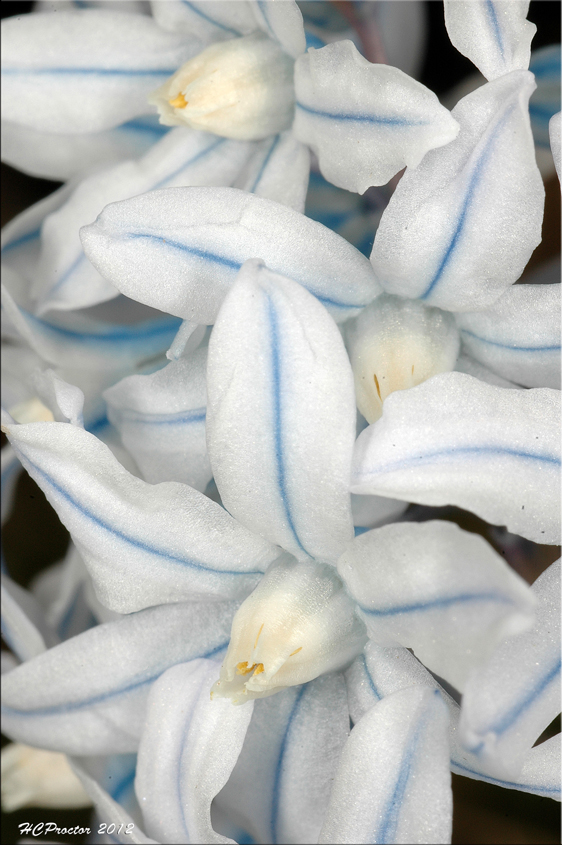
Striped Squill
The Striped Squill (Puschkinia scilloides libanotica) are the busiest at the moment, probably because they are in full sun. The queens of two early bumble bees, the Tricoloured (Bombus ternarius) and the Half-black (B. vagans or perplexus), stumble through the spikes of striped flowers with a loud buzz or two of warning, much as they did last May and many Mays before.
Tricoloured Bumble Bee at Striped Squill last May 7th
Not all is exactly as before, or at least I can't claim that is so. The fourth species of bee seems to be a largish Halictidae (Sweat Bee). Large for a Sweat Bee is not much - perhaps a tenth of the mass of a bumble bee queen - and this one is a bit skittish, so perhaps we never noticed it this early in the season before. But we do have one from mid-summer that looks very similar, so I'll leave off with that in case some other gardener would like to know what it looks like. If Mrs HBG gets a good picture of the Spring form, I'll post it for comparison.
Halictus Sweat Bee from July 2009