Showing posts with label arachnids. Show all posts

Wednesday, August 31, 2011

Summer Flies & My Favourite Weed

August is going out on a cold and dreary note. The dropping temperatures and yellowing leaves remind us that soon the Frost Monster will be slashing at the Home Bug Garden plants and animals. The first to go will be the South American Solanaceae: tomatoes, tomatillos, ground cherries, potatoes, and peppers. Tonight it is supposed to drop to between 5 and 3 C, depending on which Edmonton airport you live closest to (HBG is midway between). And I’m eyeing all those green tomatoes and yellow peppers and wondering how optimistic I should be.
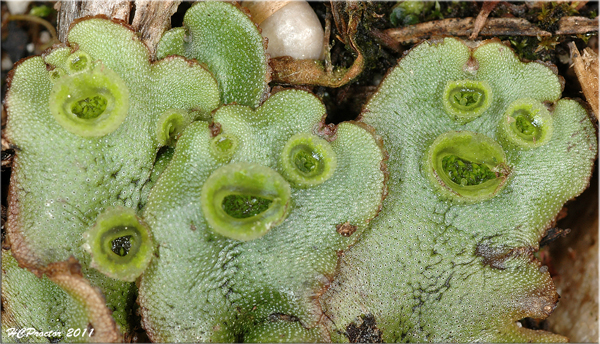
One plant that won’t pay much attention to the Frost Monster will be my favourite weed: the thallus forming liverwort Marchantia polymorpha Linnaeus. Many liverworts look much like the mosses with which they used to be grouped, but marchantia looks more like a lurid green lichen with tentacles (females) or parasols (males) than your typical bryophyte. It does well on wet soil and may annoy greenhouse owners and some gardeners.
I suppose if I were trying to grow ferns but all I ended up with was more marchantia, then I might be annoyed too. As it is, I chop it up when it is in the way and try to appreciate it when it is growing in some more appropriate space, like around the base of the bird bath.
 Some people think that flies are pesky too, but other than ineffectively swatting at an importune muscid or calliphorid we try to get along with the higher Diptera.
Flies will likely be the first active insects next spring, so I think I’ll say goodbye to summer by revisiting some of the smaller and more interesting flies of the year.


 And lets not forget the bugs that will soon be memories too.


Sunday, May 23, 2010

Rain, Snow & Arachnophobia: An Ode to Spiders in the HBG


As I expected, yet another cold front has hit Edmonton. Below normal and wet is dragging through its 6th day and making a muddy mess of the May Long Weekend – traditional time to plant-out one’s annuals & veggies here on the northern edge of Zone 3. Oh well, the basement spiders don’t seem to mind the snow mixed with rain. The wet grey does tend to bring out the green and certainly has been good for all the plants I’ve already impatiently planted-out. No frost yet and we wish Itztlacoliuhqui full speed south (from the predictions, though, tomorrow morning is iffy). I’ve dead-headed the spent tulips and daffodils, but it is too muddy and cold to do more. Perhaps I should be doing responsible things like Spring cleaning, and then there is that mountain of unfinished work, but instead I’ve been irresponsibly indulging myself in the bug blogs.
Best discovery so far, thanks to an old 2008 post by Chris Taylor at Catalogue of Organisms has been Attercopus fimbriunguis - a Devonian fossil on the way to (or perhaps just in) the spiders. Problematic characters include a whip-tail, no distinct spinnerets (but fossil silk), and no poison glands (although modern segmented spiders apparently never had poison glands and at least one more modern family, Uloboridae, does without them). According to the Wikipedia article (at least at this moment) the generic name is from the Old English attorcoppa for "poison-head", clearly a misnomer in this case.

Fear of “poison-heads” is called arachnophobia – and it is true that most modern spiders produce venom. Few, however, have venoms that we need to be afraid of, which makes the apparently widespread fear of spiders amongst bug bloggers even more interesting. Today’s surprise confession was from the Dragonfly Woman, but it reminded me that arachnophobia runs the bug blog gamut from the bug-photography god-like heights of myrmecos to rock-bottom-up The Geek in Question. “Very interesting” (as former colleague and mammal-tooth-fancier Gordon Sanson might put it).
The Dragonfly Woman’s story comes from her teenage years and a fishing spider in her pool. So, perfect chance for me to drag up our own cherished male Dolomedes triton hanging out around our year old pond. Alas, I fear the male found no fair female and had to bugger off to an uncertain future (probably a more common fate for wandering male spiders than being eaten by their objects of desire). My wife and I, however, were delighted that he stopped by and only wish that more and bigger spiders would take up residence. Yes, we have no Arachnophobia (but are considering buying a dvd of the movie – which features an impressive cast of mostly Australian spiders, a moderately entertaining [if factually confused] script, and good, campy acting).
So, before I get serious about not enjoying my wet weeked and get out my kneepads and start cleaning out the lower kitchen cabinets, let me showcase a few of the interesting spiders that have been lurking around the Home Bug Garden. This is Alberta, so usually the only big scary spiders occur in the Autumn (especially the Jewel Spider) or in the basement (and those introduced buggers, Tegenaria domestica, and perhaps a hobo or two, do get big, hairy, and disconcerting - although the cats like them). Also, smaller spiders seem more likely to ignore a big black camera being poked at them, and so, are more photogenic.
Actually Araneus trifolium - gemmoides has two humps on its abdomen
The discerning viewer will note that all of the pictures are credited to my wife. That’s because she has the great Nikon and macro lens, not because I tend to stand a metre behind her saying “go on, get closer, it won’t bite”. Also, many are wandering males – again, “very interesting”, but in this case, I think, not unexpected. Movement and moving on to digital immortality are not unconnected.


Actually a theridiid - probably Crustulina sticta 


Tetragnatha is the correct spelling

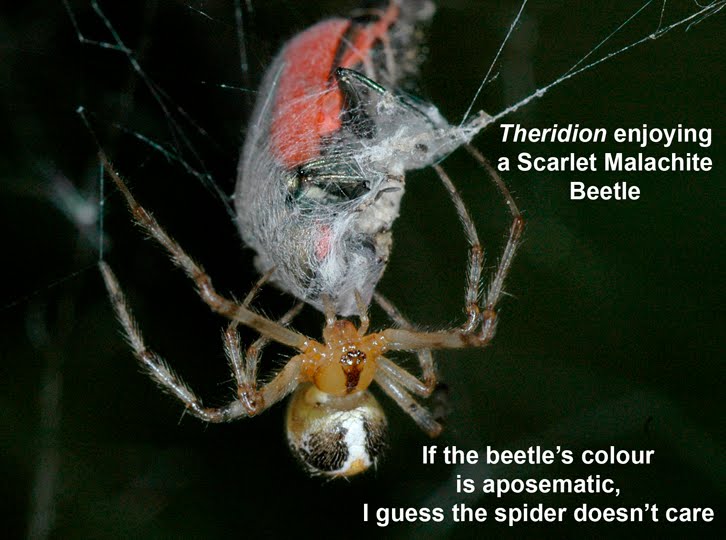
Phylonetta impressa (formerly Theridion impressum)


Saturday, May 2, 2009

Bugs in the Bug Garden: Overview, Caveats, Definitions


There’s been a lot of talk in previous posts about garden bugs, but not much in the way of evidence. Now that I’ve got the garden evolved to the stage where it started attracting more than the usual suspects, I think it is time to start celebrating the bugs and other critters that make life interesting for the discerning bug gardener. From time to time I will digress into some aspect of gardening theory or practice, but for the moment lets enjoy some bugs.

ABOUT the PHOTOGRAPHS: As time and weather permit, we do our best to document the diversity in our yard, but neither of us are professional photographers: taking pictures is a way for us to relax and the quality of the images will vary. Most of the macrophotographs (and all of the good ones) that appears on this blog were taken by my wife and she retains all rights to them. If you wish to use them for some purpose, then you must request permission (leave a comment). Ditto for any of my images – but feel free to link to them or feature them.

MISINFORMATION @ The Home Bug Garden: I (the HBG) do the preparation and labeling of the photographs. If anyone sees what they think is a mistake, then please let me know (leave a comment). If you are correct, then I will change the id and give you credit. Any and all suggestions about improving the identifications are welcome, as are any comments about the natural history of the organisms. Remember, take all identifications on this blog with a grain of salt. The higher the taxonomic level, the more likely the identification is to be correct. So, family names will usually be correct, genera less often so, and species least of all.

WHAT is a BUG in the Home Bug garden? The HBG view on animal life on this planet is Manichean: there are the charismatic invertebrates (the bugs) and then the other 1%, the birdibrates. We do keep track of the birdibrates (birds and other animals with a backbone, such as myself) – any one we can see from our yard is fair game, from the sandhill cranes in their thousands as they gruk overhead every spring and fall, to the coyote scurrying across the street in the predawn, to the white-tailed jackrabbits that eat the shoots of anything in the Rosaceae that doesn’t have spines, to the red-breasted nuthatches and house sparrows that fight over the bird boxes every spring. In total, we have identified 31 families of birdibrates (including Hominidae) visible from or in the Home Bug Garden. In contrast, and remember we do this as a hobby while both holding down full-time jobs, we have identified 137 families of invertebrates actually in the Home Bug Garden. If we were just a little more industrious, say actually trapping insects and lugging them off to a microscope (instead of taking their pictures), we could have easily doubled this total.

So, let’s start bringing on the “bugs”.