Showing posts with label beetles. Show all posts

Saturday, December 29, 2012

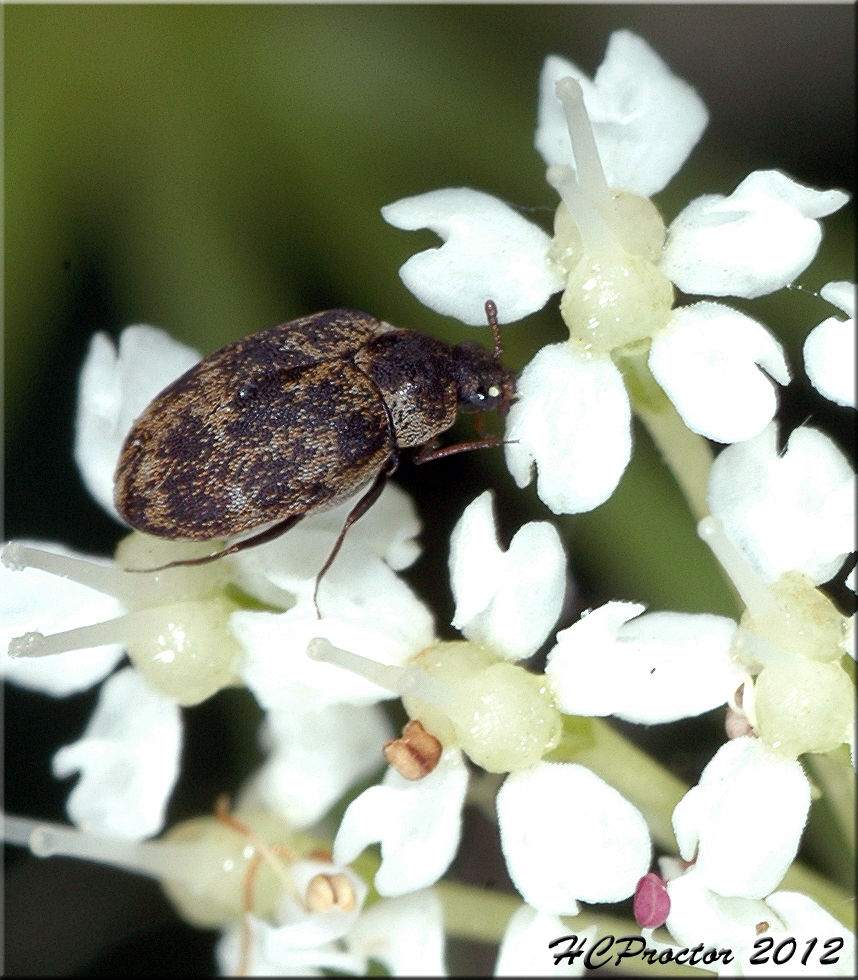
Bludging with Beetles: Ptinus fur, a spider beetle

Habanera pepper seed & cautious spider beetle
The Anobiidae is a family of beetles with the charming common name of 'Death-watch and Spider Beetles'. Among the thousands of species known worldwide, fewer than a hundred live in Canada and only one, so far as we know, inhabits the Home Bug Garden: Ptinus fur (Linnaeus,1758), the White-marked Spider Beetle. The far more ominous sounding Death-watch Beetle Xestobium rufovillosum (De Geer, 1774) bangs its head against the rafters to attract a mate on calm summer nights (you can watch and hear one here). I suppose if you can't sleep this might sound discomforting, but nowhere near as perturbing as the noises the squirrels make in our attic.
Somewhat battered male Ptinus fur ~3 mm long
Like the Death-watch Beetle, the White-marked Spider Beetle is nocturnal but with a body that is less than half as long. As well as being tiny, these beetles like it chilly - the one above just came out of a 4C refrigerator, but was running around too fast to get a decent picture. No worries, though, there are several excellent pictures on the web, such as this habitus shot at BugGuide and this spectacular stack-image on Flicker. The Flicker picture by John Hallmen consists of 153 separate images, each with a slightly different focus, that were merged into a single high resolution picture.

We find White-marked Spider Beetles in our basement every winter. They have a broad diet, including stored foods, but a long generation time (over a year) and aren't usually considered major pests. As long as we are only finding a few, I don't think I will worry about them, and they count towards the Winter Bug Challenge - over 50 species of arthropods so far.

Sunday, December 16, 2012

Adventures in Spider Misidentification: The Ravenous Ravened

A young orb weaver is more than a match for a Ravenous Leaf Beetle
I think this is a very young orb weaver, but I could be wrong. The web looks more crosshatched than orb-like, but I think I see radiating strands. In any case, the body sorta looks right (but remember the title of this series). I'm more sure about the victim, having spent much time and effort sorting it out: a Ravenous Leaf Beetle Orsodacne atra (Knoch in Ahrens, 1810).
3 pairs of Orsodacne atra being a bit excessive in a saskatoon flower
The colour patterns in Orsodacne atra vary quite a bit, but all are now considered to represent one species. The common name seems a bit off, but presumably somewhere some species in this family voraciously plunders a plant that people value. Orsodacne atra has been reported from birch and willow, but more as a curiosity than a pest. The adults, however, do seem to 'raven', i.e. devour voraciously, the reproductive parts of flowers, especially in the Rosaceae. 'Raven' and 'ravenous' come from the Old French raviner - to take by force, via the Latin rapina, from which we get several terms for unfettered excess.
A pair of Australian Ravens (Corvus coronoides) up to no good
Surprisingly, though, the crow-like bird called a 'Raven' (Corvus corax
Linnaeus, 1758) comes to use from a different origin: Old High German, Middle Dutch, and Old English equivalents of raban, the name for a big, black bird. So, even though ravens are known for plundering, Danish Vikings flew a raven flag, and many cultures fear ravens as bearers of ill omen, the similarity in words is a coincidence. The Raven is one of the few large birds to brave the Alberta winter and when they start moving into town from the countryside (once the Crows [Corvus brachyrhynchos] have moved south), you know winter has arrived.
American Raven with classic wingspread and boat-tail

Saturday, November 17, 2012

Bludging with Beetles: The skin-eaters (Dermestidae)

Not a white box: Skin-eater larva trapped in the bathtub
The Home Bug Gardener has been a busy boy and not all of his time has been spent shovelling snow. Last week the Joint Annual Meeting of the Entomological Societies of Canada and Alberta graced Edmonton with its presence. For five days (and for many months beforehand) it was bugs, bugs, bugs. Also known as the Local Organizing Committee, the local entomologists get to host the rest of the nation, and that means all work and no play. By the time it was over, I looked up to see nothing but deep drifts of accumulated snow and work to dig through. There must be something better to do.
Mystery dermestid beetle
In just a few short weeks it will be time to celebrate those hardy (or pesky) bugs that snuggle-up with us for the winter (synanthropes) or love the cold (cryophiles): John Acorn's Second Annual Winter Bug Challenge. The challenge is to the birders who will be beginning their Winter Bird Counts next month. John's hope is that we can find at least as many species of arthropods actively enjoying the Alberta winter as the birders can find birds. The hairy larva at the top is one such almost record from last winter. Although we know the family, adults are needed for species identification. Possibly, this is a larva of the Larder Beetle, the only dermestid adult we have on our in-home list. But out-of-doors during the warmer months roam other more or less mysterious dermestids. Literally 'Skin + eating' (derm + este), dermestids like their skin dead and dry. Any proteinaceous scurf will do, including dead insects, dried meats, and meat byproducts like cat food. Since I accidentally kick one of the cat bowls at least once a week, I'm sure we have bits of dry cat food crumbling in corners and toasting in floor vents. In any case, a Larder Beetle or two is not an uncommon find (although we have yet to get a good picture of one).
Carpet Beetle (Anthrenus sp.) enjoying a carpet of Goutweed flowers
But looking through BugGuide, I rather doubt our bathtub-bound hairball is Dermestes lardarius. Looks more like the larva of a Carpet Beetle in the genus Anthrenus, perhaps like the one above enjoying a goutweed flower (the generic name comes from the Greek for flower). Wool is another one of those animal products that dermestids will eat and several are known as 'carpet beetles' from their predilection for woollen carpets. Alas, we have no woollen carpets, but languorous patches of cat fur sprout spontaneously in front of our heat vents. I suppose there are worse ways to while away the winter days than watching a carpet beetle larva transforming cat fur into a scaly beetle.  A jar, some cat hair, and a beetle larva is all it would take. Perhaps not as much fun as watching a caterpillar transforming milkweed into a Monarch butterfly, but this is Edmonton in the winter.

Sunday, November 4, 2012

Adventures in spider Misidentification: Wine, weevils, and cobwebs

Intrepid Cobweb Spider makes meal of weevil
October was a dreary month in the Home Bug Garden: frosts and clouds and snow and sleet and rain. Freezing rain does make snow seem more benign, but not any easier to shovel. Not a good time for bugs, but frosty evenings are an appropriate cue for an enophile to switch from summer whites to winter reds. A glass or two of Australian shiraz or New Zealand pinot noirs are pretty fair lubricants for the task of sorting through last summer's pictures and seeing what new records may be lurking among the folders. Unfortunately, although supposedly in vino veritas, I'm not finding many Latin binomials jumping out at me yet.
Theridiidae vs Curculionidae - not the most inspired of identifications
I'm guessing that this small spider is a female Theridiidae, a Cobweb Spider, because legs I are very long and legs III rather short. The other likely alternative, Linyphiidae, should have thinner legs of more uniform length and lots of macro-setae, or at least that is my impression. The beetle is clearly a weevil, Curculionidae, and perhaps a member of the subfamily Entiminae, Broad-nosed Weevils, but other weevils also have short, broad snouts. Well, one good thing about wine. The more one drinks, the less important knowing a name becomes and the easier it becomes to simply enjoy the evening and remember sunnier times. 

Friday, September 7, 2012

Friday Stink Bugs: from the gaudy to the dowdy

Fall aggregation of stink bug nymphs
When I was a child, life was so much simpler. For example, a stink bug was a stink bug was a stink bug (although sometimes a stinkbug) and always Pentatomidae. 'Penta', of course means 'five', as in Pentagon, pentagram, etc., and 'tom' means 'cut'. Undoubtedly, this refers to the antennae of these bugs which are 'cut' into five segments. Most true bugs (Heteroptera) which get along with four or fewer. Alas, now we have two families to choose from: Pentatomidae and Acanthosomatidae. Well, whatever family they now inhabit, stink bugs usually live up to their names - they smell and, e.g. if one is too hasty eating a blackberry (not the electronic kind), taste bad too. Of course, many and possibly most 'true bugs' have thoracic glands that produce an odour that no one would mistake for a rose, but stink bugs are reliably smelly. Usually, though, they are not so brightly coloured.
Understated stinkyness - One-spotted Stink Bug
Take, for example, the One-spotted Stink Bug Euschistus variolarius (Palisot de Beauvois, 1805). Although not leaf green, as many stink bugs are, she clearly has no interesting in standing out. This is a full grown adult, but what I think is a nymph is similarly unremarkable.
What I think is a nymph larva of the One-spotted Stink Bug
Well, in my youth this was a nymph, as all immature terrestrial insects that did not go through complete metamorphosis were called. But now 'nymph' is out of fashion and hip entomologists call all immature insects, from maggots to hoppers, larvae. I'm sure the heuristic value of a holistic view of metamorphosis makes up for the loss of information conveyed by anachronisms like 'nymph'. Anyway, as long as someone knows that 'larvae' is plural and 'larva' singular, I'm unlikely to have a fit. (Although this information does not seem to be being passed down very well to the larval generation of entomologists.)
Twice-stabbed Stink Bug Adult and Larva: Cosmopepla lintneriana Kirkaldy, 1909 
Stink bugs are capable of advertising their distastefulness in both the adult and larval stage, as in the Twice-stabbed Stink Bug above. That our larval One-spotted Stink Bug does not is is interesting, in a rather intricately drab way. Why not advertise one's ability to make one go 'yuck!'? The One-spotted has a rather broad diet, everything from grass to veggies to fruit trees to other insects. So perhaps it finds being rather averagely drab an advantage in a variety of habitats. Sure, brightly coloured stink bugs may taste inexecrably bad, but who's to know until one tastes one?
Ground beetle that likes smelly food?
So is this predatory ground beetle (Carabidae) about to get the surprise of its life or does it like stinky food? Or perhaps caution will get the better of hunger. Alas, the photographer didn't stick around to find out, so we will have to end with a double mystery: and unknown larval bug and an unknown ground beetle.

Monday, September 3, 2012

A Tiger Beetle, not exactly glowing, but with a very long name

Kirby's Oblique-lined Tiger Beetle Cicindela (Cicindela) tranquebarica kirbyi LeConte, 1866
In the previous post we took a look at a fairly diverse family of flies where most were obscure and lacked common names. Today we have the cultural opposite: Tiger Beetles! Here every species has a common name and many "species" are subdivided into 'subspecies' with their own additional name. Ours is most impressively endowed as Kirby's Oblique-lined Tiger Beetle Cicindela (Cicindela) tranquebarica kirbyi LeConte, 1866.
Iridescence at a distance = crypsis
I'm not sure why tiger beetles are so beloved, but the tribe Cicindelini are called Flashy Tiger Beetles, so I suppose their metallic glitter is part of the allure. Many are very brightly coloured in metallic greens, coppers, and reds. Linnaeus named the genus Cicindela from the Latin for a 'glow worm', so I suspect even he found them showy. And Tiger Beetles are both aggressive predators and on the largish side - often 2-3 cm in length.
Not especially showy, but large enough to be seen and fleet enough to be fun chasing
Part of their allure may be that many are hard to find and not easy to catch. In spite of all their glitter, many blend into their habitats very well.  And Tiger Beetles are fast! So, gaudy, diverse, fast, and only active when the sun is shining. Pretty much the butterflies of the beetle world and with the added attraction of being deadly hunters of other insects. If you see an entomologist dashing madly about with a net, and no butterflies are in evidence, they may well be after tiger beetles. I suppose I should read John Acorn's book on these beetles. But, alas, it is at the lab, so my Labour Day afternoon must be spent on more mundane matters.

Acorn, John. 2001. Tiger Beetles of Alberta: Killers on the Clay, Stalkers on the Sand. University of Alberta Press.

Wednesday, July 18, 2012

Of Sloughs and Sogginess

Weather 1, Home Bug Garden 0
If you've read this blog for any length of time, you may have noticed that I tend to complain about the weather. Well, the weather, House Sparrows, and noisy neighbours, in about that order. Last night we had really noisy weather and neighbours: first the thunder, lightning, and deluge (3rd of the last week) and then car alarms blaring from 3 am until I dragged myself up to go to work at 5. When I realized I would need hip waders to get to the train, and that the cars bobbing around in the street were the source of the unending alarms, I stopped feeling angry at the neighbours and went and looked at my basement.
What does a 6-legged basement spider do in a flood?
What I saw was water and a sad spider, missing half its legs on one side, clinging to the basement wall above the wet. Not being able to claim I was missing a quarter of my limbs, it was time to start bailing and mopping. After Mrs HBG explained to the TV crew that we live in what used to be a slough, she put on her gum boots and slogged off in search of a train. I bailed and mopped and moped and then curled up on the dry spot on the bed (did I mention that the cat peed on the bed last night?) and dreamt I was in Queensland (where much worse floods occurred last year).
A pair of Perplexing Half-Black Bumble Bees ignoring the rain
And when I awoke, if not refreshed, at least dry, rather than continue to mope, I learned two new bugs from before the deluge. The first, Bombus perplexus, is a tentatively welcome addition to the Home Bug Garden. They do have a bit of a reputation for being aggressive, but so far they haven't bothered me. Unfortunately, they are very similar to the Half-black Bumble Bee Bombus vagans, so a bit of an id challenge.
Red Turnip Beetle Entomoscelis americana
The second is very colourful, but a pest, but not the pest I feared: the Lily Beetle. The HBG sports a number of lilies including a native, but mostly aliens raised from seed, donated by friends, or on found sale at a nursery. I never thought I'd become a lily lover, but they do have their charm.
Lily raised from seed awaits the deluge
Instead of a Lily Beetle, the HBG sported a Red Turnip Beetle. These eat crucifers such as cabbage and canola, and given how yellow with canola the countryside is at the moment, it is surprising that we haven't encountered them before. I suppose I will need to keep watch over my kohlrabi, but I know the worms of the Cabbage White will get them first, so why worry.
Bad, bad broccoli worm

Wednesday, June 6, 2012

Wet Wednesday Beetle: The Firefly that couldn't

A firefly that flies, but doesn't fire
The genus name, Ellychnia, of this luminescently challenged firefly (a beetle in the family Lampyridae) apparently is derived from the Greek for a lantern or lantern wick, but it has no light-making organ. I suppose the common name of Diurnal Firefly gives us a hint of why this may be so. We call this beetle Ellychnia corrusca s.l. The appendage stands for 'sense broad' in Latin (sensu lato), because 'corrusca' seems to be a complex of species.
Ellychnia corrusca or a close relative
Diurnal Fireflies are common on flowers such as goldenrod in the fall, overwinter as adults, and show up early in the late central Alberta spring. Although they don't shine, we like them anyway. At our place in the country, there is a firefly that shines in the vegetation along the shores of the lake and marsh. This is undoubtedly a species of Pyractomena, Alberta's only glowing glow-worms, but which of the two species we are not sure. I suppose some summer night we should brave the bog and beavers and try to get a picture and specimen. But so far, we've just been happy to watch them flicker in the dusk.


Saturday, May 26, 2012

A Sour Solution: Feed your bees & beetles cherries

Andrena bee in Evans Cherry Blossom
Edmonton has a lot of intrusive bylaws, but the ban on keeping honey bees is an especially annoying one for home gardeners. Many vegetable and fruit crops require cross-pollination, something honey bees are very good at, but they are a rare sight in the Home Bug Garden. Fortunately, the native' pollinators have responded well to the conversion from lawn into open woodland and I get 'free' pollination services.
Scarlet Malachite Beetle & cherry blossoms
I have a half-dozen varieties of cherries (Prunus) blooming in the Zone 3 HBG at the moment, but none are the Sweet Cherries that are commonly found in grocery stores. Zone 7 is about the limit for most Sweet Cherries, although some apparently can survive into Zone 5. Instead, I have a variety of 'bird cherries' (Nanking Cherry, Mayday, Sandcherry) and 'sour cherries': Prunus cerasus 'Evans' and some hybrids between cerasus and the Mongolian Cherry P. fruticosus called Prunus x-kerrasis developed at the University of Saskatchewan.
7-spot Lady Beetle - not a great pollinator, but a good predator of Black Cherry Aphid
The 'sour' cherries are self-fertile, but still need insects to move their pollen around. Currently, at least four species of bees (Andrena milwaukeensis, Bombus moderatus, Halictus confusus, and an unidentified Lasioglossum), the two beetles above, and a small hover fly have been seen doing their best to help me make cherries for snacks, crumbles, pies, and wine.
Cat-licking good: Half the first harvest
The Evans Cherries are 7-8 years old and small trees. Each Evans has produced 5-10 kg of slightly tart cherries for the last three years - as pleasant as raspberries for snacking and a very nice fruit wine base. The Prunus x-kerrasis hybrids (Carmine Jewel, Romeo, Juliette) are younger, shrubby cherries, but are reputed to have rather sweet fruit. This is the first year they have had more than a few blooms, so I hope to be able to test the 'sweet' hypothesis. Thanks to the bees, beetles, and flies, of course.
Evans Cherry reaching for the sky

Tuesday, May 22, 2012

Rainy Tuesday Click Beetle

Ampedus apicatus (Say, 1839)
Click beetles (Elateridae) are familiar to many children who delight in turning them on their backs to watch them spring up with a loud click in attempts to right themselves. Since the click beetle family Elateridae contains almost a thousand species in North America, children have a great variety of clickers to choose from. The larvae, called wireworms, of a few of these are pests in vegetable crops, pasture, and grains. In Alberta, only one of the 80 known species is a pest, the Prairie Grain Worm Ctenicera aeripennis (Kirby, 1837) (or perhaps the subspecies aptly named 'destructor').
To click or not to click ...
Ampedus apicatus (Say, 1839) lives in the boreal forest and appears to cause no problems - and hence has no common name. I think of it as the 'Two-spotted click beetle with the black thorax and head', but that is a pretty onerous handle. 'Apicatus' is clearly from the Latin for 'at the tip', but the generic name is a bit of a puzzle - perhaps an amalgam of the Latin 'Am' (loving) and the Greek 'pedo' (earth). Perhaps 'Apically-spotted Earth Lover' would come more trippingly on the tongue. Its wireworms may feed on fungi in rotting logs or perhaps prey on other insects in that habitat, but no one seems to know. Usually, I let them go on their merry way, but sometimes a childish urge to turn them on their backs gets the better of me.

Additional reference:

Webster et al. 2012. New Coleoptera records from New Brunswick, Canada: Elateridae. ZooKeys 179: 93–113, doi: 10.3897/zookeys.179.2603
http://www.pensoft.net/journals/zookeys/article/2603/

Friday, October 14, 2011

Wine, Bacon, and Beetles

A beetle that appreciates wine - the Picnic Beetle
Autumn has certainly settled in and as the leaves colour and fall, the other garden colours also fade away. Gone are the butterflies, yellowjackets, bumble bees, and flower flies. A few flowers still linger in spots sheltered from the frost, but only honeybees visit them. If you search around, there are still plenty of grey flies and midges. A small swarm of Dixella midges were dancing near the pond on a warm evening just last week. But the drabness of winter is clearly drawing neigh.
Glischrochilus fasciatus (Olivier, 1790)
So a colourful beetle is a welcome visitor, even if it seems intent on drowning in one's wine. Glischrochilus fasciatus (Olivier, 1790) has a number of boring common names based on its spots, but my favourite nom de bug is the Picnic Beetle. A member of the Sap Beetle family (Nitidulidae), well known for their fondness for fermenting plant juices, the Picnic Beetle often lives up to its name and pesters those of us that quaff our fermented drinks outdoors. The adult beetles overwinter, so their autumnal draughts are probably the last fun they'll have until the spring.
Dermestes lardarius - aka Bacon or Larder Beetle
Another, less colourful beetle, has also been around, but is not so welcome. Dermestes lardarius was named by Linnaeus himself in 1758 and now occurs around the world in people's homes. The most common common name seems to be the Larder Beetle, but I prefer the Bacon Beetle. Any beetle that likes bacon must have some redeeming qualities. Like the Picnic Beetle, the Bacon Beetle overwinters as an adult. The larvae prefer high protein foods and commonly dine on meat, pet food, and dead insects. I imagine they miss the good old days when hams and bacons were hung near the fireplace, but they seem to do just fine on what they can find now.
Hyssopus officinalis flowers into October

Saturday, August 20, 2011

Mugging with Monochamus


I’ve been religiously reading Compound Eye and trying to improve my photographic technique while sticking with my convenient point-and-shoot camera. I think I’m getting a few pictures that speak more to the strengths of my camera than to my desire to document a species, as with the long-horned beetle above and its impressive antennae. But I had a bit of a letdown this morning when I saw that the Edmonton Journal article on the White-tailed Bumblebee has eschewed my pictures in favour of my wife’s (although still attributing the picture to me). Oh well, my bee pictures were for documentation anyway, but this beetle view was for fun.
 One advantage of a point-and-shoot is one-handed snaps as above, a more difficult feat with a heavy SLR. The White-spotted Sawyer Beetle, Monochamus scutellatus (Say, 1824), is probably better known in Alberta as the Tar Sands or Oil Sands Beetle. When a conifer is damaged, a variety of volatile chemicals are released, and sensors in the long antennae allow the female beetles to track down a good tree in which to lay their eggs. The larvae then burrow in the wood for a couple of years. Apparently the tar sands emit similar turpentiny smells and keep the beetles a buzz.
 Sawyer beetles are rather large: the White-spotted Sawyer above was about 2.5 cm long with an antennal span of 7-8 cm. I once had a job sawing off all the limbs, one by one, from the ground to the top of live, standing fir trees. I still remember the shock when large sawyer beetles would crash into me while I was dangling 30 or 40 feet above the ground. It did make one appreciate their safety ropes. The beetles may have appreciated the results of our work – a limbless tree that looked more like a telephone pole – but I don’t think the poor poplar branch boring longhorn beetle (Oberea quadricallosa LeConte) above will be able to appreciate much of anything without its antennae. Who knows what disaster befell the beetle, but it may have been ants tending aphids and objecting to its feeding on a poplar leaf. As you may note from the clarity of the picture, this one came from my wife's Nikon SLR.

Saturday, June 4, 2011

Dueling Fabricii: Two Views on Complex Lifecycles

It was 2C this wet and gray Saturday morning, and I guess I could have gotten away with not covering the tomatoes, tomatillos, cukes, etc. last night. It will be cold, wet work uncovering them, so I think I'll leave their rugs on a bit longer and enjoy my breakfast of warm coffee and cold radish. If you think that radishes for breakfast is peculiar, well that's what I thought when I first read about them being a common French breakfast item. I was wrong: crunchy, peppery radishes go well with coffee.
Alas, I don’t grow my own radishes anymore: I have to buy them at the grocery store. The reason is the Striped Flea Beetle Phyllotreta striolata (Fabricius, 1803). You can see one of these above discussing the weather with Black Cherry Aphids Myzus cerasi (Fabricius, 1775) above. Both originated in Eurasia, but have colonized much of the rest of the World. Both were named by the great Danish entomologist and student of Linnaeus, Johan ChristianFabricius. The aphid’s name first appeared in his Systema entomologiæ (1775) and the beetle originally in his Systema eleutheratorum (1801) as Crioceris vittata.
 Fabricius’ ‘System of the Beetles’ (available at Google Books) used Eleutherata for the order of beetles that we now call Coleoptera. I’m not sure why his named didn’t stick – the rules of nomenclature do not apply above the level of superfamily – but he was unlucky with his Crioceris vittata too – the species name was preoccupied and its replacement has wandered through several genera before settling in Phyllotreta. However, Fabricius was able to propose a replacement name in 1803, and so the correct name for the Striped Flea Beetle is Phyllotreta striolata (Fabricius, 1803) (not 1801, as in some references). (The parentheses around the author’s name indicate that the species originally resided in another genus.)
 Thanks to some interesting archeological work excavating a buried privy in Boston, we know that the Striped Flea Beetle has been falling into outhouses in North America at least since 1775 or so (Bain & LeSage 1998). Why are there so many in my backyard? Well, my guess is two-fold: polyphagy and monoculture. The Striped Flea Beetle feeds on a variety of plants in the mustard family (Brassicaceae aka Cruciferae) and so can take advantage of many weedy mustards and the numerous backyard crucifers: radish, turnip, cabbage and similar crops. Also, the Striped Flea Beetle is a major pest in canola in the cooler parts of Alberta (another flea beetle, Phyllotreta cruciferae (Goeze, 1777), is more important further south) (see Dosdall & Mason 2010). Yellow canola fields surround Edmonton in the summer. All of this adds up to a monstrous number of flea beetles.
 Adult flea beetles overwinter in the soil and emerge ravenous in the spring just as the first radish seedlings are germinating. The tiny radish seedlings – just a pair of cotyledons – don’t last long. In contrast, a horseradish that came with the HBG produces large leaves quickly from its perennial taproot and can tolerate a massive amount of damage from its host specialist flea beetle. If I can get the radishes past the cotyledon stage, then I have a hope, but I've failed too many times. I’m trialing turnips this year – planted late and so far not showing much of the typical shot-hole damage. Flea beetles have complex metamorphosis: their grubs live in the soil and feed on roots of the same plants during the summer. The grubs are not considered major pests and for crops like radish and turnip that are soon harvested, they would be trivial. So, if you can beat the adults, you can grow radishes. We will see about turnips.
 Strangely, the Black Cherry Aphid also likes crucifers. You would think that a cherry aphid would stick to cherries, but newly emerged cherry leaves and buds is only their spring food. Although aphids have gradual metamorphosis – their young look more or less like the adults as you can see from the heading picture – they often have a complex life cycle with various winged and apterous forms on two or more host plants. A small dictionary of jargony names been coined for these forms and hosts.
 I’m not a specialist in these bugs, but I’m guessing that the fat black aphids are the fundatrix forms. If so, each developed from a fertilized egg that overwintered on the cherry and are now producing live young parthenogenetically (a long word for without sex). A fundatrix is not going anywhere, nor are her immediate offspring, so they don’t waste any energy producing wings (or males). During the summer, however, winged female aphids develop and disperse away from cherry and on to weedy crucifers or cleavers where they again crank out young without stopping to fool around. In late summer, winged males and females are produced, get it on, and eventually the females leave fertilized eggs on the cherry to spend the winter. This seems to me a complicated way to get from one year to the next, but perhaps all the natural enemies of aphids, the lady bird beetles, lacewings, hoverfly larvae, midge larvae, parasitoid wasps, hunting wasps, gardeners, and assorted diseases, make it worthwhile.

For more information on flea beetles and crucifers see:
Bain, A & LeSage, L (1998) A late seventeenth century occurrence of Phyllotreta striolata (Coleoptera : Chrysomelidae) in North America. Canadian Entomologist 130, 715-719.

Dosdall, Lloyd M. & Mason, Peter G. (2010) Key Pests and Parasitoids of Oilseed Rape or Canola in North America and the Importance of Parasitoids in Integrated Management. pp. 167-213 in Biocontrol-Based Integrated Management of Oilseed Rape Pests.

And for an interesting recent paper on the complex interactions between landscape factors, parasites and predators, ants, and Black Cherry Aphid see:
Stutz, S & Entling, MH (2011) Effects of the landscape context on aphid-ant-predator interactions on cherry trees. Biological Control 57, 37–43.