Showing posts with label wildflower. Show all posts

Sunday, June 16, 2013

Bumbling with Bombus: Chives, Bumblebees & Corrections

Three queens of the Tricoloured Bumble Bee at Chives flowers
As herbs go, Chives (Allium schoenoprasum) isn't one of my favourites. I find it rather mild and usually too tenuous for my palate. As flowering onions go, though, Chives is attractive and reliable. Even better, the bees love it. On Friday, one of my patches of Chives in the country (at Gopher Hill) had a dozen bumble bee queens nectaring.
Also known as Orange-belted Bumble Bee Bombus ternarius
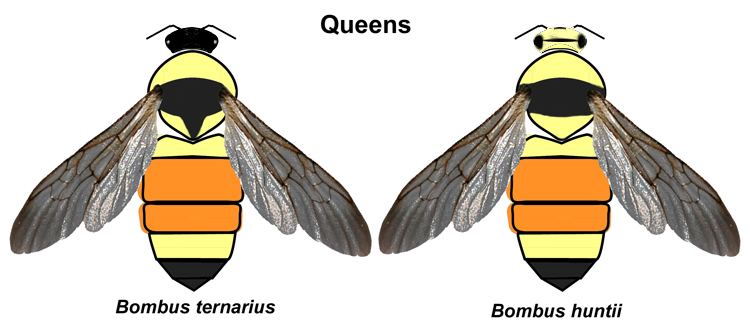
The most abundant of these bees, and probably the easiest of all Edmonton area bumble bees to learn, was a half dozen Bombus ternarius the Tricoloured Bumble Bee. The only other Bombus here with a pair of orange bands between two yellow ones on the abdomen is Hunt's Bumble Bee (B. huntii) and this bee lacks the black triangle pointing back on the thorax and has yellow hairs on the head and face (usually black in ternarius, as above, but not always).  The black triangle is a 'key character' amongst the orange-banded bees.

Hunt's seems to be fairly rare here, but the Tricoloured is very common. In the foothills and mountains, e.g. around Calgary, the Forest Bumble Bee B. sylvicola can look very similar, but usually has two yellow bands behind the orange ones.
Half-black Bumble Bee Queen Bombus vagans or rufocinctus?
More easily confused are the two Half-black Bumble Bees that we have in Edmonton, the 'true' Half-black (B. vagans) and the Perplexing Half-black (B. perplexus - aka Confusing Bumble Bee). I've buggered these up before, but now can usually tell them apart. The local B. perplexus seems to arrive earlier in the spring and has only a small, circular area of black between the wing bases and the yellow on the side of the thorax is interrupted by black. Bombus vagans has more extensive black between the wing bases and uninterrupted yellow under the wings - and often some yellow hairs on the posterior abdomen (nice character when present). [Update - and just to keep us guessing, the ever variable Bombus rufocinctus also has a half-black morph.]
Perplexing Half-black Bumble Bee queen Bombus perplexus

Sunday, August 19, 2012

Adventures in Spider Misidentification: Six-spotted Fishing Spider

Six-spotted Fishing spider on Wild Rose
I'm pretty sure (that is I think) this is a juvenile Six-spotted Fishing Spider Dolomedes triton (Walckenaer, 1837). The white stripes along the carapace and abdomen and the striped femora are clues, and although it isn't fishing, it is perched near a lake and marsh. And then the abdomen does have a half-dozen pairs of white spots running down it. Unfortunately, the common name refers not to the easily seen abdominal spots, but to 6 large black spots on the sternum - something difficult to see unless the spider rolls over.
Six pairs of fuzzy spots yes, but not the definitive spots 
Charles Walckenaer was more whimsical, but no less obscure, when he named this species triton. The Greek god Triton is associated with the ocean, waves, and loud blasts of a conch shell as in "Or hear old Triton blow his wreathèd horn" (Wordsworth 1807). In the scientific realm, species of Charonia conch are called tritons, which does make sense since these snails do live in the oceans and their shells are used as trumpets. Also a moon of the planet Neptune (Latin for Poseidon, Triton's dad) is logically called Triton. But our spider inhabits the edges of marshes, lakes, and ponds. Perhaps, like Wordsworth, Walckenaer was yearning for simpler times, when naming our putative spider, or linking their hairy visage and aquatic lifestyle with the mermaid-like Tritons and ignoring the inconvenient seas. I think I like the last best and will absorb it into my "identification" of this week's lovely, hairy denizen of the water's edge.
Wild Rose with Tricoloured Bumble Bee
I'm pretty sure (that is I would stake a bottle of wine on it) that the fishing spider is sitting on a wild rose, but which wild rose I can't say. This is a bit embarrassing, since a wild rose is the Provincial Flower of Alberta, our licence plates proclaim Alberta 'Wild Rose Country', and even a political party has taken on its name. Although 'Wild Rose' is used loosely and rarely with specific identification, technically only one of the three species of wild rose in Alberta is THE Wild Rose: Rosa acicularis Lindley the Prickly Wild Rose. Since all three of these wild rose grow in the area and this isn't a post on 'Adventures in Plant Misidentification', I will remain mute on which species.

Saturday, June 9, 2012

Wildflower of the Week: A Mystery in Spurs

Spurred mystery plant
Last summer Mrs Home Bug Gardener and I, while walking a trail on our land that we had traipsed a hundred times before, encountered a plant that we'd never seen before. We had no idea what it might be, but it was very strange indeed: purplish, spurred, and square-stemmed with somewhat fleshy opposite leaves - more like a visitor from another planet, than a normal denizen of the Great North Woods.
Scrophulariaceae, not
Alas, none of our pretty picture books of Albertan flowers was of any use. So, it was off to the flora of last resort: EH Moss's completely picture-free Flora of Alberta. Alas and alack, it wouldn't key to family! Not a mint, not a snap-dragon (Scrophulariaceae - the family I thought most likely), not any of the families with 4 stamens and 4 petals! That left only leafing through each family and trying the generic keys - and final success on p. 455: Halenia deflexa (Sm.) Griseb., American Spurred Gentian.
American Spurred Gentian Halenia deflexa
Well, gentians aren't always 5-merous, a good thing to know, and finding a flaw in a key always makes me feel virtuously smug, but why spurs? Obviously there must be some interesting long-tongued pollinators coming to the spurs. So, off to the literature - for a frustrating round of fruitless research. Although there are 22 species of spurred gentians around the world, and one is considered an important medicinal plant (Tibetan Medicine - Halenia elliptica), and there are many papers published on the anti-oxidants the plants possess, their pollination ecology is a complete mystery!


Reference
KB von Hagen & JW Kadereit. 2003. The Diversification of Halenia (GENTIANACEAE): Ecological Opportunitey versus Key Innovation. Evolution 57(11): 2507–2518 

Wednesday, March 14, 2012

2 for 1: Wednesday Wild Flower + Pollinator of the Week

Two for the price of one: Purple Peavine & Greenish Blue
Purple Peavine, aka Purple Vetchling, Veiny Pea (Lathyrus venous), stretches across North America to just barely make it into central Alberta, but I'm glad it does. A relative of the domesticated Sweet Pea (Lathyrus odorous), but without the selection for large and fragrant flowers, it still makes a fine wildflower.  Disjunct populations also occur on the West Coast; so perhaps, some earlier inhabitants of Alberta also liked these peas and took them with them on their wanderings.
Greenish Blue Plebejus saepiolus from above
The Greenish Blue (Plebejus saepiolus) is just one of the bewildering diversity of tiny 'Blues' that occur in Alberta including the Spring Azure, Western Tailed-Blue, Silvery Blue, Arctic Blue, Rustic Blue, Northern Blue, Acmon Blue, and so on. Every now and then we see enough characters to be reasonably sure of identity, but not often.
Mystery Blue
The caterpillars of the Greenish Blue feed on clovers (Trifolium spp.). Since Alberta has no native species of clover (the closest 'native' species occur in Montana and British Columbia), I suppose that means we owe our Greenish Blues to introduced, 'weedy' clovers. Most true clovers aren't really very weedy, but several are important crops and all a good source of nectar and pollen for bees and other pollinators. So, I prefer to think of clovers as nascent Albertans.
Red Clover - not a 'native'

Wednesday, March 7, 2012

Wild Flower Wednesday: Golden Fumitory

Corydalis aurea - a fumitory
Alberta's two species of fumitory (Fumariaceae), Corydalis aura (Golden Corydalis) and C. sempervirens (Pink Corydalis), are attractive if ephemeral delights. Unlike the 'perennial' commercial varieties, both Alberta natives are biennials. 'Corydalis' is from the Greek for a lark - usually credited to the Crested Lark. 'Cory' also means 'helmet', so the bird name probably derives from the prominent crest and the fancied resembles of the flower to the lark's head, well, from fancy.
Golden Lark's Head anyone?
Golden Corydalis is easy to miss in its first year, but the fern-like leaves are attractive. I suspect that 'fumitory' comes from the fancied resemblance of of the finely divided, greyish green leaves of the related Earth Smoke (Fumaria officials) to smoke, but Wikipedia claims the origin of the name is uncertain. Since Pink Corydalis is common after wildfires, perhaps the 'fume' refers to a similar habitat preference in Fumaria. The 'perennial' commercial species have larger and more showy flowers, and the pale blue varieties are especially attractive, but we've had no luck with ours surviving the Zone 3 winters.

Wednesday, February 29, 2012

Wednesday Wild Flower: It rhymes with hurtica

Urtica dioica
The very first 'wildflower' transplanted to the Home Bug Garden was a bit of root that fell out of a soil core. Rather than let the unknown root die, my wife brought it back and stuck it in a new bed along the walkway in the side yard. Next spring some interesting looking leaves sprouted and we anxiously awaited flowers so we'd have some idea of what we had. However, while weeding the bed, I was able to identify the new plant by the unpleasant stinging sensation in my hands.
Yes, nettle has flowers
Stinging Nettle (Urtica dioica) isn't an unattractive plant, but it's flowers don't seem to inspire the lyrical joy of many other wildflowers. After brushing against our rapidly going bundle of nematocysts one too many times I donned the leather gloves and grubbed it out.
Milbert's Tortoiseshell caterpillars feed on Nettle
If I'd planted it in the back of the garden rather than next to a sidewalk, I may have let it thrive. Actually, I'm a bit sorry I didn't move it to the back of the garden. After all, it is an important food for many caterpillars that turn into attractive butterflies. The young shoots are edible, and reputedly make a tasty pot herb. Also, a friend of ours made wine from the flowers - and the taste was interesting (although after a couple of tastes, the rest went into a stew). Well, maybe some day we will try a patch.

Saturday, February 25, 2012

Not Yet Native of the Week: Gladiolus imbricatus

A gladiolus for Zone 3

As my mythical long-time readers would know, I have been wont to ruminate on the native/alien dichotomy over the years. I’ve chewed the cud long enough that I have pre-digested the problem to my own satisfaction, swallowed my solution, and am ready to spread the results over my gardens and see what happens.
Gladiolus imbricatus
 Yes, native plants can be very nice and tend to be good for native insects and birds, but they alone do not a garden make and some are definitely mistakes (e.g. Jewelweed, Wild Strawberry). Yes, some horticultural creations are monstrosities, and any exotic plant has the potential to escape and grow where we’d rather it didn’t, but if you exercise reasonable caution (e.g. bird and wind dispersed seeds are bad), they do make for a much nicer and no less bug-friendly garden. Also, and I know some might find this controversial, some naturalized former exotics probably fit into their new systems rather well and increase the functionality (e.g. diversity, resistance to disturbance, recovery from disturbance) of the ecosystem.
Bombus vagans or perplexus and European Gladiolus
 Of course, if you define your ecosystems as if they were fixed and immutable and, in North America at least, created before European colonization, then you would probably take umbrage at any plant growing outside its proper place. I don’t share that particular belief system, but I do worry about letting loose something that may damage the environment. This was brought home to me the other day while reading a somewhat obstreperous review of Doug Tallamy’s book Bringing Nature Home (see Books in the Bug Garden sidebar) and the comment flurry at Gardening Gone Wild.
Leaf-cutting Bee enjoying a glad
 One thing that I realized was that I haven’t really done well by the Home Bug Garden exotics. So, herein I start a new series “Not Yet Native of the Week” wherein the pros and cons of plants not yet (or newly) part of the Alberta flora are considered. First up is the flower that enshrouded the ‘big-lipped bee’ in the most recent Pollinator of the Week, the only gladiolus that seems to be able to tolerate Zone 3 winters: Gladiolus imbricatus L. – variously called called the European, Red, or Turkish Marsh Gladiolus. Anyone who has grown the large hybrid gladioli (which need Zone 8 or better to ‘perennialize’) may be surprised to learn that there is a species that can survive our winters, but it is true. A friend gave me a handful of corms in 2006 and I’ve had a small patch ever since.
A denizen of wet meadows and marshes
 The fact that the leaf-cutting and bumble bees like the flowers is good, but also leads to seed pods which I regularly deadhead. This doesn’t stimulate more flowers, but does ensure that tiny gladioli don’t start sprouting here and there. Is that actually possible here in Zone 3?
A pleasant addition to an artificial meadow masking some squash and tomatoes
 Several gladioli are naturalized in North America, but G. imbricatus is not among them and none are listed as noxious weeds. If one casts their net somewhat wider, though, you find that this is not true in other parts of the World. Australia has several gladioli that have invaded roadsides and more intact native habitats and are considered important environmental weeds. I well remember coming across wild gladioli along the trails in Kings Park in Perth – and the disappointment on learning that these spectacular 'wild' flowers were weeds.

Where Gladiolus imbricatus is considered native (SE Europe and Turkey), it can be either a weed of cultivation or a rare meadow plant deserving protection. And, of most interest to us Zone 3ers, in Finland it is listed as a ‘casual alien’. So, I think I will continue to deadhead my gladioli and not plant them where they might escape into a wet meadow or marsh, but I certainly won’t grub them out.

Wednesday, February 15, 2012

Wild Flower Wednesday: Twinflower

Two pairs of Twinflowers: Linnaea borealis
Personally, I tend towards liking the smaller things in life. If given the choice between a dinner-plate dahlia and a tiny and delicate wildflower, I'd choose the latter every time. I guess it's good I didn't try to earn my living as a gardener. That would be especially true here, because I have not done very well by this tiny beauty.
Twinflower thriving under aspen
Twinflower is a relative of honeysuckles and snowberries, both of which may feature in some future Wednesday Wildflower. They are interesting plants, but pale in comparison to their tiny cousin. My particular HBG experiment came via an accidental severing of a Twinflower while taking a soil sample. I couldn't bear to toss it out, so I've tried to nurture it along. Maybe the soil isn't acid enough, or maybe some essential mycorrhiza didn't make the transition, but my plant barely made it through the last two winters. It's not happy. I'd suggest trying a nursery bred plant if your are interested, and if you can find one.
Thrips like Twinflower too
I'm not alone in liking Twinflower. It is claimed that the great systematist Linnaeus also loved the plant, and apparently coerced a colleague into naming it after him. Wikipedia has what seems to be an informative write-up - and a great picture of Linnaeus mugging with the flower. The subtle attractions of the Linnaea continue into modern times and I especially like this doubly twinned vignette.

Wednesday, February 8, 2012

Wild Flower Wednesday: Alberta's Provincial Flower

Longhorn Beetle  Clytus ruricola  probably doing a fair job of pollinating an Alberta Wild Rose
What better way to re-start Wildflower Wednesday than with the official Provincial Flower of Alberta: Prickly Wild Rose Rosa acicularis (aka Arctic Flame)? Well, there are roads reputed to be paved with such good intentions. I've assumed our wild roses were acicularis, but a little bit of research shows that there are actually 4 species of wild rose reported from Alberta.
Flower colour varies within a species and in age of bloom, but this bumble bee is a good pollinator: Bombus ternarius
 The USDA lists Rosa acicularis, arkansana, blanda, and woodsii in Alberta. Unfortunately, the USDA maps show distributions only by state/province. If the species is there in said political entity, then the whole province gets coloured-in. Finer details like ‘does it grow on my land’ are obscure. Still, painful experience assures me we don’t have Smooth Wild Rose (R. blanda) – it has few thorns. Also, the above ground canes of insidious thorns persist, so it seems unlikely we have Prairie Rose (arkansana), which dies back each winter.
Looking more globular than pear-shaped,
these hips are probably Rosa woodsii
That leaves us with the Provincial Flower, Prickly Wild Rose, and the other, just as prickly, Wild Rose (Rosa woodsii). For most characters, these species overlap – and in fact they hybridize - so intermediate forms may be common where they overlap in distribution (aka where I live). The easiest way to tell these species apart is by the distribution of prickles and glandular hairs in relation to the stipules, but this is getting pretty technical and not possible to resolve from photographs. I will say that I did key out one plant to acicularis, but most of the pictures I have on hand seem more likely woodsii. I probably have a mix of both species.
Added bonus - prickly leaf galls caused by
minute gall wasp Diplolepis bicolor
Seems like I will need to wait until next summer to do a more thorough analysis of what wild roses our lands are supporting, including the one started from a cutting that is now occupying a good portion of the backend of the Home Bug Garden. Until then, take my word for it – both are excellent for pollinators and both host a diversity of other interesting insects. One great example, is a tiny wasp (Diplolepis bicolour) that causes Prickly Rose Gall on the leaves. And these galls, in turn, host other insects. You can barely discern one to the left in the picture below - another tiny wasp artfully inserting its eggs into the gall - probably so its larvae can eat the wasp that made the gall.
Tiny chalcidoid wasp putting its eggs into a Prickly Rose Gall
Colourful fungi like the rose rusts (Phragmidium spp.) also make use of our wild roses. As long as they leave our domestic roses alone, I don't think I mind the rusts eating the wild roses.
Aecial stage of rose rust on Wild Rose (probably R. woodsii)

Saturday, February 4, 2012

(Self) Pollinator of the Week: Cave hortulanus Impatiens capensis!

A jewel and a weed!

In my experience, New Year’s resolutions rarely make it through January. One of mine this year has been to expand my ‘social media’ output (in preparation for a symposium here in November). This means learning Google+, increasing my rate of posting at my blogs, and analyzing what other bug bloggers are doing. One thing I’ve noticed at other bug blogs is that those that maintain a high rate of posting tend to keep most posts short and sweet – a picture and a paragraph or two.
Jewelweed or Touch-Me-Not
 In contrast, my posts tend to be long and wordy. Inevitably, what should have been a pleasant weekend hour posting a picture or three and some ruminations on insect conservation morphs into a weeks-long struggle with the literature. These habits come from too many years of lecturing and are hard to break.
Ruby-throat hummer - likes Jewelweed and is probably a good pollinator
 Of course, this is the fun part of bug blogging – learning something new – and then telling someone about it. But I have folders filled with uncompleted posts that turned out to be far more complicated than I had expected or where some critical facts or photographs were unavailable or where I just ran out of free-time and energy. At least I got paid for lecturing: blogging is supposed to be a hobby (i.e. relaxing).
Attractive, but especially so to insects & hummingbirds
 So, here’s my New Year’s Resolution: learn to shut up and blog. Regular weekly posting themes seem to work well unless you run out of images (e.g. Sunday Sawfly). So, Friday Bug has been up two weeks now (and weeks of pictures to go) and today I am starting Pollinator of the Week.
Fly on flower: probably less than it seems
 For ‘Pollinator’ to make any sense, though, I will need to make clear the difference between an insect on a flower and pollination. The picture above is more likely of a root-maggot fly resting on a flower, than a pollination event. In previous years, I would have spent the next week or two trying to determine how much was known about anthomyiid flies and pollination. This year I am considering that approach irresolute.
Bumblebee & Jewelweed:
begatting as in the Bible
 The bumblebee (Bombus vagans), however, is clearly covered in pollen and doing its best to show the Jewelweed (aka Spotted Touch-Me-Not, Impatiens capensis) a good time. 
Seedpod - begat through an ecosystem service
That is what pollinations is all about – moving plant sperm (aka pollen) to receptive female parts (aka stigmas), and setting seeds. In the case of Touch-Me-Nots, these seeds come in a pod that at maturity will explosively discharge the seeds upon a touch - scattering most over good distances.
Touch-Me-Not touched (one seed retained)
 But if the soil is too dry or otherwise unsuitable, Jewelweed can suffer from erectile dysfunction – the flowers fail to open and release their pollen. Unfortunately, crosspollination is only an option for Jewelweed, not a necessity – they also indulge in cleistogamy – self-fertailzation within closed flowers.
Not yet open, but not cleistogamaous
 Spotted Touch-Me-Not is a great wildflower that is attractive to bees and hummingbirds. But it is also a weed. Thanks to its ability to explode its seedpod and fling its seeds far and wide, it will rapidly colonize any damp spot in the garden.
Cleistogamy - these flowers will never look better
 Even if the plant can only grow a few centimeters tall, it can generate new seeds through cleistogamy and continue its conquests. The only sign of salvation showed up last year – a sawfly found on the Jewelweed. Unfortuantely, finding an herbivore on an herb is no more informative than finding an insect on a flower. We didn’t observe the sawfly feeding and found only one, so possibly it was in transit to hibernating in the soil.
Sawfly on Jewelweed - maybe help is on the way
 Cave hortulanus is Latin for ‘Let the gardener beware!’ This applies to Jewelweed. Although not hard to pullout, Jewelweed is so prolific and self-regenerating, that your garden will soon have a permanent understory of bloomless weeds. Best leave this one in the wild.
Jewelweed where it belongs
Note: this is one of those posts that I started last year and never finished, but Wednesday Wildflower will also be making a comeback - hopefully in a less prolix form than this post.

Friday, April 15, 2011

Wednesday Wildflower: Blazing Star, not Blazingstar

 Now that the partial thaw has been obliterated by the most recent blizzard and all is covered again in white, I think I need another Wednesday Wildflower (no matter that it is Friday) to brighten up the springless reality. A Blazing Star seems like a good counter to the grey and white.
 The purist may disagree that Liatris spicata (L.), also known as Dense Blazing Star or Gayfeather, is a wildflower here: its ‘natural’ range only extends across the eastern half of Canada and the United States, but that is close enough for me. The jackrabbit in the picture doesn’t seem to mind either, although I must say that only one or two stalks were snipped, so it probably doesn’t taste very good. I suspect that may be due to residual alkaloids in the stems and leaves. Much of the scientific literature that I found is devoted to bioprospecting members of the genus for novel chemical compounds.
 Blazing Star is a composite, so each of the ‘flowers’ is actually a composite head of small florets, in this case only disk florets and none of the ray florets that give daisies or sunflowers their bright ‘petals’. The plants are perennial and can be purchased as ‘bulbs’, actually a corm (but they look like tubers to me). I like the purple ones best, and so do the bumblebees. Several horticultural varieties have been developed for shorter stature and longer bloom times, but a white-flowered form Liatris spicata 'Alba' usually demands a premium. I’m not sure why. My only clump cocked it last summer, but I will miss it only in the way a collector dislikes not having an exemplar.
 Blazing Star make nice cut flowers, with the interesting habit of blooming from the top to the bottom of the spike, and they seem to tolerate Zone 3 just fine. If you find the thought of planting an ‘alien’ wildflower offensive, then you might look for one of the two species of Liatris that are ‘native’ to Alberta. Dotted Blazing Star (Liatris punctata Hook.) can be found in dry grasslands and hillsides in the southern third of Alberta especially where there is sandy soil. I suspect that very good drainage would be required to grow this successfully. This may also be true of Meadow (aka Rocky Mountain) Blazing Star (Liatris ligulistylis (A. Nels.) K. Scum.) which inhabits sandy woods in the aspen parklands. I am indebted to my friend Matthias Buck for a picture of Meadow Blazing Star from the Ukalta Dunes north east of Edmonton.
 The origin of the generic name Liatris seems to be shrouded in mystery (or just plain obscure), but that of its common name homonym, Mentzelia, is not. The latter was named for one Mentzel, a German botanist working in the 17th Century. As well as being called Blazingstar all run together, they are called Blazing Star, Evening Star (some are white and open in the evening, suggesting moth pollination), and Sand Lily. Only one species, Mentzelia decapetala, makes it into Alberta naturally at this point in time, and then only into the most southern parts of the Province. Ten-petal Blazing Star is one of those evening lilies and the flowers, at least, are spectacular (the plant is sticky and weedy-looking). I’ve only grown Lindley’s Blazing Star (Mentzelia lindleyi), a delightful yellow annual from California and Arizona, but one that does better in the greenhouse than in the yard. I think Edmonton has been far too cold and wet in recent years for this plant to thrive.