Showing posts with label spring flowers. Show all posts

Sunday, June 2, 2013

After a long wait, a week of splendour: Paeonia anomala

In-bud 6 years after the seeds were sown - Meet the Anomalous Peony
The other half of the Home Bug Gardener team likes peonies and the half that does most of the planting is always happy to do what he can to make her happy. Hybrid peony varieties are available by the hundreds and there is even a Canadian Peony Society that promotes their use. 
Formica podzolica on colourful, sugary hybrid peony sepals
Hybrid peonies have extrafloral nectaries, as do the species from which they are derived, so they are somewhat insect-friendly if you like ants, the only insects that seem to use the nectaries. 
Paeonia anomala  - a species peony (ant on bud in left background)
Hybrid peony flowers are very showy, but don't seem to be especially attractive to bees. Still, we have two hybrid varieties based on different species, Paeonia officinalis ‘Anemoniflora Rosea’ and Paeonia lactiflora ‘Dandy Dan’, planted near the front porch and they add a week or two of colour and a summer of attractive foliage to the Home Bug Garden.
A rose by any other name may be a peony - Meet Dandy Dan
Hybrid peonies tend to be expensive and can be floppy, but seem to have no problem with the Zone 3 winter. Inattention seems to work well too and other than cutting down the dead stalks in the spring, no care seems to be required.
Sterile staminodes instead of stamens in the Paeonia officinalis hybrid
For those who become obsessed with a kind of garden flower, a yearning to collect the species from which the hybrids have been derived is often manifest. This can be driven by interest or snobbishness or both, but for those interested in urban insect conservation there are valid reasons to eschew some hybrids. Often the spectacular display of a hybrid comes at the cost of functionality, such as the conversion of stamens to sterile staminodes in some peony hybrids.
Functional, but still attractive - Paeonia anomala
Well, to make a long story longer, hybrid peonies went into the Home Bug Garden in 2005 and by 2007 the Home Bug Gardener had decided to grow a species peony from seed. The Devonian Botanical Garden has a famous collection of hybrid peonies and also a collection of hardy species peonies. Seeds of one such species were available to supporting members; and so, seven pots with seeds of Paeonia anomala went out to overwinter in the Fall of 2007. In the Spring of 2008, though, not a single seedling emerged. Alas and alack, but no sense in wasting the soil in the pots which was recycled around the garden. Then in May of 2009, Anomalous Peony seedlings began sprouting all over the Home Bug Garden! 
Worth a 6 year wait?  Paeonia anomala
Now, four more years latter they are in bloom - and entirely through serendipity (which is how I prefer to view my bungled attempt to germinate peony seeds) - the Home Bug Garden woodland was graced by four scattered clumps of blooms of attractive magenta to pink flowers above feathery foliage. Given the late and cold Spring of 2013, it is hard to say when one might expect them to bloom in a more normal year, but this year the plant in the most favourable spot started opening on 20 May and one in the most shaded spot still has one flower in bloom (2 June). The hybrid peonies are still in bud, so I suppose the Anomalous Peony extends our peony season, and more importantly for the HBG pollinators, provides another early spring source of pollen and nectar.

Tuesday, May 14, 2013

And the bees are back too

Bombus rufocinctus Queen at Elephant Ears

This last week has seen bumble bees (preferred to 'bumblebees' by some) on the wing in central Alberta. All flying at the moment are fall-mated queens newly emerged from hibernation and intending to found new colonies. This one is a queen of a red morph of Bombus rufocinctus nectaring at the flowers of an Elephant Ear (Bergenia cordifolia).
T2-3-4 red-orange = Red-banded Bumble Bee (B. rufocinctus)
One of the more variable and confusing of the local species, the Red-banded Bumble Bee has numerous colour morphs. Like many insects with a noxious taste (and bad taste rather than the ability to sting is thought to be more important), bumble bees that tend to look like each other are more likely to be left alone to go about the business of raising a family. This is called Müllerian mimicry. Unfortunately, bees that all want to look alike leave many a bee-afficionado scratching their head when trying to put a name on them.
Bombus moderatus Queen wishing I would go away
Names are important, especially scientific names, if we want to keep track of species. Ten years ago when the Home Bug Garden was starting to take form, we had regular visits from the Yellow-banded Bumble Bee Bombus (Bombus) terrricola. Since then that species has become very rare, perhaps gone (I think I saw a queen at the Royal Alberta Museum last week). But a new Bombus (Bombus) has come along, Bombus moderatus (aka cryptarum). I suppose that is a good thing, a White-tailed Bumble Bee (or Cryptic Bumble Bee if you prefer obscure common names) is an interesting addition to the pollinator fauna, but what's up with the Yellow-banded? 
Andrena milwaukeensis Graenicher, 1903, tanking-up at Coltsfoot. Seemingly too small and obscure for a common name, would we miss it if one spring it didn't show up?
Of course, bees too shuffle off their mortal coils - should that give us pause? Does it make sense to get all flustered about the decline of a bug, even one with a generally nice reputation and useful lifestyle like a bee? Sure plants need pollinators, but aren't there plenty of them out there? Well, seeming not so much as there used to be in places like the United Kingdom and North America
A fat cat secure in its knowledge that food will always miraculously appear
If a bee disappears will we miss its buzz? Not unless we can put a name on the buzzer. For most bees that is not such an easy thing, but hope is on the horizon, at least for bumble bees. A new citizen science project for North Americans is about to take wing: Bumble Bee Watch (http://bumblebeewatch.org/) and a new field guide will soon be out:
Williams, P., L. Richardson, R.Thorp & S.R. Colla. (To be released spring 2013) A Field Guide to the Bumblebees of North America. Princeton University Press.
From sun to rain in 13 hrs: So long sunny weekend
Now, if the weather would only cooperate. It isn't only cats and people that enjoy sunny weekends. This is a critical time for the spring bees - all are starting their nests and need some sun and warmth to fly and to encourage the flowers to bloom. Alas, this is Alberta.

Friday, June 22, 2012

Bee-learned, not Bee-clowned: White-tailed Bumble Bee vs Globeflower

Bombus moderatus thinking about food
What does one do when a week of lectures need to be revised, a paper finished, hundreds of identifications proposed, dinner cooked, and a host of other chores gathers on the horizon? Why watch bees learn, of course.
The examination begins
Without flowers, flowering plants would have no offspring, or what they had would be monotonously similar clones from generation to generation. Ergo, one might assume that those plants that require insects for pollination would not be shy about initiating the mating dance. But many flowers seem to be of two minds, proclaiming 'here I am, come get me' but providing no obvious means of ingress. Bottle Gentians are one well known example of such coy flowers, and the European Globeflower seems to be another.
And she's in!
But things may not be all that they seem. In Finland and the European Alps, the Globeflower has been shown to have an obligate pollination relationship with Globeflower Flies (Chiastocheta spp., Anthomyiidae). Both sexes of the flies penetrate the flower, females lay eggs, and the resulting maggots eat the globeflower seeds. Globeflower must feed many of its offspring to maggots to ensure that some survive. That's all well and good (if creepy) in Europe, but how about in the Home Bug Garden where horticultural varieties of globeflower abound, but the flies seem to have missed the boat? One of the great advantages of bumble bees (Bombus spp.) as pollinators is that they can learn to pollinate even the most indifferent of flowers from beans to buzz pollinated peppers to bottled gentians to horticultural globeflowers.

Friday, June 15, 2012

Pollinator of the Week: A Buzzing Bonanza

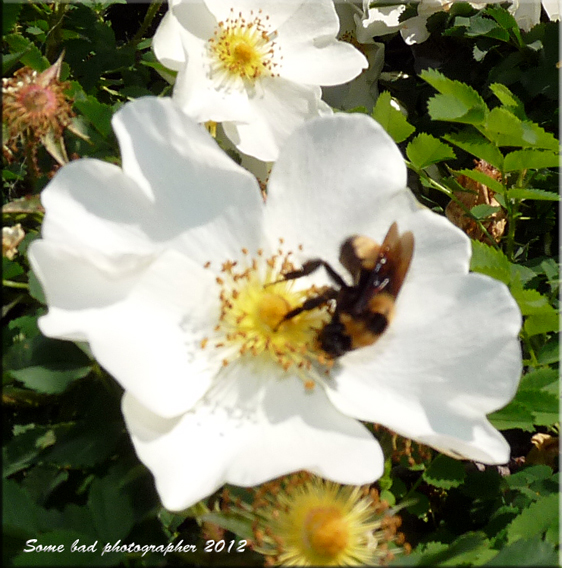
Scots Rose & White-tailed Bumblebee
June can be  beautiful month in Edmonton, or so they tell me. In my experience, the beauty comes in small doses, with the breaks in the clouds as rain-laden low after low rolls across. Oh yeah, I know, I'm always whinging about the weather here, but take a look for yourself.
When the sun does break through, though, things start popping. In the first two weeks of June, it is the Scots Rose (Rosa spinonissima 'Grandiflora') that pops the most. Our heirloom monster came with the house and is about 4 meters of spiny canes in every direction. Sometime between June 1st  and 16 June (the cold spring of 2009), the thorny mound becomes covered with large (7-8 cm diameter) single white roses - and bees galore, at least when the sun is shining.
The new, and currently most common, Bombus in town
Wednesday afternoon the sun was shining and the bees buzzing. The most common was also the most recent addition to the Edmonton Bumble Bee Fauna: the White-tailed Bumblebee, variously known as Bombus cryptarum, lucorum, and moderatus. The genetics seems to favour the latter, so that is what I am sticking with.
Red-belted Bumblebee Queen
Although apparently the most common bee at the Scots Rose - and with unusually large workers for this time of year - the White-tailed was only one of at least 6 species of Bumblebee harvesting the pollen and nectar.
Half-black Bumblebee worker
Second most common was old-reliable: the Half-black Bumblebee (Bombus vagans), both queens and new workers. But also present were queens of the Red-belted Bumblebee (B. rufocinctus - thanks to John Ascher for the id), the Tricoloured Bumblebee (B. ternarius), and a single queen each of the Yellow-banded Bumblebee (B. terricola) and what I'm tentatively calling the Black-and-Gold Bumblebee (B. auricomis). The latter seemed more interested in the lilacs, but was not above a blurry dive into a rose.
Maybe Black & Gold Bumblebee
But wait! There's more! A half-dozen or more other bees were also harvesting the bounty.
Halictus rubicundus - Banded Sweat Bee
A large and a small species of sweat bee (Halictidae) were zooming in and out and I'm pretty sure the larger one was Halictus rubicundus. She seems to lack a common name, but I will call her after her most striking character: the Banded Sweat Bee.
Leaf-cutting Bee Megachile sp.
A leaf-cutting bee was also in on the harvest, although collecting pollen on the underside of her abdomen, rather than on the hind legs. Then there were all the mystery bees.
Mystery bee in Scots Rose
Perhaps anthophorines, perhaps andrenids, perhaps halictids. Who knows? I think one may have been a yellow-faced bee and another an Andrena. There was so much rapid buzzing in and out that it was hard to keep track, but at least a dozen types of bee ended up in my notebook.
Probably a Digger Bee Andrena sp.
Alas, bees were not the only animals on hand to share in the bounty and not every bee made it home to its nest.
Digger bee becomes one with Misumena vatia
Oh well, it's not a Disney world in the Home Bug Garden, and there seemed bees enough for flowers and crab spiders.
Small worker of, maybe, B. centralis or flavifrons
Well, yet again, the showers have stopped for the moment and the sun is shining. Time to push through the wet vegetation and see if something interesting is buzzing about.
Rosa spinonissima 'Grandiflora'


Wednesday, May 16, 2012

Wednesday Wildflower: Marsh Marigold

A bright spot in the mid-May HBG
Even in a relatively good year, the first half of May in Alberta is not a colourful time of the year. Browns and greys still dominate in the bush and in Edmonton, even with its advantage of a strong Urban Heat Island effect, we depend for colour on those with the forethought to have planted bulbs last Fall.
Facing West in the afternoon sun
The one striking exception is the native Marsh Marigold Caltha palustris Linnaeus. Ever since we added it to our bog garden in 2005, the Marsh Marigold has been up as soon as the snow melts and blooming before the Ides of May. In the warmer springs before 2008, the blooms were opening in the first week (2-5 May), but since then it has been near the end of the second week. This year the first bloom was on May 8th, no record, but an indication that this Spring has been milder than the previous four.
Volunteer in foreground, progenitors in background
The bumble bees spend most of their time in the willows, coltsfoot, or the early spring bulbs, but they do forage at Marsh Marigold and no doubt contribute to seed set. Hoverflies seem especially appreciative of the flowers, although they are rather secretive about their identities. The one below may be a species of Eupeodes, but many Syrphini look very much alike to me.
Hoverfly (Syriphidae)
We now have several more Marsh Marigolds than we started with, but they are in no sense weedy. The flowers are gone before summer, but the glossy leaves are attractive too. All-in-all, Marsh Marigold is a rather excellent native addition to a damp spot in the garden.
Fruits of Marsh Marigold

Friday, May 4, 2012

Friday Bees

A Digger Bee (Andrena possibly milwaukeensis) at Colfsfoot
Spring is always slow to come to the Home Bug Garden, but when it finally arrives, it is nice to see some repeating patterns. The same Digger Bee species (Andrena cf milwaukeensis Graenicher, 1903) captured in the picture above on 2 May 2007 is active again this May 4th and joined by three other bee species.
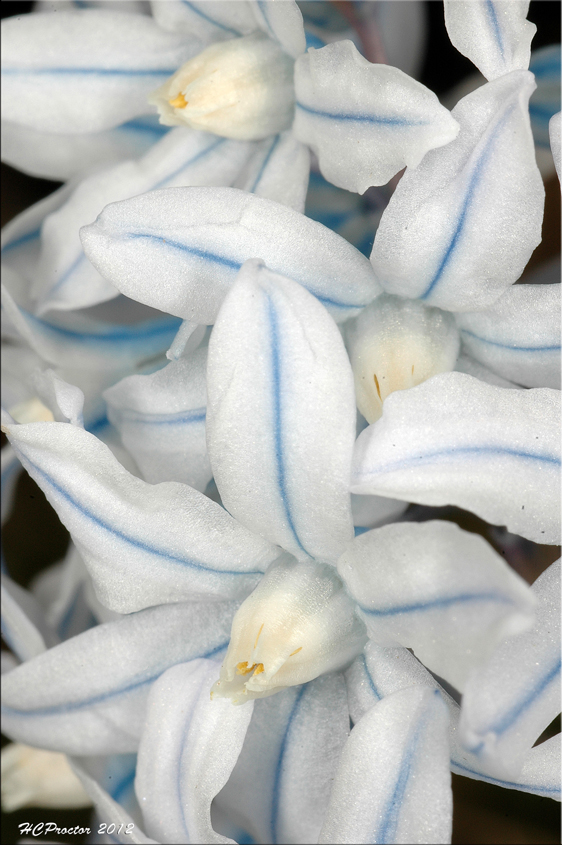
Striped Squill
The Striped Squill (Puschkinia scilloides libanotica) are the busiest at the moment, probably because they are in full sun. The queens of two early bumble bees, the Tricoloured (Bombus ternarius) and the Half-black (B. vagans or perplexus), stumble through the spikes of striped flowers with a loud buzz or two of warning, much as they did last May and many Mays before.
Tricoloured Bumble Bee at Striped Squill last May 7th
Not all is exactly as before, or at least I can't claim that is so. The fourth species of bee seems to be a largish Halictidae (Sweat Bee). Large for a Sweat Bee is not much - perhaps a tenth of the mass of a bumble bee queen - and this one is a bit skittish, so perhaps we never noticed it this early in the season before. But we do have one from mid-summer that looks very similar, so I'll leave off with that in case some other gardener would like to know what it looks like. If Mrs HBG gets a good picture of the Spring form, I'll post it for comparison.
Halictus Sweat Bee from July 2009

Saturday, April 7, 2012

Pollinator of the Week: the flies have it

Mystery male fly on coltsfoot 22 April 2010
Other than small, weedy mustards and violets, the first more or less native plant to bloom in the Home Bug Garden is the Coltsfoot (Petasites palmatus). Before the springs started getting colder in 2008, coltsfoot was in bloom and hosting early bees by the third week of April, but since then (with the exception of 2010) it has been the first week in May. With this year's seesawing between warm and cold, it will be interesting to see what happens, but so far the bed is still frozen solid and covered in snow.
Being covered in pollen is a good indication of a potential pollinator
Although early blooming, Coltsfoot attracts lots of pollinators. Based on the very large eyes, I suspect the fly above is a male. Usually male digger bees (Andrena spp.) show up next, around the time the Coltsfoot blooms, and are closely followed by females and the overwintered queen bumble bees (Bombus spp.) some time between the 2nd week of April (2006) and the first week of May (2009), probably depending mostly on temperature and sunshine, but possibly also on the presence of the Coltsfoot and the spring bulbs that start blooming around the same time. So far, though, the only potential pollinators that have made an appearance are the flies.

Monday, October 12, 2009

Of Bulbs, Bugs, & Below Zero: Frozen in an Alien Landscape


Today is Canadian Thanksgiving and we are into our fifth day of subzero (Celsius) temperatures and snow in this Zone 3 Home Bug Garden. I’ve only been keeping good temperature records since 2005, but weather this cold (it hasn’t been above -2 C since last Wednesday) is unprecedented in my Garden Journal. It’s not the earliest for snow (that was 9 September 2004), but I'm afraid that 5 consecutive days below zero means that is it for the bugs and flowers this year and all I’ll have in store for this blog is dreams of bug gardens past. I left out the last of the Rainbow Swiss Chard, because it is supposed to be cold hardy. We will see.


The chard had a hard time this summer, with lots of beet leaf miners, probably Pegomya hyoscyami (Panzer). We may have pictures of the adults, but they are indistinguishable from the numerous other small grey flies in the Home Bug Garden fauna. The small white eggs are laid on the underside of leaves and the maggots penetrate the leaf, feed between the two surfaces of the leaf, and cause large brown blotches. At first I thought they were interesting, but several generations later, I hate them. There’s no chemical control for home owners, but crushing their eggs can feel rewarding, in an impotent, chemical-free way. Picking and destroying the older, outside leaves preferred by the flies is also recommended, but seems to have no effect– the neighbourhood seems to have a large endemic population of the flies, probably from many years of people growing beets and ignoring the blotches.


Well, so much for the flies, back to this cold, nasty weather – is it unprecedented? As a conservative check on just how unusual a long freeze in early October is, I went to the Environment Canada website and the Edmonton City Centre Airport and their Climate Data Online button. It is a bit complicated and unintuitive, but eventually I was able to find the monthly reports that included maximum and minimum temperatures for downtown Edmonton going back to 1937 (Edmonton City Centre AWOS [2009-2005], A (2005-1937]). You have to go back 50 years, to 1959, to find another stretch of 5 days with below zero maximum temperatures in the first half of October (and then again in 1957) – so very unusual, but not unprecedented. Below freezing daily highs are more common in the second half of October (e.g. in 2004 – the year of the 5 cm snowfall on September 9), but above freezing and even relatively warm temperatures are more the norm.

The City Centre Airport shows a distinct Urban Heat Island Effect (UHI) compared to my backyard records and is usually another several degrees warmer at night than the International Airport (records to 1961) in the countryside south of town. However, a long stretch of subzero days in the first half of October is unprecedented in the last 48 years at the International Airport (which opened in 1960 - presumably the fields where the airport would be in 1959 would have had the same cold stretch as Downtown in 1959). So, why all this harping on cold? Well, the ground is frozen and I’m still waiting for my Dutch Spring bulb order!


One could argue that a Home Bug Gardener would be better planting native, rather than exotic bulbs. After all aren’t native plants good and alien plants bad (or at least suspect)? Alas, the native-alien divide is one of those twilight zones where the science becomes gray and shadowed by politics and beliefs trump facts. My Australian instilled aversion to invaders is still trying to come to grips with Alberta’s recently deglaciated landscape awash with relatively recent invaders. But whichever side of the invasive species controversy I eventually come down on, science or xenophobia, I know that after the long nasty winters here, I need some cheerful flowers as early in the Spring as possible. So what does Alberta have to offer in the way of native bulbs?


To answer that question, of course, one has to first define ‘bulb’ (‘Alberta’ being well defined and ‘native’ seems okay when not scrutinized). Bulb does have a reasonably precise technical definition relating to food-filled underground shoots and leaves, but after the botany final exam is over, no one seems to adhere to the limited concept, but instead embraces any underground storage organ that looks bulbish to them. To avoid more confusion than is necessary, my definition of a bulb is anything listed in the bulb bible: “Bulbs” Revised Edition 2002 by John E. Bryan (Timber Press, Portland OR). So tubers, corms, rhizomes, and some fat roots qualify.


Much to my surprise, I find that I have planted 4 Albertan true bulbs (Allium cernuum, Allium schoenoprasum [chives], Lilium philadelphicum, Camassia quamash), one AB ‘bulb’ (Maianthemum canadense), and three ‘bulbs’ from nearby areas that might reasonably have been expected to eventually make it to Alberta on their own (Iris setosa, Iris versicolor, Liatris spicata). That’s the good news. The bad news is that none of these plants is so foolish as to produce flowers in the earliest spring! In fact the Liatris (aka Blazing Star or Gayfeather) is sitting frozen in mid-bloom at the moment. No, spring colour is up to the 60-odd accessions (i.e. named species, varieties, or cultivars) of exotic alien bulbs – the vast majority of which do their best to add some early spring colour to the HBG.


Yes, it is true, the Home Bug Gardener has planted almost 10 times as many species/varieties of alien bulbs as of North American natives. I’m a bad, bad, bad native gardener, or at least not much of a purist. And that’s okay with me, because after 8 months of winter, I need to see something attractive in the garden, even if it is an evil alien. Not that these plants are especially bug-friendly. It is true that the bees and flies that are around will visit many of them, but not with the same fervour that they go after later bloomers. The earliest HBG bloomer, the native coltsfoot (Petasites palmatus), really is a bee magnet. But then again, so are many of the exotics that put in an appearance later in the Spring. The bees and bugs may be particular about what they feed on, but I don’t think they have any bias about country of origin.