Showing posts with label weather. Show all posts

Saturday, July 27, 2013

Bold-feathered Grass Moth, probably

A dizzy moth, perhaps the Bold-feathered Grass Moth 
If you've read this blog before, you know me for a whinger about the Alberta weather. You probably imagine me as a grouchy old wanker with nothing better to do than look out his window and feel sorry for himself. Well, there is something to that: I often look out my window and feel totally depressed by the weather (the climate is beyond my comprehension).
Herpetogramma pertextalis (Lederer, 1863), most likely
Still, I soldier on and find what I can to be positive about in this land in which I find myself imprisoned (my heroic aspect revealed). This weekend has been a tough one - pretty bloody miserable after a string of ordinary to miserable weekends all 'summer'. Still, I had a few hours last night with the blacklight before the massive thunderstorm hit about 3:40 am. 
Probably Herpetogramma pertextalis, but maybe Sitochroa chortalis 
This moth was one of the several interesting - oh why be coy - very cool moths that fluttered into the light between showers and downpours last night. Took me a long time to figure out its probable name because it looks so geometrioidy. But no, it is a Pyraloidea of one ilk or another, and quite possibly the rather rare (in Alberta) Bold-feathered Grass Moth.
Carpet moth, as yet identified
Should I brave the thunder and lightening again tonight or try to get some sleep? Well, when one sleeps one may, perchance, dream. Is a moth at the light worth a pleasant dream? Well, beats  a nightmare and we have all winter to sleep. My guess is that this is Dysstroma hersiliata (GuenĂ©e, 1858), the Orange-barred Carpet Moth, but a better picture would be nice and who knows what else may show up.

Wednesday, July 24, 2013

All moths are interesting, but some are more interesting than others

Two-spotted Looper outshines a Double Dart
Back on the Moth Farm the clouds continue their unending downpour. I huddle next to the wood stove and wonder if the gophers must be learning to swim. The moths, though, seem content to wing their way through the mists between showers and provide some colourful relief from the dreary doldrums of summer in Alberta. Well, some provide colourful relief, but others seem content to blend into the grey background. Compare these two Owlet Moths (Noctuidae): the brightly patterned Two-spotted Looper Autographa bimaculata (Stephens, 1830) and the dull as dishwater Double Dart Graphiphora augur (Fabricius, 1775).
Two-spotted Looper Autographa bimaculata
Bright silver spots, squiggles, scripts and autographs are characteristics of many Owlet Moths but especially those in the subfamily Plusiinae and subtribe Plusiina and are reflected in many generic names based on the Greek root grapho (= write) such as Anagrapha, Autographa, Megalographa, and Syngrapha. What the genus Plusia may refer to, however, is a mystery. 
Putnam's Looper Plusia putnami Grote, 1873
A mystery too is why the silver spots and squiggles? Since similar marking occur on unrelated moths, one might think they serve some function. Perhaps they reflect moonlight or sonar to dazzle bats. In any case, the clouds continue to scuttle across the sky, dropping rain, rain, rain and the moths flutter between squalls and hunker down during them.
The Hooked Silver Y Syngrapha alias (Ottolengui, 1902)

Tuesday, July 23, 2013

Three Elegant Moths

Diachrysia balluca Geyer, 1832 the Large Brassy Plusia or Green-patched Looper
In the Alberta summer one has to take their enjoyment of nature when they can amongst all of the rains, hail, lightening and strong winds. So far, it has rained two out of every three days in June and July and over 10 inches of rain have fallen in the Home Bug Garden (and much of that has flowed through the basement). However, Saturday night at Gopher Hill from midnight until 1:30 am the rains let up and the black light went out to see what might be roaming around the cloudy darkness.
Malacosoma disstria Hubner, 1820 adult of the Forest Tent Caterpillar
As usual when the black light works its magic here, the response of the nocturnal Lepidoptera overwhelmed all other insects. That's probably an Alberta thing too, at least compared to Queensland and other warmer lands in which I've gone night-lighting - where beetles, wasps, flies and bugs were often almost as diverse as the moths.
Sicya macularia (Harris, 1850) the Sharp-lined Yellow
So, here's a short tribute to just a few of the hardy moths that braved the cool, damp night to flutter around a black-light.

Saturday, July 20, 2013

[Inter]national Moth Week: Wet Night One

Virgin Tiger (Grammia virgo) over flies a Sharp-angled Carpet Moth (Euphyia intermediata) as coyotes (Canis latrans) howl in the night
Well, the yanks are doing their National Moth Week again and we friendly neighbours to the north are ready to remind them that moths respect not borders. Last week the Environment Canada prediction looked like we would be starting Moth Week with sunshine and clear skies. Well, Edmonton did have on of its rare two days in a row without rain this week; but alas, such perversity is now passed and the clouds and rains have returned.
Haploa lecontei aka LeConte's Haploa, another Tiger Moth
Rain is not so good for mothing, but clouds have a silver lining - cloudy nights are best for blacklighting. So the next week's predicted dreary day after day after day of clouds casts no pall over nights of scaly wonder. As an added bonus, if you stay up late enough each night appreciating moths then you'll probably sleep through most of the dreary day anyway (of course, this could get you fired). With any luck, tonight's rains will have passed before the long northern summer day is done and the black light will once more call forth the amazing diversity of scale-winged beauties. If not, well, I've been saving up moths for you for a rainy night or even a rainy week.
Large Lace-Border Scopula limboundata

Friday, June 14, 2013

Weather Whinging, Camouflage, Violets & Mosquitoes

Bombus rufocinctus queen climbing Jacob's Ladder in a rare ray of sunshine
Those of you who make a habit of reading this blog already know that I make a habit of whinging about Edmonton's weather. Although I have taken every opportunity to point out its failings, the Weather has yet to improve one bit. I give up! If it wants to rain every day in June, then let it. Instead here are a few interesting bugs and flowers from those rare moments between showers. Goldenrod is a great flower for insects, and so, always a joy to see in bloom (even though it means 'summer' is ending), but not especially interesting before it blooms - except this year. 
What the ...? 
Synchlora aerata (Fabricius, 1798), otherwise known as the Wavy-lined Emerald is a new visitor to the Home Bug Garden. Or at least I think it is - the first one I saw looked more like bits of leaves stuck in a spider web than a caterpillar and I wonder how many I'd missed in the past. Also known as the Camouflaged Inchworm (aka Looper), this geometer larva likes to eat a variety of composites - and adorn itself with bits of leaves and flowerheads. Many geometer caterpillars do very good imitations of twigs or are pale green with light longitudinal lines that blend into vegetation, but this was the first I've seen that dresses up the better to not be seen. Miklos Treiber studied some of these caterpillars and found the process was more or less continuous - as the fragments dried out the inchworm added new bits of plant (using a glue-like substance from its mouth).
Synchlora aerata (Fabricius, 1798) inching along
Anyway, there is lots of goldenrod, gayfeather and Joe Pye Weed in the Home Bug Garden, so the Camouflage Inchworm should feel right at home. Also popping up in a brief bit of sun is another native plant, the Prairie Violet Viola pedatifida
Prairie Violet Viola pedatifida
Also called the Crowfoot, Birdfoot or Larkspur Violet because of its dissected leaves, unlike most violets, this one likes it relatively hot and dry - gravelly hillsides and prairie grasslands being it usual habitats in Alberta. 'Hot and dry' are not appropriate terms for a garden in Edmonton, but two of the three plants I put into the southwest corner of the Home Bug Garden survived the winter and bloomed. 
AKA Crowfoot, Birdfoot and Larkspur Violet
Finally who can resist the charms of Edmonton's most famous flying insect, the mosquito. We bug paparazzi flock to them whenever we see them and try to annoy them as much as they annoy us. Here's one mugging for two cameras.
Two views of one mozzie.

Wednesday, July 18, 2012

Of Sloughs and Sogginess

Weather 1, Home Bug Garden 0
If you've read this blog for any length of time, you may have noticed that I tend to complain about the weather. Well, the weather, House Sparrows, and noisy neighbours, in about that order. Last night we had really noisy weather and neighbours: first the thunder, lightning, and deluge (3rd of the last week) and then car alarms blaring from 3 am until I dragged myself up to go to work at 5. When I realized I would need hip waders to get to the train, and that the cars bobbing around in the street were the source of the unending alarms, I stopped feeling angry at the neighbours and went and looked at my basement.
What does a 6-legged basement spider do in a flood?
What I saw was water and a sad spider, missing half its legs on one side, clinging to the basement wall above the wet. Not being able to claim I was missing a quarter of my limbs, it was time to start bailing and mopping. After Mrs HBG explained to the TV crew that we live in what used to be a slough, she put on her gum boots and slogged off in search of a train. I bailed and mopped and moped and then curled up on the dry spot on the bed (did I mention that the cat peed on the bed last night?) and dreamt I was in Queensland (where much worse floods occurred last year).
A pair of Perplexing Half-Black Bumble Bees ignoring the rain
And when I awoke, if not refreshed, at least dry, rather than continue to mope, I learned two new bugs from before the deluge. The first, Bombus perplexus, is a tentatively welcome addition to the Home Bug Garden. They do have a bit of a reputation for being aggressive, but so far they haven't bothered me. Unfortunately, they are very similar to the Half-black Bumble Bee Bombus vagans, so a bit of an id challenge.
Red Turnip Beetle Entomoscelis americana
The second is very colourful, but a pest, but not the pest I feared: the Lily Beetle. The HBG sports a number of lilies including a native, but mostly aliens raised from seed, donated by friends, or on found sale at a nursery. I never thought I'd become a lily lover, but they do have their charm.
Lily raised from seed awaits the deluge
Instead of a Lily Beetle, the HBG sported a Red Turnip Beetle. These eat crucifers such as cabbage and canola, and given how yellow with canola the countryside is at the moment, it is surprising that we haven't encountered them before. I suppose I will need to keep watch over my kohlrabi, but I know the worms of the Cabbage White will get them first, so why worry.
Bad, bad broccoli worm

Sunday, July 15, 2012

They're back: Black & White with Red on top

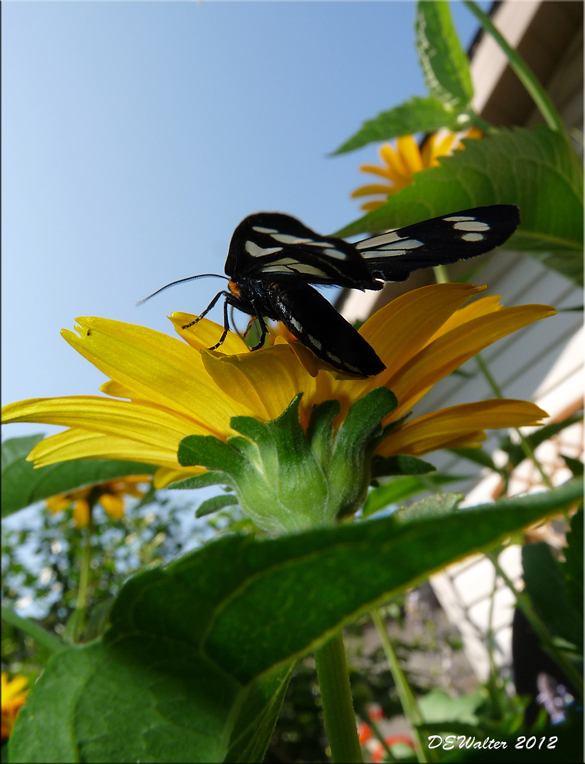
We're back! Gnophaela vermiculata poses for the camera
It's still a week until the US National Moth Week (which we Albertans will celebrate, even if we aren't invited), but the Police Car Moths started flying last week, perhaps to avoid the subsequent deluges.
Green Lattice?
With the Edmonton Police now sporting black & white patrol cars, the common name makes more local sense than in previous years. As common names go, this one is a good model. Consider the previous 'common' name, Green Lattice.
Another side of the Police Car Moth
OK, whatever, there's no rule that common names (or scientific names for that matter) have to make any sense. I suppose the long hairs on the caterpillar may intersect like a lattice? Well, not really and 'green' eludes me. Blue, yellow, black, and red, sure, but green?
Gnophaela (originally Omoiala) vermiculata (Grote, 1864) larva 
The genus name is probably from the Greek for 'darkness' (gnoph), the moth is mostly dark, and the species name seems to mean wormy. In English we have 'vermiculate' for 'worm-like' or decorated with wormy lines. The gardener's friend 'vermiculite' also comes in worm-like accordions. Perhaps the name was coined on a dark and wormy night?Nah, the original name was Omoiala vermiculata: wormy shoulder (Greek omo = shoulder) anyone?
Orange-shouldered Panda Moth?
I'm tempted to make up my own name for this attractive day-flying moth. But that's really just bludging (the basement needs mopping up, but the rain is still pouring, ergo blog). Police Car Moth is fine with me.