Sunday, February 13, 2011

Sunday Psyllids


 Thanks to everyone who offered supportive emails and comments over the last few weeks. They were much appreciated. Even without family tragedies, I find this time of the year, February through March, the most bleak and difficult in Alberta. The winter has dragged on, the holidays are past, and it will still be two or three months until there is more than the faintest signs of life escaping from the icy shell. Sometimes one has to dig deep to find some winter bug interest.
 The winter weather here derives mostly from the struggle between cold Arctic air masses moving south and warmer, moist Pacific air masses trying to force their way over the Rockies. Every now and then the Arctic air breaks away and drifts further south, bringing storms and snow to the US, but often letting in enough Pacific air to give us a brief thaw and a view of an overly optimistic fly, spider, or lacewing basking in the faint sun. The few days of warmth are appreciated, but the false springs are soon gone and below zero weather reigns again. Under the snow, however, there is a lot going on, and it is always worthwhile to shovel down and see what is up. On our last snow-delving trip to the Moose Pasture, we found something unexpected - a superfamily of tiny (3 mm) bugs we didn’t know we had – jumping plant lice Psylloidea.
 In Australia, I would have called these lerps, or if being more formal, psyllids, but neither is technically correct. A lerp is actually a sugary covering of the larvae of some psylloids and a much appreciated food for some Australian birds, such as the infamous Bell Miner (Manorina melanophrys). You don’t have to go to Australia to see lerps – California is close enough to see the The Redgum Lerp (Glycaspis brimblecombei) devastating introduced gum trees. But fortunately no one has introduced the Bell Miner or it’s similarly aggressive but more flower-loving cousin the Noisy Miner to North America. The latter is slightly larger than a North American Robin, more aggressive than the Mockingbird (but lacks any musical ability), hangs out in gangs, and vigorously beats up and chases away any perceived competitor or threat. But at least they don’t farm psyllids.
'Psyllid' seems to be hanging on as a common name, although the Psyllidae of my youth is now Psylloidea (‘psylloid’ is a bit pedantic) and contains a number of families, depending on the authority. I follow Ian Hodkinson, not just because he did time in Alberta, but because he and J. Bird revised the subfamily Livinae (Aphelaridae) that includes my two snow-bound specimens. These psyllids are not lerpy, instead the larvae form galls on sedges (Carex) and rushes (Juncus). Some Livia species have been collected overwintering on conifers. The two I collected were from the litter of a white spruce under 40 cm of snow. Since psyllid workers don’t seem to have spent much time looking for their bugs under snow, it is possible that, at least in Alberta, this protected winter habitat is the actual overwintering site. Neither psyllid quite fits a described species, but little is known of the biology of psyllids unless they are pests. Seasonal polymorphisms are known in other psyllids and usually related to diapause, so I may have an overwintering morphology of a described species. Galls, polymorphisms, secret diapause sites, I never thought that such tiny bugs would prove such a welcome winter respite!
Thanks to The Atavism in New Zealand for opening my eyes to the new Psylloidea in a November post that prepared me to recognize them (I surely would have ignored them otherwise). While thinking of the southern hemisphere, let me say I’m happy to learn that Bunyip Co and A Snail’s Eye View (and her padymelons) survived Yasi and are back to blogging. I hope that is the last of the giant cyclones they have to experience.

For more on psyllids see:
Hodkinson ID. 2009. Life cycle variation and adaptation in jumping plant lice (Insecta: Hemiptera: Psylloidea): a global synthesis. Journal of Natural History 43: 65–179.

Hodkinson ID & J Bird. 2007.Sedge and rush-feeding psyllids of the subfamily Liviinae (Insecta: Hemiptera: Psylloidea): a review. Joumal of the Linnean Society  128: 1-49.

Saturday, February 5, 2011

Some Flowers for Tina

 
 I started the HomeBugGarden for two reasons: I needed an excuse to ruminate on what I could and could not contribute to invertebrate conservation in a small urban lot and I wanted to showcase some of my wife’s excellent photography. The first thing I learned during this endeavour was that although I had spent 40 years learning and practicing some aspects of the biological sciences, some of my most basic assumptions were not very scientific.
 That discovery was interesting, if disconcerting, but since I had decided to give up the profession of a tenured professor of the truth, in favour of one puttering around in a garden, the discovery seemed of but academic (or rather chewing-the-cud) interest.
 Discovering that things one always assumed were true were not, however, does tend to make one question other aspects of their lives. I’m not really ready to throw over most of these other convictions, but I am prepared to be neutral about them: maybe they are valid and maybe not. I’m pretty sure that when I die I will not go to heaven and God will not explain to me exactly what happened to the dinosaurs, but I am willing to suspend disbelieve about how successful others may be in their search for the truth.
 Perhaps I am merely maturing as a scientist – learning what questions can be addressed by the scientific method and which ones cannot. Perhaps.
 In any case, life marches on, relentlessly. I suppose I know this in the abstract sense, and more immediately in the recent deaths of several of my wife’s relatives. For the last 40 years or so, however, I have tried to keep a very broad buffer between me and my genetic family (the Pacific Ocean worked well).
 I come from a fairly dysfunctional family – and I think my brothers and sisters would mostly agree with this assessment – but not totally dysfunctional. Minor civil wars aside, my brothers and sisters have kept on mostly civil terms. We all dispersed from our natal home, but all the others have been drawn more or less back. Creepy, as if invisible spider web pulled us all back home, but I have resisted the pull. No kudos to me; though, rejection is always easier than accommodation, and I am the distant one.
 I thought that one day, perhaps, I might go back and get to re-know my family. There’s some saying somewhere about paths and good intentions, and I’m sure I’m stumbling down several of them at the moment, but in this case the good intentions never happened. Now it is too late, at least for my closest sister.
 A few months ago, my sister Tina was diagnosed with a cancer. Her emails were invariably cheerful and upbeat and the treatments seemed to offer hope. Then, suddenly last weekend, she was hospitalized with breathing problems. Here last emails told us not to worry, but on Friday she died.
That was very sudden, and all good intentions to the contrary, I will never get to show Tina the Home Bug Garden. I think she would have liked it. Although not an insectophile, she was interested and always sending me pictures of things she or her daughter Tessa had found in the backyard, in the driveway, in the bath tub, in the basement ... 
 Even if Tina would have just tolerated the bugs, I’m sure she would have like the flowers. So, here is my way of saying goodbye to my sister – a feast of flowers that I never got the chance to show her.

Friday, December 24, 2010

Merry Christmas from the Home Bug Garden


The Dragonfly Woman has a nice post on what insects you might see on a white Christmas. The only one of those true insects that we have recorded in the Home Bug Garden, a winter stonefly in the family Taeniopterygidae, is from the day after the last frost on 5 May 2005. Although the Last Spring Frost has since moved closer and closer to the end of May (with a light frost on 1 June of this year) along with the snow, we like to think that we will some day see early springs and winter snowflies without snow again. Meanwhile, we really should start looking for ‘snow fleas’ (aka springtails, Collembola). With the snowpacks we have been getting, it is highly likely that lots of tiny arthropods are going about their business under the snow where temperatures may be hovering around freezing and that some of these will follow the tiny channels to the surface where they can offer us a bit of diversion over the long, long winter.
Meanwhile, on reviewing the HBG portfolio, it looks like the beetles are the bugs with the most Christmas colour, so here follows a small sampling of festive red, white, and green from over the years. We’d also like to wish all of our fellow bug bloggers, those obsessed few who have challenged the stereotype of blogs as cesspools of political invective and made each morning’s readings an uplifting experience, a Merry Christmas & Happy New Year. Among that long list, we’d especially like to thank Ted MacRae at Beetles in the Bush – our first visit each morning; The Bug Whisperer – our local hero, the multi-talented Adrian Thysse; the anonymous, always interesting, and often annoying Bug Girl’s Blog; and finally, the master of bug blogging, the one and only Myrmecos (aka Alex Wild). To each and all bug bloggers a joyous and interesting bug-filled New Year.


Saturday, December 11, 2010

Rugged up until Spring: A Mammalian Digression

 By the calendar it isn’t winter yet, but winter weather closed down the last lingering greenery in the Home Bug Garden in November. Temperatures plunged to -29 C (-20 F) and the North Saskatchewan River froze over 3-4 weeks ahead of schedule. Other than the occasional fungus gnat in the bathroom or spider in the basement, that is it for this year’s bugs: same for the Moose Pasture. Last weekend the snow at the MP wasn’t quite deep enough for snowshoes, but the thermometer had registered -32 and even birds were few and far between. The only sign of insects were the honeybee hibernation hotels. So, my choice this Saturday morning is either shovel the snow off the driveway or invent a post on the HBG. If only all of life’s choices were so easy!
 One thing still in evidence at the Moose Pasture last weekend were its mammals. And since there were mammals, of course, there were arthropods, because mammals are a year-round tropical beach for their arthropod ectoparasites. Well, at least for those that take up residence, as opposed to just stopping by for a meal (fair weather fiends). Ditto for the Home Bug Garden’s mammals or at least those that live outside. We HBGardeners like to think of ourselves as bug-free zones and, except perhaps for the transient mosquito and resident follicle mites (and let’s just not think about them) we are and so are our house-bound cats. But that isn’t true of the ‘native’ mammals: each is the potential home to several species of lice, fleas, mites and ticks.
 So, let’s take Middle Earth Garden’s question one step further and see how similar the HBG is to the MP in terms of mammal habitat for bugs. Now, we don’t actually do much mammal collecting, so our estimate will be mostly theoretical, but it seems a reasonable comparison (and much better than shoveling the driveway).
 If you were to look out at the front of the HBG this morning, you’d see a garden covered in snow and crisscrossed with tracks. Among these are a few cat paws, bird claws, and squirrel scratches, but the vast majority are contributed by one animal: the White-tailed Jackrabbit (Lepus townsendii).
 Jackrabbits are born ready to run and adults don't make burrows, but get by with resting in a slight depression in the soil or snow, so their contribution to the arthropod fauna would be limited to their ectoparasites (mammals that den or burrow are much more arthropod friendly). These are big hares – to 5.4 kg (12 lbs) and over 2 feet in length – and they pay no attention to cats and little attention to people. Dogs do give chase, but with top speeds of over 70 kph (Wood et al. 2006), one tends to feel sorry for the dogs (unless they are trampling the garden). If a dog, or more likely a coyote, does get close, jackrabbits are capable of sudden near 90 degree turns – and their black tipped ears go one way while their bodies go the other, with the coyote left snapping at a vanished ear and the jackrabbit vanishing in the other direction.
 While limited to open areas and rare outside the City (<1 per 4 km2), White-tailed Jackrabbits thrive in residential areas of Edmonton with densities averaging about 4 per km2 in the winter (Woods et al. 2006) or about 1300 shrub snipping hares. I regularly see a half dozen or more of these nocturnal munchers during my pre-dawn walk to work. Anything in the Rosaceae except spiny roses seem to be a preferred winter browse, so every autumn I have to spend a day putting wire cages around the saskatoons, cherries, crabapples, and chokeberries or they will be eaten down to the snowline by spring. In comparison, the Moose Pasture has no jackrabbits at all, but does host a few Snowshoe Hares (Lepus americanus). These also are nocturnal, but somewhat smaller and prefer forested cover. I sometimes see one in the River Valley and we often see their tracks at the Moose Pasture, but they do not make it into the HBG.
Coyotes (Canis latrans), however, do occur both here and at the MP, although only as transients in the HBG. Some estimate that 600 reside in the City. I see one every now and then on the way to work or coming home late at night and always make a point of giving it a chase (well, I try to look threatening anyway). Attacks on people, usually children, joggers, or someone walking a meal (aka small dog) are rare but increasing in frequency as coyotes learn to associate people with food rather than fear (Timms et al. 2004). Coyotes may eat more house mice than house cats, but the telephone poles littered with posters of missing cats bear mute testimony to another aspect of their diet. At the MP coyotes are very common - it sounds like 4 packs (probably male-female pairs with young) are within howling distance - and their tracks, turds, and the occasional bloody remains of dinner are everywhere. Since coyotes also dig dens, as well as produce feces and bits of carrion, they contribute significantly to the arthropod fauna of the Moose Pasture. We watch them watch us, but in the country they know that people are dangerous, so we camp amongst them with little concern.
That attitude would be inappropriate for the two largest carnivores in the region. Both cougars and black bears wander through the Edmonton River Valley on occasion, but were generally considered extirpated south of the River. That is no longer true and our MP neighbours, especially the beekeepers, were treated to a bit of ursine drama two summers ago. Fortunately, no one was hurt and losses were limited to bees (wiped out) and damage to homes (and to bears) and to Disneyesque views of Nature. The new hives are now protected by scarebears (apparently somewhat effective), electric fence (ineffective), and relocation to the middle of cleared agricultural areas (very effective if you have such land).
The cougars have yet to cause a problem (but see David Barron’s excellent book) and probably subsist primarily on the large population of White-tailed Deer (Odocoileus virginianus). Mule Deer should also be in the vicinity, but we have yet to see any. Larger, but not as numerous, is the largest member of the deer family: the Moose (Alces alces). We have at least 5 moose that wander the MP, but fortunately for our shrubs, none in the HBG and only rarely have we seen deer nearby. In the spring after the snowpack melts, the ground at the MP is covered with piles of decomposing moose and deer pellets that support a diversity of beetles and flies (and fungi).
 Although moose are potentially dangerous, they are more likely to hurt us if we crash our car into them, then if we upset them some other way. In Alberta, you are far more likely to be killed or maimed by a car, then by all of the wildlife put together (including West Nile Virus vectoring mosquitoes). However, the Moose Pasture does have one significant wildlife danger to those camping there – being crushed by a beaver-felled tree.
Of all of the mammals in Alberta other than people, beavers clearly have the greatest impact on the environment. They also probably contribute more to arthropod diversity than any other mammal. They build and inhabit large, permanent lodges along with their fleas, parasitic beetles, and a host of detritivores. The meadows they flood eliminate some insects, but the new marshes support hosts of dragonflies, damselflies, water bugs, beetles, and more.


The trees beaver fell are a bonanza for beetles, flies, parasitic wasps, and anything that likes to nest or hide in decomposing wood. Beaver love aspen and will clear it as far from water as they feel safe. This opens up browse for moose and deer, but also spots for herbaceous perennials to bloom and feed more bees, wasps, beetles, butterflies, and moths. The cleared, sun-warm ground is a boon for ants and ground nesting bees and wasps. If you like arthropods, then you should love beavers – just don’t set your tent up anywhere near an aspen or poplar.
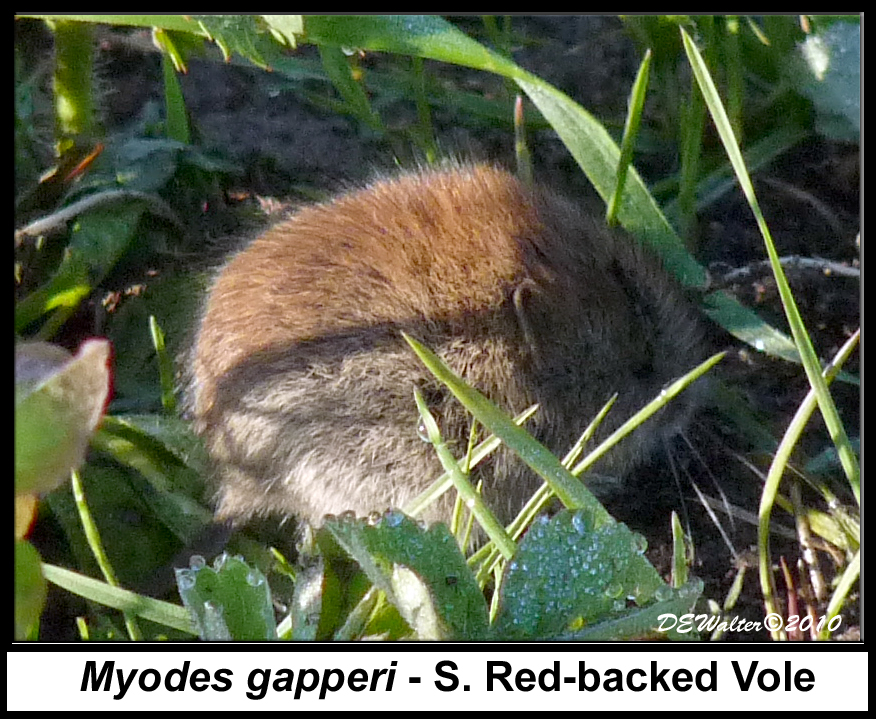
 Muskrat benefit from the marshes beavers create and smaller rodents benefit from the open areas covered in herbs and grasses. Deer Mice build burrows and our bumblebees like the abandoned burrows for nesting sites. Voles with their mites and fleas graze on the grasses and herbs that sprout amongst the stumps and most everything is both changed and generally more diverse when beaver are present.
This beneficial effect is especially true during one of the frequent droughts in the Parkland when lush, verdant areas are restricted to around beaver ponds. Porcupines may benefit indirectly, since they like birch and beaver don’t, so the prevalence of birch may increase with beaver present (and with that all the birch-loving insects).
 Beaver are a bit ornery and noisy (it takes a lot of gnawing to bring down a tree – which can make for a restless night), and if you like trees and meadows they are harder to appreciate, but as far as mammals go, they seem a boon for arthropod biodiversity.
Well, I suppose that is enough effusion about beavers for the moment. The Home Bug Garden has no Castor canadensis and few of the other mammals that inhabit the Moose Pasture. Alberta has about 90 species of 'native' mammals and almost half of them (>40) show up at Elk Island National Park, so several more of these will show up at the Moose Pasture if we get serious about finding them.
Not all of these would be welcome in the Home Bug Garden, and I would put deer and Deer Mice at the head of that list.
Even without these peculiarities of taste, mammal-driven biodiversity gets short shrift in the Home Bug Garden. Except, of course, for the only mammal more potentially arthropod biodiversity friendly than the beaver: the naked ape! In my own small way (and usually well clothed) I have made this small lot more diverse and bug-friendly and I guess that will just have to do for the mammal contribution for the moment. Good fences make for good neighbours, and the fewer mammals in the HBG, probably the better for all.
Baron D. 2005. The Beast in the Garden: The True Story of a Predator's Deadly Return to Suburban America. W. W. Norton & Company.

Timm RM, Baker RO, Bennett JR & Coolahan CC. 2004. Coyote Attacks: An Increasing Suburban Problem. pp. 47-57, in: Proc. 21st Vertebr. Pest Conf. (R. M. Timm and W. P. Gorenzel, Eds.) Published at Univ. of Calif., Davis.

Wood JR, Krenz J & Boyd-Zhang T. 2006. Urban White-tailed Jackrabbits of the Edmonton Region (1992-2002). pp. 119-133, in: RW Wein (Ed). Coyotes Still Sing in My Valley. Spotted Cow Press.

Friday, November 26, 2010

Aculeata Agonistes: Bombus Squared & Gone?

Herein, I begin my bumbling through the subgenera and species of Bombus in the Edmonton area with what seemed like an easy start: Bombus (Bombus). Thanks to the online resources that Paul Williams has created at the British Museum of Natural History website, I know that only 11 of the 250 or so recognized species of bumble bee belong to the nominate subgenus – less than 5%. Also, selecting the Nearctic Region from the key, I can reduce this to 4 possible species, albeit with 21 different colour forms. However, according to Richards (1978 – see citations at end) Alberta is abuzz with 21 species of Bombus – how can I tell if any of my bees are Bombus (Bombus)?
The best solution would be to ask a specialist on Bombus and preferably one with knowledge of the local fauna. Alas, no one I know will admit to such knowledge. I could try Calgary – there are bumble bee ecologist there - but here the response from the hymenopterists here has been to bugger off and learn them myself, they have more than enough to do already (which is probably what the Calgary ecologists would say). This is called a ‘taxonomic impediment’ (TI) – a well-known problem to overworked taxonomists and frustrated people who need identifications, but seemingly of limited interest to most of the world. For example, Google comes up with less than 60 thousand hits for ‘taxonomic impediment’, but 27 times as many (1,610,000) for ‘bee decline’.
For those who haven’t heard of TI before, here’s a definition from an Australian source that is more than 15 years old: “The taxonomic impediment to progress in the study of biodiversity is linked to a worldwide shortage of taxonomists who can be called upon to identify species, describe species that are new to science, determine their taxonomic relationships, and make predictions about their properties.” And, 15 years later, if you are interested in how Canada is dealing with TI, then you are in luck: last week the Council of Canadian Academies released Canadian Taxonomy: Exploring Biodiversity, Creating Opportunity. You can download the 4mb pdf for free – but to make a long story short: “Job openings in taxonomy have virtually ceased’ ‘Canada’s ranking [in taxonomic publications] dropped from 6th in the 1980s to 14th in the 2000s’ ... [and most relevant to this post] ‘pollinators provide a crucial ecosystem service (via fertilization of crops) to agriculture, yet there is a growing taxonomic expertise gap in pollinator identification.”
Okay, I get the point – the Government may tut-tut about the shortage of taxonomists every decade or two, but better look elsewhere for a solution. Is there a generous specialist from some more enlightened elsewhere with a pro bono bombology streak? Well, one could submit pictures to BugGuide where John Ascher seems to have the talent to name that bee. For example, The Bugwhisperer’s recent spectacular photo of a Bombus melanopygus ménage à trios now resides name and all on BugGuide. The BugGuide route is tempting, but Dr Ascher probably has more than enough to do as it is. In theory, I have some skill with arthropods, small though it may be, and it’s not like I’ll be seeing any new bumble bees before May. If I could make a small, local contribution to the pollinator expertise gap, then it would be a pleasant break from shoveling snow.
So, what lies ahead? Richards (1978) reported that 15 species of Bombus could be found in Aspen Parkland in southwest Alberta. That is a pretty good diversity considering that Donovall & van Engelsdorp (2010) found records for only 17 species of Bombus in the entire state of Pennsylvania and Grixti et al. (2009) only 16 for Illinois (and four of these appear to be locally extinct). I don’t know if a similar diversity survives in the lower elevation (~700 m) former Aspen Parkland of the Home Bug Garden, but this is mostly because we HBGs have been loathe to collect and kill. Instead, we flutter around flowers with our cameras capturing many a mysterious mugshot. I’ve spent much of my spare time the last few weeks perusing BugGuide for matches, but I’ll be buggered if I can identify many pictures with any certainty. That leaves the Laverty & Harder, Discover Life, and BMNH keys (see previous post for links). The authors of these keys, however, expect you to know all the characters they think important, not just those you happen to have photographed clearly.
The keys also are written with the expectation that you to have a bumble bee in hand, and not some faker. Discover Life does have a Bumblebees & Mimics Key with some of the likely mistakes. Robber flies (Diptera, Asilidae, Laphria spp.) and hover flies (Syrphidae) such as Volucella bombylans are the mimics with the mostest – but as with the drone flies discussed in the previous post, the wings, head, and antennae give away their true fly identity. Also, any ‘bumblebee’ eating another insect is not a Bombus. If you live further south, you could be fooled by large carpenter bees in the genus Xylocopa especially the Eastern Carpenter Bee X. virginica, but they do not make their homes in Alberta. We do, however, have several bumblebeeish solitary bees, e.g. some digger bees (Andrena) and mason bees (Osmia). All I can say is that most bees do not resemble Bombus except in the most bee-general way, and those that do are only as large as the smallest bumble bee workers, their fur isn’t as brightly coloured, and they never have orange bands (but a red thorax is possible).
Bumble bees themselves indulge in mimicking each other which leads to convergence in colour patterns between species: mimicry complexes that emphasize the “don’t mess with me” message of the boldly contrasting bands of black and brightly coloured hairs (the skin itself is invariably black). Self-mimicry is probably the primary non-taxonomic impediment to bumble bee identification. So, if one wants to pursue the species identity of the local Bombus, you need to take one of two routes: (1) collect, kill, and pin a good selection or (2) take lots of photographs of individuals from every angle. If one really wants to get serious about Bombus identity, then you need to consider being even more intrusive than the TSA and pulling out the genitalia of the males for inspection. Male claspers are a useful guide to Bombus subgenera and probably to species. Williams at the BMNH provides a rather Andy Warholish gallery of dissected male claspers. I’m sure this is a worthy project, but at my level of understanding, I can’t say that the images are of much help. However, the Home Bug Garden has now become a dangerous place for lazy, shiftless drone bumble bees (the corpses of whom are destined to repose in the Royal Alberta Museum – where irrespective any names I rightly or wrongly put on them, they will contribute to a record of what lived here at this time).
So on to our first subgenus Bombus (Bombus) – a mere 11 species worldwide and only 4 in the Nearctic. Range and unique colour patterns can be used to eliminate three of the four species from my female Bombus. That leaves Bombus (Bombus) terricola looking like some of my bees. A good colour pattern character is that the upper side (tergum) of first and fourth segments (T1 and T4) of the ‘abdomen*’ are covered in black hairs and the second and third (T2, 3) with yellow hairs (remember the skin underneath is black). This contrasting yellow-black pattern, I suppose, accounts for the common name Yellow-banded Bumble Bee. No other local Bombus have this specific pattern, although many are black and yellow. The only local Bombus with the first abdominal segment black belong to the subgenus Psithyrus – cuckoo bees that usurp young colonies of species in other subgenera of Bombus – and these kleptoparasites also have black-haired second abdominal terga.
Among those bees pinned and pictured are a few with a black-yellow-yellow-black abdominal pattern and also a yellow-black thorax and other characters consistent in all three keys = Yellow-banded Bumble Bee Bombus terricola. One of my pinned specimens is a TSA’d male and the genitalia match the BMNH picture. However, on double checking for somewhere I may have gone wrong, I found a species on BugGuide - Bombus occidentalis – that is not present in the Williams’ key. A little searching on other pages of the website discloses that current research suggests that occidentalis and terricola may be one highly variable species, which helps explain the 13 different colour form pictures in the Williams’ key for terricola. This would be a bit annoying if I had colour morphs attributable to occidentalis (especially since Bertsch et al. 2010 think they are both good species) but I don’t. The reason that I don’t is probably because (a) occidentalis was restricted to southern Alberta (Hobbs 1968) and (b) this once common species has essentially disappeared in the last two decades (Evans et al. 2008).
Now that we have an id, what can we say about our bee? Well, Laverty & Harder (1988) list it as an underground nester (places like rodent burrows are good) and with early spring emerging queens. Like all bumble bees, Bombus (Bombus) terricola is considered a long-tongued bee, but all is relative: our humble bee is rather short-tongued. This means that terricola can pollinate only relatively shallow flowers or those that require buzz pollination. But as Laverty & Harder point out “queens and workers commonly bite holes in flowers with long corolla tubes”. Technically, this makes terricola a nectar robber and not necessarily the best pollinator in an ecosystem. Also, terricola seems to be a bit lazy when it comes to foraging from shallow flowers – it prefers to walk when it can, rather than fly.
Plowright & Plowright (1998) noticed that at a site in Ontario where B. terricola and B. ternarius (one of the orange banded bees in the subgenus Pyrobombus) were foraging at the same time, terricola was confined to the milkweed Asclepias syriaca L. – a plant with a dense cluster of upright flowers – and ternarius to the dogbane Apocynum androsaemifoliurn L. – a plant with loose clusters of pendulant flowers. At another site without milkweed, however, both species foraged together in dense patches of dogbane. Their observations and experiments demonstrated that B. terricola is relatively inefficient at flying between flowers, and so tends to visit dogbane only in areas where the plants are dense and closely spaced. Also, Williams et al. (2008) note that Pyrobombus species are noted for their ability to forage from hanging flowers, no doubt giving them an advantage when there is no easier alternative.
All this is interesting, but the place that B. terricola most often shows up in studies is where it isn’t showing up at all – this is one of the species that appears to be disappearing. What could account for the decline? Perhaps as a consequence of emerging early in the spring, Franklin & Sampson (1992) report that the cuckoo bee Bombus (Psithyrus) ashtoni will usurp terricola nests. Cuckoo bees enter a young nest, usually kill the resident queen, and then take over the workers to raise new queen and drone cuckoos. B. (P.) ashtoni, however, is also in decline and may be on the edge of extinction (Evans et al. 2008), presumably because of the decline of its hosts B. (B.) terricola and the related B. (B.) affinis.
Well, if not a cuckoo, then perhaps a predator is knocking off our B. terricola. There are lots of predators and parasites of bumble bees and Morse & Myles (2005) found that B. terricola workers showed no tendency to avoid patches of milkweed with predatory crab spiders. However, mice, shrews, ants, parasitic conopid and syrphid flies, crab spiders, and ambush bugs seem to be problems with which all Bombus must deal, so too the habitat destruction and pesticide encounters that are the suspected causes of much native bee decline. A more insidious cause, and one that seems a likely explanation for the rapid decline of the species in the subgenus Bombus is pathogen spillover (Colla et al. 2006, Rao & Stephen 2007, Otterstatter & Thomson. 2008).
Members of the subgenus Bombus are good pollinators, including of plants that require buzz pollination, and these bees are easy to rear and handle. As a result, Bombus (Bombus) species such as the European terrestris and the North American occidentalis have been mass reared and shipped around the World. As part of these commercial operations, New World bees have been exposed to Old World pathogens and then shipped back to North America for use in greenhouses. Invariably, some escape and intermingle with native bees foraging at flowers around greenhouse facilities. The result is the spread of Old World diseases for which our New World bees have little or no resistance. What a bummer: the first bumble bee that I feel comfortable identifying is now on its way to the Red List of Threatened Species (Mann 2010). I guess I can take some comfort in knowing that, although rare, they are still here around Edmonton. Perhaps some of these survivors are resistant to the introduced diseases and with luck the populations will eventually recover.


*All aculeate Hymenoptera have a ‘wasp-waist’ or petiole that divides the first segment of the abdomen from the remainder. Although there are technical terms for this reorganization of the abdomen, aculeate workers seem happy to use abdomen for the rump and start numbering with the first apparent segment, and so shall I.


Literature Cited

Bertsch A, de Angelis MH & Przemeck GKH. 2010. A phylogenetic framework for the North American bumblebee species of the subgenus Bombus sensu stricto (Bombus affinis, B. franklini, B. moderatus, B. occidentalis & B. terricola) based on mitochondrial DNA markers (Hymenoptera: Apidae: Bombus). Beitraege zur Entomologie 60: 229-242.

Colla SR & Packer L. 2008. Evidence for decline in eastern North American bumblebees (Hymenoptera: Apidae), with special focus on Bombus affinis Cresson. Biodiversity and Conservation 17: 1379-1391.

Colla SR, Otterstatter MC, Gegear RJ & Thomson JD. 2006. Plight of the bumble bee: Pathogen spillover from commercial to wild populations. Biological Conservation 129: 461-7.

Donovall LR & van Engelsdorp D. 2010. A Checklist of the Bees (Hymenoptera: Apoidea) of Pennsylvania. J Kansas Ent Soc 83: 7–24.

Evans E, Thorp R, Jepsen S & S. Black H. 2008. Status Review of Three Formerly Common Species of Bumble Bee in the Subgenus Bombus. Prepared for the Xerces Society of Invertebrate Conservation [Online]:
http://www.xerces.org/wpcontent/uploads/2008/12/xerces_2008_bombus_status_review.pdf

Grixti J C, Wonga LT, Cameron SA, & Favret C. 2009. Decline of bumble bees (Bombus) in the North American Midwest. Biol Conserv 142: 75-84)

Fisher RM & Sampson BJ. 1992. Morphological specializations of the bumble bee social parasite Psithyrus ashtoni (Cresson) (Hymenoptera: Apidae). Can. Ent. 124: 69-77.

Hobbs GA. 1968. Ecology of species of Bombus Latr. (Hymenoptera: Apidae) in southern Alberta. VI. Subgenus Bombus, Canadian Entomologist 100: 156-164.

Laverty TM. & LD Harder. 1988. The bumble bees of eastern Canada. The Canadian Entomologist 120: 965-987.

Mann A. 2010. Plight of the bumblebee. Nature News. http://www.nature.com/news/2010/101117/full/news.2010.614.html?WT.ec_id=NEWS-20101123

Otterstatter M C & J D Thomson. 2008. Does pathogen spillover from commercially reared bumble bees threaten wild pollinators? PLoS ONE 3(7):e2771.

Plowright, CMS & Plowright, R.C. 1998. Floral use by two sympatric bumble bee species (Bombus terricola and Bombus ternarius): efficiency considerations. Canadian Entomologist 130: 595 – 601.

Richards KW. 1978. Nest site selection by bumble bees (Hymenoptera: Apidae)in southern Alberta. Can. Ent. 110: 301-318.

Rao S & Stephen WP. 2007. Bombus (Bombus) occidentalis (Hymenoptera: Apiformes): In decline or recovery? The Pan-Pacific Entomologist 83:360–362.

Williams PH, Cameron SA, Hines HM, Cederberg B & Rasmont P. 2008. A simplified subgeneric classification of the bumblebees (sic) (genus Bombus). Apidologies 39: 1-29.